
Harmonising with God in Our Music and Practices
Part 2 - The Influence of Music
Chapter 9
Chapter 9
Emotionalism

Music is presented as an important form of praise to God in the Bible. The Israelites praised God in song after crossing the Red Sea (Ex 15:1-21). Music was a valuable element of temple worship. Jesus sang with the disciples (Matt 26:30; Mk 14:26) and singing was also part of the narrative of the early Christian church as outlined in Acts (e.g. Acts 16:25). Finally, in the book of Revelation, there are scenes of singing praise to God and the Lamb in heaven (Rev 5:9, 15:3).
Psalm 49, written by the sons of Korah, says, “I will incline my ear to a proverb; I will solve my riddle to the music of the lyre (Ps 49:4 ESV).” This verse introduces the Psalm’s theme by stating that the speaker will listen to a difficult saying and will use the music of a lyre or harp to help explain the meaning. It suggests that meditating on Scripture with music can help us to better understand deeper spiritual truths.
Moreover, Paul seems to understand that singing accompanies or facilitates the indwelling of the Holy Spirit when he says, “be filled with the Spirit, speaking to one another in psalms and hymns and spiritual songs, singing and making melody in your heart to the Lord (Eph 5:18-19).” When faced with concern, Elisha called for a musician and the hand of the Lord came upon him (2 Kings 3:15). Throughout the Bible, we learn that music is an important way of expressing different aspects of our relationship with God, such as faith, repentance and devotion. It is also a means of proclaiming and remembering God’s words and commands (Deut 31:19).
During the dark ages, martyrs sang songs of triumph to God as they were being burned at the stake.159 The reformer, Martin Luther, had a high regard for music:
“I truly desire that all Christians would love and regard as worthy the lovely gift of music, which is a precious, worthy, and costly treasure given mankind by God… next to the Word of God, the noble art of music is the greatest treasure in this world.”
Again, Luther wrote: “After theology I accord to music the highest place and the greatest honour.”160 (p4) Music was a chief pleasure for General Booth.161 He believed that Christian music should be used to attract people and to speak the message of salvation to their hearts.3 As a preacher in the Methodist church, he noticed there really was not much joy in church a lot of the time. For example, as he looked over the congregation as they sang “Oh happy day”, there wasn’t much happiness to make it a happy day.31 (9:18) Mrs White said that music, rightly employed, “is a precious gift of God, designed to uplift the thoughts to high and noble themes, to inspire and elevate the soul… It is one of the most effective means of impressing the heart with spiritual truth.”135 (pp167-8) It is widely agreed, therefore, that music is an important part of the worship of God.
Music is also one of the strongest triggers of, and most effective mediums for, conveying emotions.162 Emotions are an essential part of life but can be harmful if not controlled appropriately, as seen in some of the fanatical demonstrations in 19th century revivals. Peter counselled us to be sober-minded (1 Peter 1:13, 4:7, 5:8-9). The Pulpit commentary interprets sober as: self-restrained, calm, thoughtful and avoiding excitement and neglect of common duties.163 Barne’s Notes on the Bible says: “There are advantages in seriousness of mind. It enables us to take better views of things… a calm, sober, sedate mind is the best for a contemplation of truth, and for looking at things as they are.”164 King Solomon said there is wisdom in sombreness over amusement: “The heart of the wise is in the house of mourning, but the heart of fools is in the house of mirth. It is better to hear the rebuke of the wise than for a man to hear the song of fools (Ecc 7:4-5).”
Jesus and the apostles talk a lot about joy and rejoicing, but this joy comes in response to abiding in Jesus rather than a reaction to external stimuli. For example, Jesus said:
“As the Father loved Me, I also have loved you; abide in My love. If you keep My commandments, you will abide in My love, just as I have kept My Father’s commandments and abide in His love. These things I have spoken to you, that My joy may remain in you, and that your joy may be full.” (Jn 15:9-11)
Throughout His ministry, Jesus brought about conviction and transformation by teaching, preaching and instruction. Never in the gospels did he use instruments or music or popular entertainment to create excitement or joy in his listeners. Likewise, with the apostles, the emphasis is on preaching and teaching.
In the book of Psalms, we do find outward expression of ecstatic joy in the last few Psalms, but only after 147 Psalms of thoughtful reflection on our wretchedness, sorrow and lament and reflecting on God’s glory and His creation, redemption, judgement, sovereignty, wisdom, law, mercy, compassion, guidance, help in time of trouble, righteousness, peace, holiness and many other topics. The purpose of the praise is a climactic celebration of God, but only after meditating on His law and his perfect character. Reflection on God’s Word brings conviction and is followed by a natural outpouring of praise. When Paul instructs believers to sing together, he says to sing and make melody in our hearts to the Lord (Eph 5:19). The melody is to emanate from the heart.
There is praise scattered throughout much of the book of Psalms; however, it is not until the very end of the book that we find true ecstatic praise. It begins with the following stanza in the opening verses of Psalm 148:
“Praise the Lord!
Praise the Lord from the heavens;
Praise Him in the heights!
Praise Him, all His angels;
Praise Him, all His hosts!
Praise Him, sun and moon;
Praise Him, all you stars of light!
Praise Him, you heavens of heavens,
And you waters above the heavens!” (Ps 148:1-4)
This enraptured praise continues throughout the last three Psalms. This is an important pattern that we see in the Bible. Euphoric praise is not a momentary feeling brought about by an external stimulus, such as music, but it is the end result of discovering God and it flows from the heart. Psalms opens with the admonition to meditate on the law of the Lord day and night and joyous praise is the outcome as expressed at the very end of Psalms.
The Science of Excitement & Decision Making
Neuroscience and brain imaging is revealing just how powerful the influence of music is over our emotions. Sukhbinder Kumar is a neuroscientist who specialises in auditory perception, cognition and emotion processing. He and his colleagues have been involved in numerous studies which have repeatedly shown that music is a powerful stimulus for all kinds of emotional experiences. “There’s nothing like it that evokes such strong emotions,” he says.165 (p123)
The universality of music also makes it a useful tool for creating excitement in congregations. People commonly think that the emotional meaning of music is primarily culturally dependent. However, this view has been challenged by the research of Dr Petr Janata and colleagues. Janata is a cognitive neuroscientist with a special interest in the mechanisms underlying strong emotional experiences of music. It is recognised that listeners can perceive the mood expressed by music of a different culture. In one of Janata’s studies, excerpts of Western classical, traditional Chinese and Hindustani classical music were presented to controlled groups of participants. Participants felt a similar number of chills to both familiar and unfamiliar musical styles. Chills is an autonomic response and, therefore, a useful objective measure of a person’s emotional reaction to a stimulus. This study suggests that strongly felt emotional responses can be induced cross-culturally.166
People often have the idea that music is innocuous and, therefore, music choice should merely be a matter of personal preference. However, Steven Brown, researcher in cognitive neuroscience, and his colleague, Ulrik Volgsten, professor in Musicology, emphasise the power of music to influence us in their book Music and Manipulation, On the Social Uses and Social Control of Music. On the back cover of their book, it is stated:
“Since the beginning of human civilization, music has been used as a device to control social behavior… Music is an emotive manipulator that influences attitude, motivation and behavior at many levels and in many contexts. This volume is the first to address the social ramifications of music’s behaviorally manipulative effects, its morally questionable uses and control mechanisms, and its economic and artistic regulation through commercialization, thus highlighting not only music’s diverse uses at the social level but also the ever-fragile relationship between aesthetics and morality.”167 (back cover)
God never forces allegiance to Him – including emotional manipulation. Given the powerful influence of music on our emotions and its universality, a whole congregation of worshippers from diverse backgrounds, even culturally diverse, can have a deep emotional experience due to the influence of music if it is highly emotive. They do not have to understand or believe the message to be moved by the music. Mrs White argues that highly exciting emotional experiences are ‘not favourable to growth in grace, to true purity and sanctification of the Spirit.’168 (p612) On the other hand, church services which are dominated by the message, rather than by excitement driven by highly emotional music and loud energetic preaching, will stir the hearts of those who are truly convicted by the message. If Mrs White is correct, this would be an example of a ‘healthy enthusiasm’ created by the Holy Spirit.
Dr Archibald D. Hart, Senior professor of psychology and dean emeritus, Fuller Theological Seminary said of excitement:
“Our world and our digital world is a world of excitement. One famous sociologist just recently said that ‘Excitement is now our most dangerous drug.’ And we are literally fragmenting the brain. Scientists are now saying we are rewiring the brain… And not only that, but we are dumbing it down. There is a lot of evidence to show that our brightest students at our top universities are now not as smart as they used to be.
Multitasking for example: everyone thinks that multitasking is a good thing for you. You must learn to multitask because you’ll get on better in the world – absolute nonsense! The science is clear that it fragments the brain. You are toggling and jumping backwards and forwards. And we are losing our capacity to stay focused. We are losing our capacity to contemplate and most important, we are losing our ability to tolerate boredom… I’m telling you now as a scientist, with expertise in neurology and psychology, boredom is something the brain needs a lot of. Boredom is necessary for the learning process because, if you keep rushing things in… nothing stays put, it all goes out again the other side.”169
Research has shown that intense excitement can diminish attention and concentration as well as lead to distorted perception and judgement. After very exciting events, such as concerts, people are often left with symptoms of grief and depression which can last for greater than 2 weeks. Symptoms can include fatigue, difficulty concentrating and feeling sad, empty and disconnected.170,171When we feel sad, research has shown that we set our goals lower.172
Another well-known phenomenon of concerts is post-concert ‘amnesia’ where chunks of the concert are totally forgotten. When bombarded with sensory overload, such as at a concert, cortisol levels rise compromising frontal lobe executive function which is important for cognitive functions such as attention, reasoning, judgement and impulse control.170,173 According to Psychology Today, there is a reason why casinos employ bright lights and loud noises:
“They want you to get excited. The more excited you feel, the more likely you’ll be to spend large amounts of money.” Therefore, they advise that “We make the best decisions when we can achieve a careful balance between emotions and logic. When your emotions run too high, your logic will be low, which can lead to irrational decisions.”
Excitement can cause us to overestimate our chances of success and underestimate the risks.172 Another thing that causes us to overestimate our success is what is known as the Dunning-Kruger Effect. This effect occurs when a person’s lack of knowledge and skill in a certain area causes them to overestimate their own competence, leading to flawed decision-making. As Dan Pilat, author of the best-selling book ‘Intention’ said:
“People who don’t know much about a given subject don’t have the knowledge or skills to spot their own mistakes or knowledge gaps. Due to these blind spots, they can’t see where they’re going wrong, and they, therefore, assume they’re doing fine.”174
Therefore, excitement coupled with a lack of Biblical knowledge can greatly impair our judgement. For example, we may overestimate our likelihood of salvation. We may think we are right with Jesus, when in actual fact, we do not even know Him. Young people may come to church and in the excitement of the worship, give their hearts to Jesus and then go to the night club that evening still thinking that they are right with Jesus. They may underestimate the weakness of their flesh and the power of the devil to manipulate them and draw them away from Jesus.
Fanaticism in the Nineteenth Century
In the 19th century, there were sporadic outbreaks of emotionally expressive worship styles in various evangelical Protestant denominations, particularly in the Holiness movement. The Salvation Army in its early years was a very different entity to what it is today. Roland Robertson divides the establishment of the Salvation Army into four phases. He says the first two phases of Salvation Army’s history was characterised by sensationalist methods of conversion.175 Salvationists would stop at almost nothing to attract the attention of the public. For example, two Army lasses stirred up an immense sensation and record crowds when they paraded the streets in nightgowns over their uniforms.176 Another officer lay motionless in the snow for 45 minutes every night until, after several days, he finally drew a crowd, upon which time he stood up and preached.2 Many of their preachers used theatrical techniques. Posters advertising the spectacular were used to draw crowds. The music and display attracted those who had no interest in hearing about God or the Bible. The Salvation Army leaders also drew on the controversy and novelty surrounding women speakers to draw a crowd with extraordinary effect. These methods – the brass bands, theatrical preaching, street exhibitions and women preachers – all appealed to the senses and created a storm of excitement. George Scott Railton viewed sensationalism as the most effective means of arousing people out of their callous indifference.2
General Booth himself was not blind to the fact that open acts of repentance might be produced by a mere passing excitement. In a letter to him when he was in his early ministry, Catherine wrote: “I know how possible it is to preach & pray & sing & even shout while the heart is not right with God… Watch against mere animal excitement in your revival services.”14 However, General Booth felt that excitement was necessary to make it easier for people to overcome the appreciable barriers to conversion.57 Though his methods attracted much criticism in the early years, as the organisation grew, his popularity around the world increased. In a report, the General wrote:
“When I went to Japan, the entire missionary community everywhere united to uphold me as the exemplar of true Christlike action for the good of all men. But the leaders of all the five sects of Buddhism were no less unanimous in their welcome to me, or in their expressions of prayerful desire for the success of my work.”57 (p52)
When the Salvation Army published a successful article in their periodical, The War Cry, opposing the work of the brothels in Japan, the brothel owners immediately hired men to attack sellers of The War Cry. When word got out, the whole Press of the country came out strongly on the side of the Salvation Army and from that day on their standing in the country was assured.57 The General continued his report as follows:
“In India and Africa I have repeatedly seen supporting me in my indoor and outdoor demonstrations the leaders of the Hindu, Parsee, Sikh, Buddhist, Jewish, and Mohammedan communities, who had never met with the Christians in so friendly a way before. I cannot think this would have been the case had I ever become settled amongst any Christian body in this country.”57 (p52)
Between the social work and the exuberant presentations, General Booth was gaining quite a reputation. Excitement began to centre around General Booth and his family as they gained celebrity status. Kings and government officials welcomed him to their tables. The Queen praised General Booth for his success.2 He was received by King Edward VII in 1904 and granted an honorary doctorate from Oxford University in 1907.177 Booth weddings became a grand public spectacle, with twenty thousand people, for example, attending the wedding of Frederick Tucker and Emma Booth, General Booth’s daughter. Upon the death of Catherine Booth in 1890, she was praised as a most famous and influential Christian woman of her time and 50,000 people attended her funeral.2 On a tour of the United States in 1903, the General was welcomed by large audiences in their thousands and received by President Roosevelt at the White House. Policemen had to keep the crowds back as people came out in their droves to catch a glimpse of the General. Even in far-flung lands such as India where he expected small turnouts, he was pleasantly surprised to be met by crowds of greater than 3000 people.57 General Booth recalled a pleasurable send-off he experienced in 1900:
“On that occasion a crowd of my own people and friends came to the station to give me a send-off. Such was the affection shown, and so manifest was the pleasure derived from my visit, that I said to myself: ‘Why should I not impart this satisfaction to those comrades and friends throughout the country who have never had the satisfaction of seeing my face, or hearing my voice?’”
That was the inspiration for starting his motor tours. One little girl remarked that the General was like Father Christmas, while an old lady who had lost the use of both of her legs, waited eagerly for him to pass by her home. When he did, she remarked, “I can now die happy, I have seen The General.”57 (p207) One reporter wrote:
“It was not mere love of sensation that led such a stream of men to the Princes Hall on Tuesday evening. They wished for once to come face to face with the old General whose work they had learnt in the course of time to value. Men of science, clergymen and officials and educated people generally, for once made The Army their rendezvous.”57 (p226)
So popular had this man become that an unhealthy admiration developed. People started to put too much stock in the man rather than his message. Similar could be said of Mrs White. Some of those convinced of her prophetic gift began to develop an unhealthy admiration for the person rather than the message and were reading her books more than they read the Bible and speaking of Mrs White more than they spoke of Jesus – though Mrs White strongly discouraged this behaviour. Speaking of Jesus, John the Baptist said, “He must increase, but I must decrease (Jn 3:30).”
Ambition was a constant temptation for General Booth. As a young man, he longed to be a preacher and evangelist but, because of the competition for the pulpit, he became increasingly frustrated at the lack of opportunities. Numerous times in her letters to her husband, Catherine warned against becoming overly ambitious. In 1852, she wrote to her fiancé:
“My dearest Love, beware how you indulge that dangerous element of character, ambition. Misdirected it will be everlasting ruin to yourself and perhaps to me, alas. Oh, my Love, let nothing earthly excite it, let not self-aggrandizement fire it; fix it on the Throne of the Eternal.”14
Again, in 1853, she wrote to William:
“I know how popularity & prosperity have a tendency to elate & exalt self, if the heart is not humbled before God. I know how Satan takes advantage of these things to work out the destruction (if possible) of one whom the Lord uses to pull down the strong holds of his kingdom…
Allow me, dearest, to caution you against indulging ambition to be either a revivalist or anything else. Try to get into that happy frame of mind to be satisfied if Christ be exalted, even if it be only by compelling you to lie at the foot of the cross & look upon him.”14
Now, in older age, he appears to be revelling in recognition. But, in 1904 when invited to Buckingham Palace to meet King Edward VII, perhaps recalling his wife’s advice, he wrote in the king’s autograph book: “Some men’s ambition is art. Some men’s ambition is fame. Some men’s ambition is gold. My ambition is the souls of men.”14
Upon his death in 1912 at age 83, 150,000 mourners attended General Booth’s funeral.177 By contrast, Mrs White’s main funeral service was attended by only 3000 people.178 Upon his death, the General was highly venerated in the press across the globe. Berlin Exchange Courier said of General Booth that he was “perhaps the most popular man of our day.”179 (p267) The General Gazette of Erfurt called him “The Bonaparte of free Social help.”180 (p267) The General Business Paper of Amsterdam said that he was “one of the noblest men who ever lived.”181 (p271) The Age, of Milan said “he was one of the most celebrated men in the world.”182 (p273)Swedish Morning Standard said General Booth was one of the world’s “noblest and most remarkable men.”183 (p274) Gothenburg’s Post said he was “the greatest modern apostle of Christianity, charity, and mercy… and one of the most discussed and remarkable of modern personages.”184 (p275) The Daily Chronicle said he was the world’s “greatest missionary evangelist, one of the supermen of the age. Almost every land on the face of the globe knows this pioneer and his Army.”185 (p253) The Army had procured much fame and adoration. So influential was General Booth that over 50 substantial biographies have been written on his life since his death.31 (3:22)
If he was such a successful evangelist, why not embrace his methods? If music was one of his best helps in the growth of his movement, why hold back on using popular secular tunes as he did? The General did not just use music to create excitement and get people’s attention but ‘startling’ and ‘terrific’ content in his sermons. He discovered that simply preaching of ‘Christ weeping over sinners’ did not get the desired attention of the audience. His wife, Catherine, would often help in his sermon preparation and the following is a request he made of her in one of his many letters to her:
“I want a sermon on the flood, one on Jonah and one on the Judgment. Send me some bare thoughts; some clear, startling outlines. Nothing moves people like the terrific. They must have Hellfire flashed before their eyes, or they will not move. Last night I preached a sermon on Christ weeping over sinners, and only one came forward, although several confessed to much holy feeling and influence. When I preached about the harvest and the wicked being turned away numbers came. We must have that kind of truth which will move sinners.”186 (p19)
It is clear that General Booth had a great passion to reach the lost and believed excitement was an effective means of achieving this. Mrs White disagreed. She repeatedly cautioned against excitement, arguing that it distracts us from contemplation of truths: “We need to be thoughtful and still, and to contemplate the truths of revelation. Excitement is not favourable to growth in grace, to true purity and sanctification of the Spirit.“168 (p612) In ‘Selected Messages’ she says that it is not our job to create excitement, but it is the work of the Spirit: “Calmly and clearly preach the word. We must not regard it as our work to create an excitement. The Holy Spirit of God alone can create a healthy enthusiasm.”12 (p16) “Love is the agency through which God works to draw the heart to Him,”16 (p283) she said. In everything we do, we are to demonstrate calmness: “In our speaking, our singing, and in all our spiritual exercises, we are to reveal that calmness and dignity and godly fear that actuates every true child of God.”12 (p43) She also said, “the itching desire to originate something new results in strange doctrines.”12 (pp37-8) Martin Luther also criticised those who “rush in… without faith or reason, and who delight only in novelty and tire of it as quickly, when it has worn off.”7 (p19)
The Salvation Army’s counterargument to the accusation they were attempting to substitute excitement for a deep heart work was the great reaping they were experiencing, as described by Mrs Booth:
“Something more than excitement,” it has been argued, “is necessary to produce a force of men and women who deny themselves all personal comfort and ease, and, separating themselves from all their old friends, come out in all weathers, night after night, to do their utmost for the rescue of others, whom they see to be perishing around them… It must be a true and not a false faith which can enable rough men, who have been accustomed to drink and swear and fight, and delicate women, to go through storms of abuse and even to endure all sorts of violence without retaliation… in every part of the world to which it has gone, the Army has succeeded in assembling together crowds of the most ignorant and ruffianly kind, thus proving that the means made use of have been admirably fitted for the accomplishment of the purpose in view.”45 (p204-6)
While large growth can be a sign of the success of a ministry and the working of the Holy Spirit, it is not absolute proof. In fact, truths can make a message unpopular. During Jesus’ ministry, crowds of people followed Him but when He told them hard sayings, they soon departed (Jn 6:60-66). Some have reasoned, perhaps unfairly, that Salvation Army theology is just an expression of ‘self-help’ for the destitute,2 since even secular organisations can transform drunkards into able citizens.
There are many agnostics, atheists, secular organisations and people and organisations of other faiths who work tirelessly for the needs of the downtrodden. This is excellent and deserving of respect, but it is not proof that they are faithfully carrying out God’s will. Even tyrants can also do acts of kindness. We can look to numbers and praise God that His spirit is transforming lives, but we should never look to numbers as a measure of our success or failure. Success in ministry is measured by our faithfulness to God’s will and our abiding in Him. If the church is not growing, we should ask ourselves, are we doing His will? Are we teaching and observing all that Jesus commanded (Matt 28:20)? Are we totally consecrated to Him and totally dependent on His Spirit? These are the measures of success.
In an interview on his YouTube channel to two members of the Newsboys Christian rock band, Sean McDowell posed the following question concerning Christian music: “do you share the concern that there’s an overemphasis on emotionalism?”187 Sean expresses his concern for the emphasis on feeling and experience rather than obedience and faithfulness, which the Bible talks a lot about. He queries whether or not the emotionally high moments brought about by Christian rock and pop concerts might foster the idea that it is only in these emotional states that we experience God. In response, Jeff Frankenstein, keyboardist for Newsboys, admits that we are very emotional people so we can easily be emotionally manipulated; therefore, leaders need to be sure that what is coming out is grounded in truth and reality and it is not just something to rile people up.187
This is sound advice; however, during the conversation Jeff appears to inadvertently contradict his own advice. He recalls his experience growing up in a Pentecostal church and how the teachings and practices were not always sound. But he argues that just because not everything was ‘legit’ doesn’t mean that, overall, the church’s teachings were not acceptable. If some of it is ‘legit’ then that’s what you go on, he argues.187
However, Jesus taught us to recognise false teachers by their fruits. If they are producing bad fruit, then they are false teachers. In Testimonies for the Church, volume 2, we read: “The hypocritical Pharisees prayed and fasted, and observed the forms of godliness, while they were corrupt at heart.”188 (p142) Even the worst criminal can do acts of kindness but is judged according to his criminal acts. Likewise, a church is gauged by its false teachings rather than its true teachings. The devil mixed truth with error when he tempted Eve in the Garden of Eden and emotionally manipulated her with false promises. Prosperity theology does the same thing. False teachings can be very persuasive, especially if the worship is emotionally driven, and can have serious consequences for a person’s faith. In God’s kingdom there is perfect harmony between love, mercy, peace, faithfulness and righteousness (Ps 85:10-11).
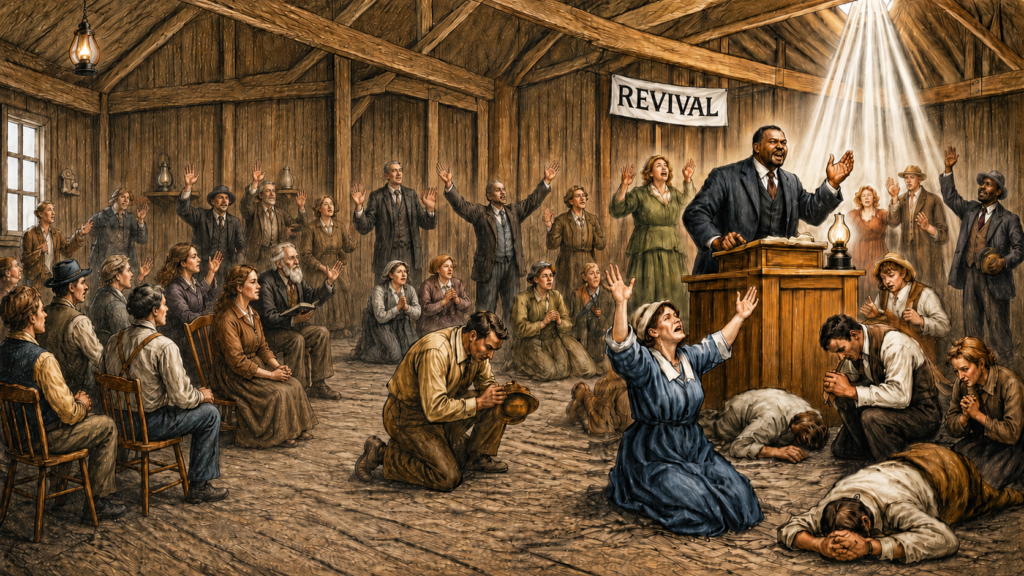
The great religious awakenings of 19th century America were facilitated by large camp meetings which drew crowds numbering in the thousands. Most of the time, they produced a strong influence for good and music was often used to good effect. However, the camp meetings of some denominations of the 1800s were prone to sensationalism. Many historians recognise that music was at least partially responsible for bringing about extreme emotionalism and excitement in these camp meetings. Preachers, such as General Booth, liked to use songs popularised by revivalists, such as Ira D. Sankey and Dwight L. Moody, which were often simple and repetitive.2 Hymns were sometimes sung over-and-over with hypnotic effect, leading to erratic behaviour, such as jumping, screaming, clapping the hands, thumping the floor and agitating the body and lying prostrate.9 (p41-2,47)
For them, these bodily manifestations demonstrated a physical encounter with God and were sought after as a sign of the presence of the Holy Spirit. Salvation came through the body, they believed. The music, preaching and other sensational performances were intended to cause people to sing, clap, shout and move the body until the Holy Spirit came upon them.2 It was not uncommon in these settings for people to fall into trance-like states that could last for hours or even days.189–191 As described by Walker, these Christians believed that “A religion that did not make a convert shake, weep, and shout did not have the power to transform that person into a Christian, ready to do battle with sin.”2 (p243) In her concluding remarks in her book on the history of the Salvation Army, Walker states:
“Its evangelical, holiness theology, dramatic bodily conversions, and the steadfast commitment to a strict behavioral code all link the Salvation Army to the Pentecostal movement of the early twentieth century.” Given the large growth of the Pentecostal church and its widespread influence, she reasons that the Salvation Army contributed to one of the most significant developments in twentieth-century Christianity.2 (p243)
Pentecostal & Charismatic Influence
Pentecostal and Charismatic churches are the modern-day version of the early Salvation Army. Similar behaviours to the 19thcentury revivalist meetings can be witnessed in contemporary Christian worship services when songs are played repetitively. Contemporary songs often lend themselves to repetition due to the simple lyrics and repeated ‘builds’ that create tension and increase energy toward a drop to keep the audience interested and maintain a high level of emotion. For example, Way Maker was sung at Jesus ’19 in Orlando, Florida, January 1st, 2020, and recorded live and made available on YouTube. The song was played continually for a marathon 28 minutes, repeating the same line over and over again for much of the song. One of the lead singers is seen swirling around, throwing the arms and legs in the air, jumping up and down, sitting on the floor rocking backwards and forwards, shaking the head, shaking the arms and legs, sitting on all fours on the floor and speaking with a quivering voice.192 In the 19th century, this kind of behaviour was termed fanaticism. Similar manifestations are often seen in Pentecostal worship services. Unfortunately, modern music has become so powerful at capturing people’s interest that it can take over and dominate the worship service. It can also crowd out time for prayer and Bible study in our daily lives.
In an attempt to keep everyone happy, church leaders have segregated congregations according to preferred worship style. However, when the Methodists splintered into numerous groups, each going their own way according to the style of worship and revival they preferred, it led to extremes – some to extreme excitement and fanaticism, others to extreme formalism and ritual. Mrs White urged members to ‘press together.’16 (p292) When we pull together, it prevents extremes: grandma does not like the modern music, so the music gets toned down a bit; the young people get bored with repeating the same old hymns, so new medleys are added to keep it interesting. In the end, balance is maintained. The worship does not end up dry and formal, neither does it become like a night club atmosphere.
The problem with extremes is that emotional experiences without understanding do not lead to lasting conviction. In His explanation of the parable of the sower, Jesus said:
“When anyone hears the word of the kingdom, and does not understand it, then the wicked one comes and snatches away what was sown in his heart. This is he who received seed by the wayside. But he who received the seed on stony places, this is he who hears the word and immediately receives it with joy; yet he has no root in himself, but endures only for a while. For when tribulation or persecution arises because of the word, immediately he stumbles.” (Matt 13:19-21)
Emotional experiences might hook people in and grow the church rapidly, but without depth of truth, these members can easily fall away. The American Super Bowl and the Australian State of Origin are examples of how hype and emotion can draw people in. A large proportion of the crowd and those who tune in on television know little about football, its rules or the players because they rarely watch it or take any notice of it the rest of the year. The excitement draws them in. If they had to sit through a game without the added effects of sound and music, they would be bored and confused. They would not attend the next time. Only the die-hard footy lovers would still attend because they are in it for the footy and not for the emotional experience. Likewise, sincere Christians are drawn to the message and not the experience. Though music helps, it is the message that sustains them and guides them through every difficult experience.
One reason music has gained the influence it has is because of modern technology coupled with large resources that have been injected into creating catchy tunes. Recent research has found that the most popular worship songs come from four influential Charismatic megachurches – Bethel, Hillsong, Passion City Church and Elevation. These churches believe a particular style of worship song is instrumental in bringing about God’s presence in a meaningful and powerful way – a primary means of connecting with God. They have had a major influence on the spiritual practices of churches around the world.81 To varying degrees, these churches hold to Charismatic Word of Faith teachings, including the belief that Christians can gain financial prosperity, power and good physical health through prayer and belief in Jesus’ resurrection and death.
Cristina Rocha, Professor of Anthropology at Western Sydney University, said that by adopting pop music, cool designs, fashion trends, and styles of clubs and concerts, churches like Hillsong have blurred the sacred and the secular (similar to General Booth).46There is less distinction between what is sacred and what is of the world. If the lyrics are removed, it becomes indistinguishable from secular pop music. Even with the lyrics, some Christian songs might be confused as simply secular love songs. The Salvation Army became so adept at copying the designs of the advertisements of popular entertainment that people sometimes mistakenly attended Army programs thinking they were music-hall events or circus performances.2 Likewise, some modern Christian artists have so mastered the art of copying secular music that it has become almost indistinguishable from it.