
Harmonising with God in Our Music and Practices
Part 2 - The Influence of Music
Chapter 10
Chapter 10
Moral & Spiritual Influences of Rock Music

King Solomon advises that “It is better to hear the rebuke of the wise than for a man to hear the song of fools (Ecc 7:5). He also says to “Leave the presence of a fool, for there you do not meet words of knowledge (Prov 14:7).” So, if we are to leave the presence of fools and avoid their songs, we need to be able to identify who a fool is. King David said, “The fool has said in his heart, ‘There is no God (Ps 14:1).’” Some of the other characteristics of a fool described in the Bible, include: a person who proclaims folly (Prov 12:23), spurns a parent’s discipline (Prov 15:5), speaks perversity (Prov 19:1), is quick-tempered (Prov 12:16), mocks at sin (Prov 14:9) or commits sexual immorality (Prov 6:32; 7:7–12). While not pretending to be righteous and perfect ourselves, this list of characteristics of fools sums up many of the glaring and unapologetic immoral and godless attributes of the secular music industry. What Solomon’s text, therefore, suggests is that popular worldly music, in general, is the ‘song of fools.’ Having said that, we have all been fools at times, so we should avoid calling people fools, but Solomon’s advice to avoid spending time in the presence of people who openly live foolish lifestyles is sound advice, including avoiding their songs.
Solomon’s advice and the Bible’s definition of a fool would also suggest that we should not describe someone as virtuous simply because they have talents and ‘good works’ – which is often seen in musicians. Pop stars may be highly skilled at their art plus they may support charities or advocate for the disadvantaged. It is often concluded that, if they do enough good works, regardless of their flaws, then their music must be acceptable to listen to. We are quick to rationalise the virtues of something we watch or listen to as long as there is some good found in it. Perhaps this is why the theologian, Mark Powell, author of Encyclopaedia of Contemporary Christian Music, believes that secular and Christian rock and roll has done more good for humanity in the last thirty odd years than all of the theologians in the world.5 However, much immorality in rock and pop music has to be filtered through to get to the good.
According to the Biblical definition, musicians who are agnostic or promote sexual immorality or perversity of any kind, are fools. We are to depart from them. Though we should not call them fools, we must recognise the foolishness of their ways and their music. Folly tends to contaminate any good thing that it comes in contact with. Some secular musicians may have some wonderful traits and they may be kind-hearted and generous. They may even eventually turn to God, but while ever someone is deliberately and openly continuing in foolishness, according to the Biblical definition, we should not listen to their songs, as advised by Solomon. But how far do we take this? Does it mean all secular music is bad and should be avoided? We will talk more about this topic in a later chapter.
General Booth and Mrs White were both opposed to popular secular music and entertainment. General Booth viewed it as evil. Mrs White said:
“When turned to good account, music is a blessing; but it is often made one of Satan’s most attractive agencies to ensnare souls. When abused, it leads the unconsecrated to pride, vanity and folly.”193 (p505)
Her comments on popular secular music are always negative.194 For example, she warned that songs “fit for the dance hall” cause angels to flee from the scene and darkness gathers around those who are present.193 (p505) “A love for music,” she said, “leads the unwary to unite with world lovers in pleasure gatherings where God has forbidden His children to go.”195 (p594)
However, for General Booth, it was only the lyrics that made music bad; therefore, any style of music was acceptable for worship as long as the lyrics were spiritual. Mrs White, on the other hand, believed that the style and characteristic of music are also important. She said:
“Satan knows what organs to excite, to animate, engross and charm the mind so that Christ is not desired. The spiritual longings of the soul for divine knowledge, for a growth in grace, are wanting.”193 (p496)
Mrs White’s suggestions for appropriate worship music, includes: “not loud singing… but clear intonation, correct pronunciation and distinct utterance;”196 (p144) “like the music of the birds – subdued and melodious;”168 (p510) “conducted with solemnity and awe;”197 (p493) “not funeral notes, but cheerful, yet solemn melodies. The voice… modulated, softened, and subdued.”168 (p508)
Is there any evidence from the Bible that music in itself has influence for good or evil? We know from the Bible, especially from Saul’s experience, that music has power over spirits. As discussed in a previous chapter, Saul disobeyed God’s command to utterly destroy the Amalekites (1 Sam 15:19) and the prophet Samuel told Saul that “rebellion is as the sin of witchcraft (v23).” Soon afterward, the Spirit of the Lord departed from Saul, and a distressing spirit entered him (16:14). Whenever the distressing spirit was upon Saul, David would play his harp, and the distressing spirit would depart from him (v23).
Paul says we wrestle against “spiritual hosts of wickedness in the heavenly places (Eph 6:12).” We are to be sober minded and vigilant because our “adversary the devil walks about like a roaring lion, seeking whom he may devour (1 Pet 5:8).” Spirits are going about looking for someone to torment. If spirits are driven out of someone, they soon return with even greater force if the person is void of the Holy Spirit (Lk 11:24-26), such as when we are living in rebellion against God. The tormenting spirit left Saul only to return again because he failed to fix his mind on the Lord (1 Sam 18:10-11; 19:9-10). We leave ourselves vulnerable if we are not in continual prayer and meditation upon God’s Word (Eph 6:17-18).
If the right music has the power to drive out evil, then it stands to reason that certain music might also have power to invite evil. The more time we spend in secular activities that distract us from Jesus and tempt us into immorality, the more opportunity evil spirits have to influence us. Our most reliable protection is the armour of God, including “the sword of the Spirit, which is the Word of God (Eph 6:17).” Paul says to “Abstain from all appearance of evil (1 Thes 5:22).” Why leave ourselves vulnerable? Why spend time listening to music orchestrated by minds controlled by the one who knows “what organs to excite… so that Christ is not desired?”193 (p496) It is better to have nothing to do with the music of the unconverted, especially if they live immoral or godless lifestyles.
Therefore, there is some evidence from Scripture that music, apart from the lyrics, may have moral force to shape human behaviour for good or evil. There are many principles in the Bible, such as Solomon’s advice to leave the presence of fools and Paul’s advice to abstain from all appearance of evil, but does that mean that the very tunes produced by unbelievers has evil influence and should be avoided? For some, these examples alone are enough to warrant avoiding popular secular tunes. Others need more convincing. Information from extra-biblical sources may help us better understand the power of music.
Rock Music’s Association with Rebellion and Sex
It is not just scientists who recognise the powerful influence of music. Since the evolution of rock music, musicians and producers have openly admitted that rock and pop music communicates sex and rebellion – not just in the lyrics, but in the very rhythm and beat of the music. African Americans had been using the term rock and roll as a euphemism for sex, decades before rock and roll music emerged in the mid-1950s.198 The terms ‘rock’ and ‘roll’ have been traced back as far as 1922 in Black music, when Trixie Smith recorded My Baby Rocks Me with One Steady Roll, a song about Smith, a woman, making love with her man.199Seven years later, the same song was sung by a man, Frankie Jaxon, singing in a feminine voice and performed as a female impersonator adding in various grunts and moans which leads many music historians to believe this is the first recorded song to include an allusion to an orgasm.200
Rock and Roll was founded on folk African music. Daniel Glass, American drummer, writer and authority on classic American drumming and the evolution of American popular music, describes how American pop music is made up of a whole variety of ethnic elements:
“You have Chinese cymbals, Greek cymbals, Chinese tom-toms, wood blocks, cowbells and of course European tradition of the bass drum and the snare drum coming from a marching band martial background. All these things are thrown together with an African American sensibility giving it swing and that’s how you get our pop music.”201 (3:30)
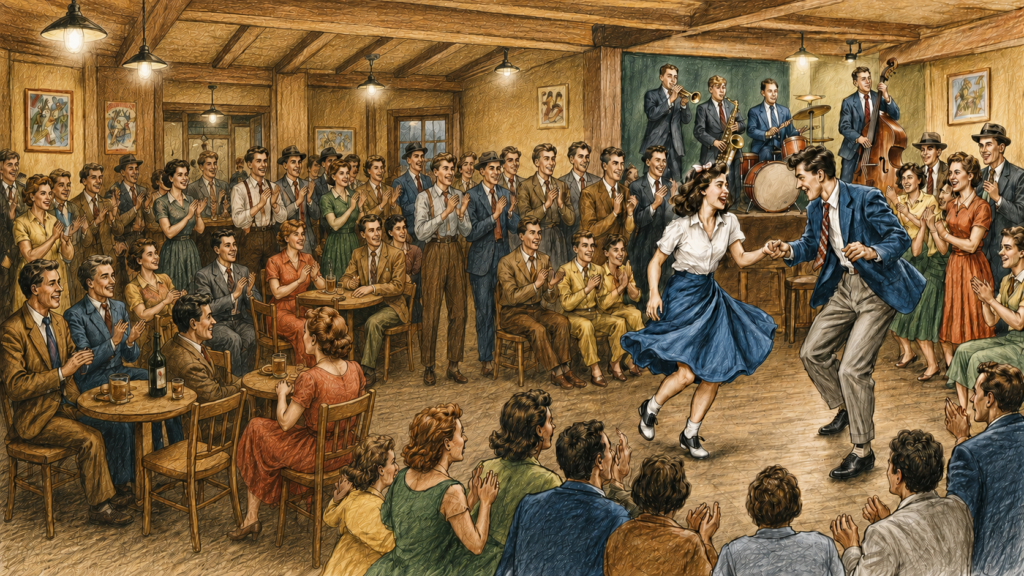
Alan Lomax was a pre-eminent anthropologist in the area of folk music and he helped to popularise folk, blues and jazz in America. His field trips into the American South in the thirties and forties played a seminal role in the emergence of the Blues and African American folk music in the global marketplace. He was instrumental in launching the Folk and Blues revivals that took place among American musicians and listeners in the 1950s and 60s. In 1959, he produced Folksong ’59, a Carnegie Hall concert, which was one of the first major events to recognise Rock and Roll as a musical form worthy of serious consideration. Lomax is also celebrated for his extensive research into and recordings of folk-dance traditions across the globe. He said that the multi-unit dance, upon which Rock and Roll dance moves are based, is highly sexual.202–205 Elvis Presley, whose music and dance moves oozed sexuality, emerged in the mid-1950s on this backdrop.198
Rock and pop music has continually been identified with sex and rebellion. Andrew Oldham, recording manager of the Rolling Stones, said “Rock music is sex and you have to hit them in the face with it.”206 TIME states that it isn’t just the lyrics that makes rock music rebellious: “In a sense, all rock is revolutionary. By its very beat and sound it has always implicitly rejected restraints and has celebrated freedom and sexuality.”207 Raymond Arthur Gosling, English broadcaster, journalist, author, and gay rights activist said:
“Rock ‘n’ roll is a beast. Well-intentioned people thought you could pick it up and cuddle it. They forgot it had claws… Behind every sweet doowop and bebop is an unfettered sexuality and sympathy for the devil… Anybody with a penn’orthy of grey matter could see it was trouble.”208
Hans Rookmaaker, Dutch scholar who wrote and lectured on art theory and history, music, philosophy and religion said of rock and roll music:
“A new music emerged, again completely nonintellectual, with a thumping rhythm and shouting voices, each line and eachbeat full of the angry insult to all western values … their protest is in their music itself as well as in the words, for anyone who thinks that this is all cheap and no more than entertainment has never used his ears.”209 (p188-190)
Drummer, Mickey Hart, said “Looking back on the early years of rock and roll now, I can see why the adults were scared. The screams, the ecstatic states, the hysteria – this music had a power that adults didn’t understand. We didn’t even understand it ourselves…”210 (p171)
Therefore, the leading authorities in the secular music industry, in no uncertain terms, openly affirm the power in the rhythm and beat of pop and rock music to communicate sexuality and rebellion. As well-meaning as General Booth may have been, scientists and music experts do not seem to agree that music, apart from the lyrics, is neutral. That is why we have to be very careful making bold claims without proof – especially clear evidence from the Bible.
In all reality, the association of rock and pop music with sexuality and revolt against social norms is self-evident – it does not need pointing out. The evidence is in the fruits of the music. Something about this form of music causes performers to accentuate their sexual organs. By contrast, performers in a classical orchestra are generally fully and appropriately clothed. Pop music artists have a reputation for wearing sexually explicit clothing, continually pushing the boundaries of lewdness even to the point of performing highly inappropriate sexual portrayals on stage. These performances are broadcast to homes around the world where children are watching. Authors of an article on the trends of lyrics in the Billboard Hot 100 Charts made the following observation:
“When we look at the mentions of ‘sex’, ‘love’, and related terms in the lyrics of songs appearing in the Hot 100 since 1960, it’s easy to see how popular the two have been over time. One of the most striking trends is that while love has waxed and waned, sex has skyrocketed, with mentions becoming several times more common in the 2010s than in the 1960s.”211
Paul says that “the flesh lusts against the Spirit… Now the works of the flesh are evident, which are: adultery, fornication, uncleanness, lewdness… (Gal 5:17,19).”
We can conclude, therefore, that rock and pop music is contrary to the Spirit of God and we should have nothing to do with it:
“But the fruit of the Spirit is love, joy, peace, longsuffering, kindness, goodness, faithfulness, gentleness, self-control. Against such there is no law. And those who are Christ’s have crucified the flesh with its passions and desires. If we live in the Spirit, let us also walk in the Spirit.” (Gal 5:22-25)
Since Paul said to “Abstain from every form of evil (1 Thes 5:22),” and since the very name ‘rock and roll’ is synonymous with promiscuous sex, it would be wise to have nothing to do with this style of music, regardless of the lyrics. Paul also said:
“…among you there must not be even a hint of sexual immorality, or of any kind of impurity, or of greed, because these are improper for God’s holy people.” (Eph 5:3 NIV)
Brandon Toews is a drummer, author and educator based out of Vancouver, Canada. He is the author of The Drummer’s Toolbox and the co-author of The Best Beginner Drum Book. Toews, who has experience in secular and worship drumming, says that worship drumming is essentially no different to pop and rock drumming:
“Every groove and fill that you hear played in your favourite worship songs are also used in pop and rock.”
He says that 99% of the skills required to play drum music for contemporary Christian music (CCM) is absolutely identical to rock and pop. He advised that if you want to improve your skills for playing worship music you can look to any pop or rock drumming lesson.212 Therefore, at bare minimum, there is at least a hint of sexual immorality in the rhythm of the tunes we copy from the secular world. There is strong Biblical precedent, therefore, to stop listening to contemporary Christian music which copies these identical rhythms from pop and rock music.
Still, some may not be convinced even of the opinion of leading authorities and musicians in the secular music industry. Therefore, later in the book, we will look at the science behind sex and rebellion in the beat and rhythm of popular music. We will also examine what the Bible has to say about music. That way, we can all make an informed decision regarding this important subject.
The Influence of Music on Spirituality & Character
The concerns over rock and pop music do not end with rebellion and sexuality. We know from the Scriptures that music also has spiritual influence. Just as David was able to use melodious music to drive away spirits (1 Sam 16:23), Jimi Hendrix, ranked by Rolling Stone magazine as the number one greatest guitarist of all time,213 believed his music had spiritual influence. When asked in an interview if he thinks music has meaning, Jimi Hendrix replied: “Oh yeah, definitely, it’s got a more spiritual soul than anything now.” In the same interview he described the ‘electric church’ as belief coming into people through the electric guitar:
“That’s why we play so loud. Because it doesn’t actually hit through the eardrums… We plan for our sound to go inside the soul of the person and see if they can awaken some kind of thing in their minds, because there’s so many sleeping people.”214
Hendrix told Life magazine in 1969:
“I can explain everything better through music. You hypnotize people to where they go right back to their natural state… and when you get people at that weakest point, you can preach into their subconscious what we want to say.”215
We now know from a scientific perspective that these goals of Jimi Hendrix to influence people through music are possible.
Judy Mowatt, one of the backup singers for Bob Marley, likens the experience of their concerts with church:
“It was a crusade, it was a mission. We were like sentinels, like lights. On tour the shows were like church; Bob delivering the sermon. There were mixed emotions in the audience: you see people literally crying, people in a frenzy, on a spiritual high … These concerts were powerful and highly spiritual. There was a power that pulled you there. It was a clean feeling … For months and maybe years it stays with you.”216 (p74)
Musicians also often seek enlightenment and spiritual experience through the use of drugs which, in turn, changes culture via the influence of their music. Certain illicit drugs bring on an altered state of consciousness. During these psychedelic experiences, musicians turn to song writing. Dr Timothy Leary, a prominent American psychologist, widely known for his scientific research into the effects of psychedelic drugs, describes how LSD has influenced the rhythm of music, and the expression of the arts in general, moulding the way we think as a population:
“The LSD cult has already wrought revolutionary changes in American culture. If you were to conduct a poll of the creative young musicians in this country, you’d find that at least 80 percent are using psychedelic drugs in a systematic way. And this new psychedelic style has produced not only a new rhythm in modern music but a new decor for our discotheques, a new form of film making, a new kinetic visual art, a new literature, and has begun to revise our philosophic and psychological thinking.”217 (p141)
Little Richard, American singer and song writer, described as the architect of Rock and Roll and renowned for signature songs such as ‘Tutti Frutti,’ once said:
“My true belief about Rock ‘n’ Roll is this: I believe this kind of music is demonic. I have seen the rock groups and the punk rock people in this country. And some of their lyrics is demonic. They talk against God. A lot of the beats in music today are taken from voodoo, from the voodoo drums. If you study music in rhythms, like I have you’ll see that is true.”218
Music can also fundamentally change us by its influence on our character. In his book The Secret Power of Music, psychologist David Tame explains how there are two factors that influence our character: experiences and innate traits, which are genetically inherited. Psychological studies have estimated that about one-third of our character is shaped by experience. It logically follows, he reasons, that:
“…if music gives us feelings, then these feelings – of uplift, joy, energy, melancholy, violence, sensuality, calm, devotion, and so forth – can certainly be said to be experiences. And the experiences which we have in life are a vitally important factor in the moulding of our character.” Therefore, he concludes, “Music moulds character.”219 (pp146-147)
Of course, this just confirms what many historical figures already believed, including Plato, Aristotle and Confucius,220 just to name a few.
CCM’s Foundation in Rock Music
The reason that the influence of rock and pop rhythms is so important is because contemporary Christian music (CCM) developed out of rock and roll during the Jesus Movement of the late 60s and early 70s.5 CCM is an umbrella term for modern music with lyrics that express the Christian faith or biblical themes. Though it can include any modern style of music, CCM is most often seen as sacred themes wrapped in folksy, upbeat or rock-style music.5,13 In other words, CCM is the modern version of what General Booth was doing – putting popular dance tunes to Christian lyrics – something Mrs White was outspoken against.
A quick surf of the web reveals that almost every source defines CCM as synonymous with rock and pop music. According to Wikipedia:
“Contemporary Christian music has influences from folk, gospel, pop and rock music. Genres of music such as soft rock, folk rock, alternative, hip-hop, etc. have played a large influence on CCM. Charismatic churches have had a large influence on contemporary Christian music and are one of the largest producers of CCM.”221
The website, AllMusic, defines CCM as “pop music with inspirational and religious lyrics. Musically, much CCM is indistinguishable from mainstream pop/rock, featuring the same melodic and production techniques.”222
Mark Powell, who compiled an exhaustive encyclopaedia on CCM, says:
“…the term ‘contemporary Christian music’ was coined as a euphemism for Christian rock music back in the days when many Christians couldn’t bring themselves to admit that they were listening to the supposedly demonic sounds of rock and roll.”5
Mark Powell, who is a professor of theology and a professional music critic, thinks “rock and roll is a beautiful thing” and, in his encyclopaedia on CCM, he wonders why church leaders are not more invested in CCM, given its ability to capture the attention of its people.5
In his very influential book, The Purpose Driven Life, Rick Warren defends the neutrality of music:
“God loves all kinds of music because he invented it all – fast and slow, loud and soft, old and new. You probably don’t like it all, but God does! … Christians often disagree over the style of music used in worship, passionately defending their preferred style as the most Biblical or God-honouring. But there is no biblical style! … God likes variety and enjoys it all. There is no such thing as ‘Christian’ music; there are only Christian lyrics. It is the words that make a song sacred, not the tune. There are no spiritual tunes.”223 (pp65-66)
There are quite a few claims that Rick Warren makes here but they need to be supported by evidence before we can accept them. What if Mark Powell and Rick Warren are wrong? Given the great influence they have had on ministers and worship leaders around the world across many denominations, the implications are significant. As already discussed, science and secular music experts agree that music is not at all neutral, contrary to Rick Warren’s view – it has powerful positive and negative effects on us. The very beat can communicate sex and rebellion. It has spiritual influence and can change our characters. It can also influence culture. There is no statement in the Bible that tells us that God likes all music. We must be careful not to put words in God’s mouth.
If our “adversary the devil walks about like a roaring lion, seeking whom he may devour (1 Pet 5:8)” and if Lucifer is a master musician (Ez 28:13), then we can be certain that he will use music for his purpose. If the very foundation of rock music was sex and rebellion, we should question its suitability for Christianity. Given that music has such power to influence us, as demonstrated by science, if we are not sober and vigilant (1 Pet 5:8), we can be certain that Satan will find ways to use music in ways that we are totally unaware of to divert our minds away from God and His true nature. If music ‘talks to us,’ as the neurologist, Dr Richard G. Pellegrino, says, might it not be possible that anti-God sentiments could be transmitted through the very music of godless people?
If CCM is mimicking the sounds of worldly music, are we not risking the influence of worldliness? One of the goals of secular pop and rock music companies is to make their tunes sensual and sexual because that is what sells.224 Equally, the goal of CCM companies is to mimic the sound of secular pop and rock music – because their music sells. However, Paul said to flee from sexual immorality (1 Cor 6:18); therefore, if secular musicians and managers openly admit that their music is sexually seductive, we should flee from it. We should not imitate it. Since so much of the secular music industry is openly defiant against our Saviour and His commands, might it not be prudent, out of protest alone if for no other reason, to reject these popular forms of music? Is God’s Word so deficient that we must turn to worldly tunes to make it attractive?