
Harmonising with God in Our Music and Practices
Part 2 - The Influence of Music
Chapter 8
Chapter 8
Disorder
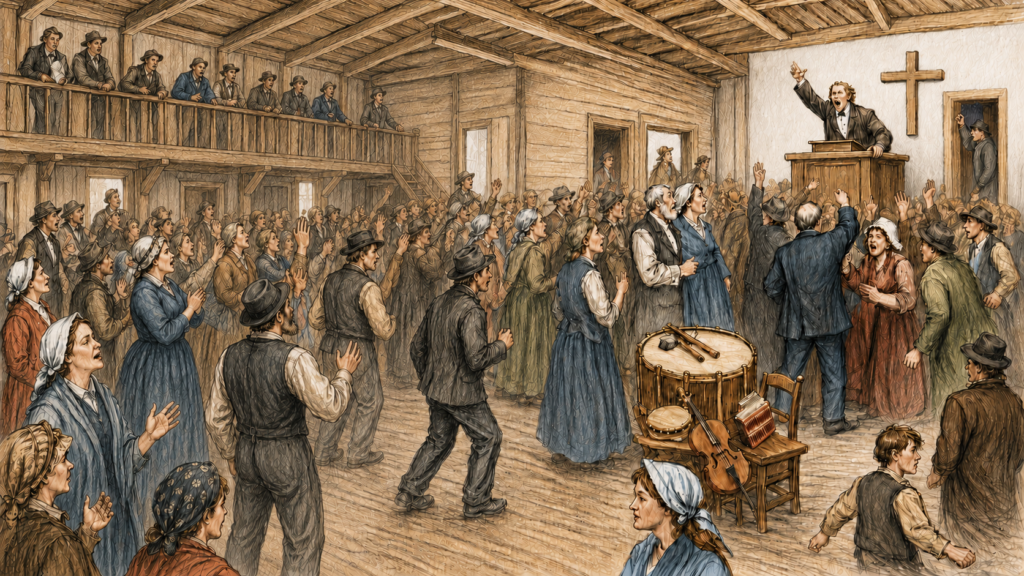

Emotional revivals in the 1800s came to be associated with female preaching and disorderly practices, plaguing the Booths for much of the remainder of their lives.2 (p25) They were constantly having to defend their revivalistic methods. For example, Mrs Booth preached defensively:
“People contend that we must have quiet, proper, decorous services. Where is your authority for this? Not here. I defy any man to show it. I have a great deal more authority in this book for such a lively, gushing, spontaneous, and what you call disorderly service, as the Army services sometimes are, in this 14th of Corinthians, than you can find for yours.”130 (p60)
The Salvation Army used its uniforms and immensely popular brass bands to attract attention, rather than holding conventional worship services. One of the motives for this approach was the Booths’ disillusionment with the cold formality and ritual which had set in at the Methodist New Connexion,125 for whom General Booth had formerly worked as a preacher and evangelist. The debate between those who favoured orderly services to build a stable congregation and those who favoured zealous preaching had long divided Methodists.2 (p20)
Though she was shy and reluctant to preach, Mrs Booth found motherhood difficult and demanding, but on the platform, she said, she felt far more at home than in the kitchen. Financial struggles also influenced her move into a preaching career – she was buoyed by the possibility of earning income from her ministry, but this was dependent on the popularity of her preaching. She became highly critical of the Methodist New Connexion Conference which she considered to be authoritative and restrictive. A preaching career was only possible by separating from the mainline orthodoxy of the Methodist church.2 (pp31-35)
General Booth felt ‘cribbed, cabined and confined’ by the Methodist leadership – he was not content in ordinary pastoral work which he was often called to. Inexperienced ministers were expected to serve their time, to learn and mature in life and theology. But General Booth was young and impetuous. He desired freedom and liberty to do evangelistic work. He longed to do something great with his life and the sooner he could get on with it the better. He wanted to reach the ‘lost,’ not just those who went to church. So, he left his post with the Methodist New Connexion and branched out on his own.14,57 (p30) As described by Pamela Walker, apart from John Wesley, Booth modelled his ministry on the methods of popular revivalists who conducted highly emotional revival meetings, which brought him into conflict with more ‘respectable’ members of the Methodist church in Britain:
“William’s theology and preaching were deeply influenced by revivalists in the United States, particularly James Caughey and Charles G. Finney. These preachers proclaimed in dramatic, emotional language that sinners must find salvation or expect to suffer the eternal torments of hell.”2 (p19)
Catherine admired Caughey’s freedom. He was not “handcuffed or shackled by conferences or annual committees. He can go where he likes and stop as long as he likes.”142 (p34) The Methodist New Connexion, on the other hand, regarded the governance of the church as necessary discipline and order. The Booths longed for freedom, not only to go where they liked, but to conduct ministry in their own way without restriction.
Like the Booths, Mrs White’s family, the Harmons, also had disagreement with the church which led to a separation from the Methodists. However, their separation was primarily over theology and not governance and revival style as it was with the Booths. The doctrine of the Booths’ new organisation was essentially Methodist, whereas the beliefs of the Seventh-day Adventist Church diverged significantly from Methodist doctrine in some fundamental areas. Like the Harmons, Luther also separated from his church, the Catholic Church, over theology, and he believed in orderliness and opposed those that he perceived to be fanatical or troublemakers, such as the Anabaptists.143 (p180) He also believed there should be order in the divine service, especially for those new or weaker in the faith, to assist them to grow in their understanding of God’s Word and to become skilful in sharing their faith.144
Unlike the Booths, though she was also against dry formalism, Mrs White believed in orderliness in the administration of the church and in the conduct of evangelistic meetings.145,146 (p115) Speaking out against formalism, Mrs White said, “I tell you in the fear of God, our churches are altogether too formal. The love, the tenderness of Christ is not expressed in practice in their intercourse with one another.”44 Despite this, she saw order in the Bible. For example, there is order in leadership: “But I want you to know that the head of every man is Christ, the head of woman is man, and the head of Christ is God (1 Cor 11:3).” After studying Scripture, David recognised the importance of order in worship. It was not only the method of moving the ark that he had gotten wrong, but it was also the method of worship. The whole of Israel sang and played musical instruments as the ark was moved without any apparent organisation. However, on the second attempt to move the ark, he instructed the Levites to organise the worship according to the proper order and to appoint leaders to take charge of various components of the worship:
“You are the heads of the fathers’ houses of the Levites; sanctify yourselves, you and your brethren, that you may bring up the ark of the Lord God of Israel to the place I have prepared for it. For because you did not do it the first time, the Lord our God broke out against us, because we did not consult Him about the proper order… Then David spoke to the leaders of the Levites to appoint their brethren to be the singers accompanied by instruments of music, stringed instruments, harps, and cymbals, by raising the voice with resounding joy.” (1 Chron 15:12-13&16)
We see many examples of order in the role distinctions given to individuals throughout the Bible, starting at the top:
“Christ Jesus, who, being in the form of God, did not consider it robbery to be equal with God, but made Himself of no reputation, taking the form of a bondservant, and coming in the likeness of men… Therefore, God also has highly exalted Him and given Him the name which is above every name.” (Phil 2:5-7&9)
Lucifer, on the other hand, said in his heart, “I will exalt my throne above the stars of God… I will be like the Most High (Is 14:13-14).” Therefore, God said to him, “you shall be brought down to Sheol, To the lowest depths of the Pit (Is 14:15).” He tried to promote himself but was demoted and thrown out of heaven. Mrs White said:
“Formality should be shunned; but, in so doing, order should not be neglected. There is order in heaven. There was order in the church when Christ was upon the earth, and after His departure order was strictly observed among His apostles. And now in these last days, while God is bringing His children into the unity of the faith, there is more real need of order than ever before; for, as God unites His children, Satan and his evil angels are very busy to prevent this unity and to destroy it. Therefore, men are hurried into the field who lack wisdom and judgment.”147 (p97)
Mrs White’s understanding of the relation between the roles of men and women reflects her understanding of priority in the Church and in the home. In their early marriage, Mrs White spent much time travelling and preaching, but she felt more drawn to homely duties than she did to ministry outside the home. When the Whites’ first child, Henry, was born, Mrs White was happy to have an excuse to make her little nest and to stop travelling. After a while, however, she decided that she should also continue the ministry God had given her to do, but it tore her heart to leave her little one behind in the care of friends. For Mrs White, home was where she belonged and where she wanted to be. The majority of travelling appointments were in winter when James was not able to work and travelling with a small child in the cold winter months was not practical. Mrs White regretted that better arrangements could not be made. This continued for several years until James began work in the printing house and the church developed more of an orderly structure with support and regular work hours.141
As with any newlywed, Mrs Booth also looked forward to setting up a home and having children. However, she was strongly drawn to a ministerial career and felt it was her right to preach and she enjoyed being excused from domestic duties, when possible, to attend to ministry. As with most middle- and upper-class Victorians, Mrs Booth employed maids to help with housework and raising the children. She became increasingly reliant on domestic help over the years as she and William spent more and more time away from home doing ministry.14 (ch9)
In the home and in the church, Mrs White believed everything is to be done in an orderly manner according to the Word of God and she believed that emotionalism leads to disorder. When emotionalism sets in, there is a natural tendency to move away from God’s order, including order in roles and responsibilities as well as rules and regulations. There is to be order and submission to authority according to the dictates of God. Though she claimed her writings were inspired, she recognised their subordinate position to Scripture and that her writings were given to point people to the Bible.
By the standards of most Christian organisations of the time, the Salvation Army meetings were very disorderly. They acquired theatres, music halls and pubs for conducting religious programs. The performances they carried out in these venues were as lively as the secular entertainment of the preceding occupants – people would talk and shout, eat and drink, move about, catch up with friends and come and go as they pleased throughout the meetings.2 Mrs White shared an experience in Australia in which Salvation Army officers were able to witness the success of orderly Adventist evangelistic meetings over sensationalism:
“Quite a number of the Salvation Army were present on these occasions. They can learn that meetings can be held in the open air without the drum, without the jumping and the gesticulations that create a laugh and rob the service of God [of] its solemnity. Our meetings were very orderly, and we know that much prejudice was swept away. A different impression than had hitherto prevailed was left on minds in regards to Seventh-day Adventists.”146 (p115)
Appropriate Order in the Organisational Structure
Paradoxically, although the Booths left the Methodists primarily because of the restrictions imposed on them by committees and conferences, they eventually established their own organisation with a strict military style of control. Salvation Army members were expected to put their duty to God and the Army first. General Booth was so consistent in this requirement that, when his daughter Kate and his sons Ballington and Herbert left the Salvation Army, he refused all contact with them.2 So severe was the rift between Herbert and his father when he resigned from the Salvation Army, that his father did not permit him to take part in his beloved sister Emma’s funeral. This broke Herbert’s heart.148 In the home, General Booth raised his family with strict discipline. David Earnshaw explains:
“We have plenty of evidence from the letters that the children wrote to their mother and that she wrote to them… that they had a very hard time. Now we have to put it in the Victorian context but we have from the letters that William was very severe on his children… He was very keen at laying on the hands and many a time his children took a severe thrashing.”
He describes how the children did not feel that they were good enough for him. They felt they could not please their father, though they were trying their best.149 These comments have to be balanced against the often affectionate and loving correspondence also seen between General Booth and his children. However, without trying to discredit him, but simply trying to give the basic facts, David Earnshaw says, there is no doubting that the man General Booth finished up being is not the man that he started out as.149Toward the end of his life, he suffered greatly in his own personal life. Into his 60s, he was often lonely, ill and demanding. Though he achieved great things, he was human. Harold Begbie, who wrote a two-volume biography on the life of General Booth, says that toward the end of his life, General Booth sometimes wondered, ‘very sadly and pitifully’, if he had asked too much of people. Those of his own household broke away from him. Officers forsook him.57 (p263) Cathy Le Feuvre, in her biography on the life of William and Catherine Booth, said:
“Catherine was still the only person who could be completely honest with and about William Booth, who even his most loyal supporters, friends, and colleagues recognized to be an autocratic leader and, particularly as he grew older, less patient and kind with those around him.”14 (ch19)
Initially, their organisation began as a democratic, participatory system which they found to be unwieldy and prone to division. Individual interference threatened the leadership. In order to procure more control, General Booth informed the membership that reorganisation was necessary because they were engaged in ‘war.’ A new Deed Poll was drawn up and those who could not abide by it were asked to withdraw. From that point on, General Booth had oversight, direction and control of the organisation until his death.2David Earnshaw says that General Booth ran an incredibly tight ship. He did not like committees and he did not believe in democracy.57,149 It had transformed into an autocratic and strictly hierarchical organisation. Every member was under the strict command of the General. First Commissioner of The Salvation Army, George Railton, argued that this autocratic structure was key to the success of their work, including giving women equality with men.150 (p105)
The Army was very much a product of the Booths. Their primary concern was to preach to as many people as possible – a message of salvation and warning of the eternal punishment of hell – using revivalistic methods. At all costs, they were determined to achieve this goal, even if it meant abandoning their church, living with financial hardship and adopting non-conventional outreach methods at the ridicule of others. As circumstances have it, while pursuing that goal, they found themselves in the East End of London working amongst the poor, delivering that message to them. In the 1850s, before the Booths arrived, there were around 144 charities at work in London, many of them Methodist. A lot of these charities combined religion with welfare. This part of London was notorious for its severe poverty, overcrowding, endemic disease and crime. When the Booths encountered the poverty and the enormous needs, they were moved and desired to become a part of the effort to make a change. After years of trying to find his place in ministry and evangelism with limited success, William finally found his calling. He said to his wife, “Darling! I have found my destiny!”14 (ch13) To his family he said, these people are our people and they shall have our God for their God.151 From the outset, the Salvation Army was very much a church of action. In time, welfare to the poor evolved to eclipse the emphasis on evangelism.
Apart from Holiness theology and women in ministry, there is very little discussion of theology in the early writings of the Salvation Army. There was minimal thought expressed about the appropriateness of their methods from a Biblical standpoint. The Salvation Army had a very practical theology that was based on experience and observation rather than on systematic theology.57Early in the organisation, members received scarcely any formal training but acquired necessary skills through experience.
In 1880, the Salvation Army began to provide formal training of cadets, including basic training in Salvation Army religious beliefs, but it was mostly practical in nature, including account keeping and other practical skills, such as speaking and singing.2 (p112) There was no in-depth Biblical education or training in hermeneutics. There was a suspicion of academic theology amongst the early leadership of the Army and a deliberate effort to avoid training an educated clergy.152 (p16)
In a letter to William Booth in 1877, George Railton reinforced that there should be “no college, no book but the Bible, nothing but living teaching.”153 (p224) General Booth feared that formal ministerial education would lead to loss of zeal and preferred, instead, to focus training on practical preparation for mission rather than academic training. Even in later years, when General Booth began to warm to the idea of formal education for his officers globally, he still envisaged the training to be practical in nature, including three main aims: “teaching on practical godliness; detailed instruction in some form of Salvation Army work; and practical training in the given field.”152 (p16-17) In attempting to avoid an aloof clergy, detached from the congregation it was ministering to, General Booth discarded ministerial education. Interestingly, Jesus used simple uneducated, even illiterate fishermen, yet he also used academics such as Paul who could articulate sound doctrine and a physician, Luke, who methodically documented a chronological record of Jesus’ life and ministry and the spread of the gospel in the early church.
If we rewind back to the story of Uzzah, King David, who was a mighty man of God with a sincere desire to serve Him, was also exercising a practical religion as the Booths were. He was getting the job done, with much enthusiasm and sincerity. However, he neglected to seek guidance from the Torah. God demonstrated His displeasure by abruptly ending the life of Uzzah. David believed that moving the ark on a cart was appropriate but without checking if it was in line with God’s will.
General Booth, who made much of music in his ministry, believed there was no moral force in music, but without robust scriptural reasoning for this viewpoint. His rationale for this was based on loose interpretation of Scripture. The lack of theological discussion in the Salvation Army may be due, in part, to their holiness backgrounds. The Booths both believed that they had been instantaneously cleansed of original sin and imparted with the indwelling presence of the Holy Spirit which empowered and guided them to be perfect in works of love and mercy. They desired to have in the Salvation Army what they perceived to be the Pentecost experience of the early church.
Many other church denominations, in contrast, were established primarily on theological grounds. The Lutheran Church, for example, was founded on the grounds of salvation by grace through faith alone (sola fide) which came about by Luther’s methodical study of Scripture. The Protestant reformation, in general, came about because people studied Scripture and attempted to remove error and return to a purer Christianity based on the doctrine of the early church. The Seventh-day Adventist Church was founded by numerous Christians from various denominations who studied the Scriptures together with the primary goal of finding truth and discarding what they believed to be erroneous traditions and doctrines. Of those who are teachers, Mrs White wrote:
“…unless they become thoroughly familiar with the Word of God and their minds are absorbed in studying the glorious truths concerning the life of the Great Teacher – they will encourage the very errors the Lord is seeking to correct. Plans and opinions that should not be entertained will imprint themselves on the mind, and in all honesty, they will come to wrong and dangerous conclusions. Thus, seed will be sown that is not true grain.”16 (p155)
Humans are finite and prone to deception but when we come together in greater numbers, in an orderly manner, in prayer and earnest study of Scripture, we are less likely to make mistakes. This was the lesson that David learned after the death of Uzzah. He learned that, before jumping into action, we have to study Scripture and understand God’s will. How can we discern which spirit is guiding us if we have not first thoroughly immersed ourselves in God’s Word which was revealed by His Spirit? An autocratic style of governance which tells us what we must or must not believe does not encourage growth in our understanding of Scripture. Everyone must study for themselves and should be given the opportunity to share their understanding of Scripture with others and with the leadership and consensus drawn on the interpretation of Scripture.
The Salvation Army makes the following statement concerning the role of the General:
“The general has a role that is similar to the Pope’s role within the Catholic Church. Since the Salvation Army maintains a hierarchical, quasi-military structure, all appointments and regulations are issued under the general’s authority.”154
The British newspaper, The Times, said that General Booth was:
“…known as the head of a vast organisation well known over all the world, and yielding to him an obedience scarcely less complete than that which the Catholic Church yields to the Roman Pontiff.”155 (p250)
Salvation Army officers had to solemnly promise to obey the General and to report any cases of ‘neglect or variation from his orders and directions.’ General Booth even appointed his successor – his own son, Bramwell Booth – revealed to the commissioners in his own handwriting in a sealed envelope upon his death.57 (pp143,153)
This style of leadership can hinder open dialogue within the church concerning doctrinal issues. For example, General Booth made the decision not to offer Baptism in the Salvation Army, partly due to the controversy amongst evangelicals between infant baptism and baptism by immersion.2 (p51) General Booth decided that only spiritual baptism is required and not water baptism. With the prominent role of women in the Salvation Army, if they were to administer the sacraments in church, it would only work to heighten the controversy. Because of the autocratic power that the General held, he was able to shut down any risk of dissension by ordering that members refrain from discussion of the issue. The sacraments, henceforth, have not been practised by the Salvation Army.
Historically, in the Roman Catholic church, any dissent from church teachings attracted discipline. Throughout history, the Pope has been given titles such as Vicar of Christ. The Catholic Encyclopaedia states: “Vicar of Christ (Lat. Vicarius Christi), a title of the pope implying his supreme and universal primacy, both of honor and of jurisdiction, over the Church of Christ.”156 (p403) Fr. William G. Most, in The Basic Catholic Catechism, said of the authority of the Pope:
“By the Magisterium we mean the teaching office of the Church. It consists of the Pope and Bishops. Christ promised to protect the teaching of the Church… the promise of Christ cannot fail: hence when the Church presents some doctrine as definitive or final, it comes under this protection, it cannot be in error; in other words, it is infallible. This is true even if the Church does not use the solemn ceremony of definition. The day-to-day teaching of the Church throughout the world, when the Bishops are in union with each other and with the Pope, and present something as definitive, this is infallible. It was precisely by the use of that authority that Vatican I was able to define that the Pope alone, when speaking as such and making things definitive, is also infallible.
A ‘theologian’ who would claim he needs to be able to ignore the Magisterium in order to find the truth is strangely perverse: the teaching of the Magisterium is the prime, God-given means of finding the truth… Vatican II taught: ‘The task of authoritatively interpreting the Word of God, whether written or handed on (Scripture or Tradition), has been entrusted exclusively to the living Magisterium of the Church, whose authority is exercised in the name of Jesus Christ.’”157
Humans are prone to error, whether chosen by the church or by God Himself. Judas was chosen by Jesus, but he betrayed the Lord. King Saul was selected by God but disobeyed His prophet. We cannot put our confidence in humankind. Putting too much power in the hands of a few leads to error. Seventh-day Adventists teach that it is the Holy Spirit that reveals truth to us (Jn 16:13; 1 Cor 2:9-14).158 Just as we can boldly come to the throne of grace (Heb 4:16) without going through a priest, we can also go to Scripture and with the guidance of the Holy Spirit, come to an understanding of Scripture without the need for the clergy to interpret it for us. Speaking of church structure, Mrs White advised:
“God has not set any kingly power in the Seventh-day Adventist Church to control the whole body or to control any branch of the work. He has not provided that the burden of leadership shall rest upon a few men. Responsibilities are distributed among a large number of competent men.
Every member of the church has a voice in choosing officers of the church. The church chooses the officers of the state conferences. Delegates chosen by the state conferences choose the officers of the union conferences, and delegates chosen by the union conferences choose the officers of the General Conference. By this arrangement every conference, every institution, every church, and every individual, either directly or through representatives, has a voice in the election of the men who bear the chief responsibilities in the General Conference.”47 (p236)
What if God did not strike Uzzah dead? The Israelites would have kept carrying the ark all the way to the new City of David by cart. The next time the ark needed transporting, they might have done it the same way, since it was practical and convenient and even King David had approved. If they did not turn to Scripture to discover God’s will but instead trusted David’s lead, in time, after many generations, it could have easily become custom. When custom becomes set in stone, it is difficult even for Scripture to overturn it. This is how false doctrines and practices often develop. It may begin with sincerity to serve God but a neglect to carefully analyse Scripture. Once a false teaching becomes the norm, it is hard for it to be undone. It becomes tradition. However, custom and human endorsement does not make something right.
If we are to worship God correctly, we have to look for the proper order as outlined in Scripture. If we are to understand what the Bible says about music, we must be as true to the plain commands and teachings of the Bible as possible, while maintaining harmony with all of Scripture to the best of our ability. We must look for God’s pattern of use of music and at the way godly Biblical characters used it. We have to look at all the passages on a given topic and lean in the direction of where the weight of evidence lies – the more often something is repeated, especially if given directly by God or His prophets, the more significant its importance. We are not to put confidence in man’s wisdom but we are to empty ourselves of our own desires and allow the Holy Spirit to guide us as we seek God’s will in Scripture with all our hearts.158 Jesus said, “If anyone desires to come after Me, let him deny himself, and take up his cross, and follow Me (Matt 16:24).” We must not rely on the wisdom of individuals, but collectively, we must study Scripture and come to a consensus on the proper way of doing things by following an ordered process that considers the views of all members.
As with every belief, our theology of music should be firmly grounded in Scripture. Many decisions about music and worship style have been, as with the Booths, based on discontentment with formalities and church authority rather than a firm understanding of Scripture. Most Christians have barely studied about music in the Bible. They have not tried to discover why David encouraged shouting, dancing and loud music while Jesus did not talk about music. Why is music, though encouraged, given a subordinate role in the New Testament compared to other forms of ministry? Why is music not even listed as one of the spiritual gifts? Can the cymbals, tambourines, harps and dance of Psalm 150 be extrapolated to include drums and pop rhythms of modern worship?
We must wrestle with these questions and find a satisfactory explanation. We have to strive to harmonise the teachings of the Bible before we rush into adopting innovative music styles for our ministry. Like the Salvation Army, we must be churches of action and practical in our methods (the Salvation Army excelled in this area compared to most other denominations), but we must also be firmly grounded in God’s Word. Otherwise, we risk becoming indistinguishable from the world – just another charity or a self-help organisation or just another so called path to God amongst many. Our message must be distinct and founded on truth and everything we do must express the uniqueness of God.