
Harmonising with God in Our Music and Practices
Part 11 - Conclusion
Chapter 35
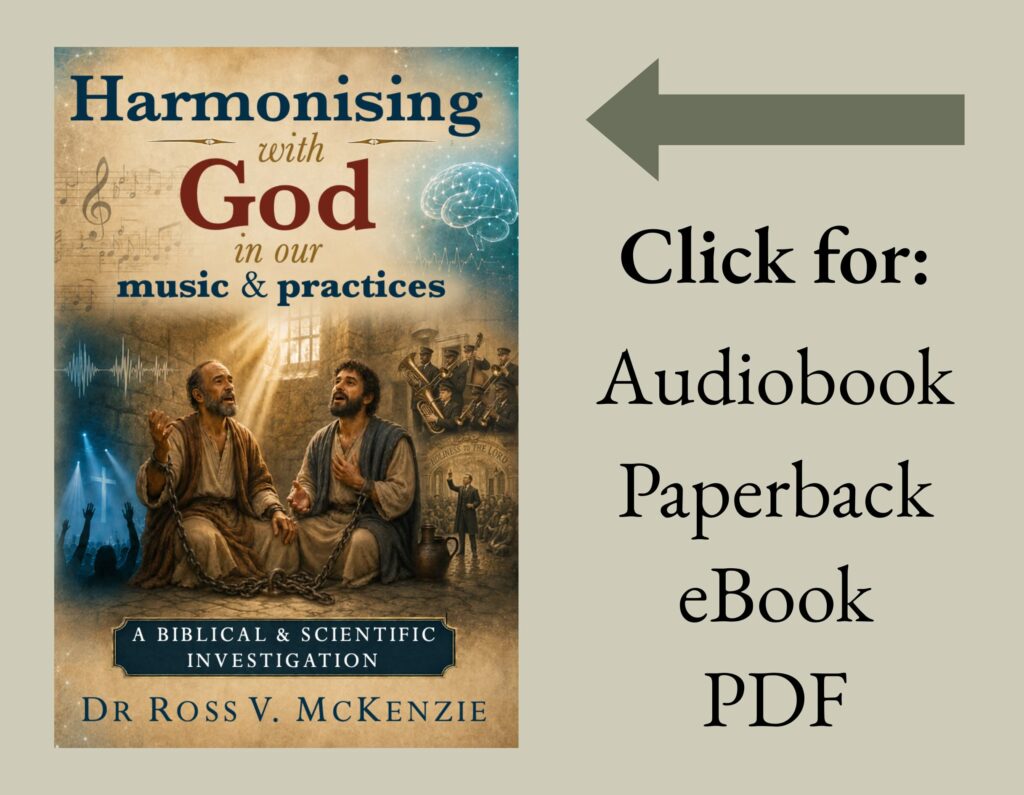


General Booth believed that music in and of itself has no moral force and, therefore, any style of music is fine as long as the lyrics are appropriate. Mrs White, on the other hand, who claimed to receive direct inspiration from God, opposed the Salvation Army method and believed the style of music does matter. This book has investigated what the Bible and science say about music, comparing it with General Booth’s and Mrs White’s ideas. The conclusion is that there is indeed moral force in music and that the style of music does matter. Consequently, poor music choices – including the style of music and the content of the lyrics – have had detrimental effects on the theology and practices of the church. Every individual, however, must make up their own mind where the harmony lies. What is most important is that we press together, despite each other’s differing views, and be mindful of each other’s convictions and respect each other – this will help to avoid extremes in any one direction. We should also continue to be open to discussion and debate on this topic, to ensure that we continue to grow in our understanding of God’s will.
As we have seen throughout this book, the uniqueness of God and the distinctions He established at creation have gradually eroded – such as the distinctions between good and evil, God and people, regular days and the Sabbath day, male and female, and animals and humans. Poor music choices are one factor that has led to this erosion – for example, we no longer sing of the beauty of the Sabbath as Fanny Crosby did. Consequently, there is now little distinction between the days of the week other than the remnants of a weekend, which, instead of being a time set apart for God, is now a time for work, recreation, sport and caring for our material possessions.
This book has also found fault in Holiness teachings, of which William and Catherine were proponents. Does that mean they were heretics? Only God knows the heart of each individual, but the Booths were very likely sincere Christians who, like the rest of us, did not get everything right. When genuine Christian individuals and churches start heading too far to the right or to the left in any belief, over time they will self-correct as they see the result of the error and as they study Scripture guided by the Holy Spirit. In hindsight, we can see the dangers of the Holiness way of thinking, and many Christians moved away from it. However, some individuals and denominations embraced Holiness ideas, developing them further and incorporating these ideas into their music. Unfortunately, as a result, it opened the way for Christianised Pagan ideology to filter into the church. One of the main suppliers of contemporary Christian music is Bethel Church, who has openly integrated New Age with their practices. Gnostic, New Age, New Thought and Word of Faith ideology is now widespread across Christendom. Peter Jones believes a new term for the New Age movement is Progressive Spirituality and the driving forces of occult spirituality today are interfaith mysticism and social justice.476 He believes Progressive Christianity is bringing pagan ideology into the church, further eroding the distinctions God established at the beginning. This will create disharmony between our practices and God’s Word. If that is the case, how do we correct the imbalance? How do we find harmony with God?
Harmony with God requires humble submission to Him and faith in the assurance of our salvation. When we lack humility and faith, we rely on self and we remain under the curse of the law, burdened by fear of God’s condemnation. But when we let go of self and accept the blood of Jesus, we are freed from the curse of sin and we rejoice in the beauty and blessings of God’s commands. Perfect symphony is achieved when our music and practices honour Jesus as both loving Saviour and as sovereign King. As God is merciful, we are merciful. As Jesus submitted Himself to His Father, we submit. As Jesus offered up His body as a sacrifice for sinners, we present our bodies a living sacrifice, holy, acceptable to God rather than conforming to this world (Rom 12:1-2).
Instead of conforming with the world, the early church strove to maintain purity in the church. Paul lovingly counselled church members to turn from sin (Rom 6:12) but quickly dealt with unrepentant sinners by removing them from the congregation (1 Cor 5:13). In fact, church members are not to keep company with immoral Christians, such as “sexually immoral, or covetous, or an idolater, or a reviler, or a drunkard, or an extortioner – not even to eat with such a person (1 Cor 5:9-11).” Mrs White’s counsel is in line with Scripture:
“Choose poverty, reproach, separation from friends, or any suffering rather than to defile the soul with sin. Death before dishonour or the transgression of God’s law should be the motto of every Christian. As a people professing to be reformers, treasuring the most solemn, purifying truths of God’s word, we must elevate the standard far higher than it is at the present time. Sin and sinners in the church must be promptly dealt with, that others may not be contaminated. Truth and purity require that we make more thorough work to cleanse the camp from Achans. Let those in responsible positions not suffer sin in a brother. Show him that he must either put away his sins or be separated from the church.”197 (p147)
Sounds harsh! But by saying nothing and doing nothing, we become complicit in sin (Eph 5:11, Gal 6:1, 1 Tim 5:20, Jam 4:17). Even more importantly, James said:
“…if anyone among you wanders from the truth, and someone turns him back, let him know that he who turns a sinner from the error of his way will save a soul from death and cover a multitude of sins.” (Jas 5:19-20)
What if a drug user starts attending our church? Our response should be to look past the sin and welcome him with open arms and treat him with love and respect. If he starts Bible studies, we would also provide support and encouragement to quit drug use. If he accepts our doctrines or fundamental beliefs and tries his best to quit drugs, we would baptise him, even if he is still struggling with drugs because sanctification is a process – though we would not yet make him an elder or a Bible teacher. However, if he was openly using drugs without any remorse, we would be very concerned about his influence, especially on young people. Worse still, what if an elder or pastor condoned his drug use? We would be horrified and the elder or pastor’s position would become untenable unless they retracted their position. Likewise, to Paul, other forms of immorality are unacceptable, but we have become so accustomed to immorality in the world around us and in secular entertainment that it no longer horrifies us. Moreover, it has come to be seen as unloving to rebuke sin. Mrs White said:
“Sins exist in the church that God hates, but they are scarcely touched for fear of making enemies. Opposition has risen in the church to the plain testimony. Some will not bear it. They wish smooth things spoken unto them. And if the wrongs of individuals are touched, they complain of severity, and sympathize with those in the wrong.”594 (p283)
Sin and heresy have to be promptly dealt with and stamped out before it corrupts and divides the church. That includes removing music and practices which are not in harmony with God’s character and His teachings. It would also include avoiding music produced by churches that are out of harmony with God and His teachings. The prophet Nathan confronted King David about his adultery with Bathsheba and his murder of Uriah the Hittite (2 Sam 11-12). A whole Psalm is dedicated to David’s prayer of repentance (Ps 51). Confronting sin in the church must be done in the context of our own fallenness. We must first be deeply convicted and repentant, overcoming our own sins by drawing close to Jesus. We must blend justice and grace and emphasise God’s provision of forgiveness as outlined in David’s prayer of repentance.
As with Psalms, which perfectly balances mercy and justice, our songs in modern times should perfectly balance blessings and warning. In that way, people will see their need for repentance without being crushed by guilt. Even though Jesus has set a high standard for us, the story of the penitent thief on the cross gives us much hope in the mercy of God. Mrs White said of this thief:
“He had seen and heard Jesus, and had been convicted by His teaching, but he had been turned away from Him by the priests and rulers. Seeking to stifle conviction, he had plunged deeper and deeper into sin, until he was arrested, tried as a criminal, and condemned to die on the cross.”87 (p749)
The heartbreaking story of Stephanë Anthon, affectionately known as Effie, is stored in the archive of Queen Mary University of London.595 Effie’s experience illustrates how the ideals of holy Christian living do not always work out, even in those who sincerely seek it. Effie was the daughter of a woman rescued by the Salvation Army and adopted by a middle-class supporter of the Army. The Salvation Army thrived on success stories of transformed lives, but there were many stories of defeat. Effie was one of them. She failed to achieve any lasting change in her spiritual life, continuing in sexual and other sins. At one point she wrote to her adopted mother:
“I always have been a failure and I suppose always will be. I don’t care now what happens to me. I shall never again try to be good, it is all rubbish. I shall just please myself and go my own road. I don’t care what becomes of me now. Your wretched, Annie.”2 (p159)
She soon picked herself up again and returned to the Army’s meetings, but this was a regular cycle for Effie. Life is hard and that is why we must be gentle with each other. Mrs White said, “Let us remember that we are struggling and falling, failing in speech and action to represent Christ, falling and rising again, despairing and hoping. Let us beware of dealing unkindly with those who, like ourselves, are subjects of temptation and who, like ourselves also, are the objects of Christ’s unfailing love.”196 (p222)
The story of the cross gives us hope that, though we are caught in the cycle of sin, we have hope, as long as we cling to Jesus. There is hope, even for those like Effie, who feel hopeless. Though Mrs White challenges believers to “lay aside every weight, and the sin which so easily ensnares us (Heb 12:1),” she repeatedly brings her readers back to the cross and God’s merciful love. She goes on to tell of the story of the thief as he hung on the cross:
“When condemned for his crime, the thief had become hopeless and despairing; but strange, tender thoughts now spring up. He calls to mind all he has heard of Jesus, how He has healed the sick and pardoned sin. He has heard the words of those who believed in Jesus and followed Him weeping. He has seen and read the title above the Saviour’s head. He has heard the passers-by repeat it, some with grieved, quivering lips, others with jesting and mockery. The Holy Spirit illuminates his mind, and little by little the chain of evidence is joined together. In Jesus, bruised, mocked and hanging upon the cross, he sees the Lamb of God, that taketh away the sin of the world. Hope is mingled with anguish in his voice as the helpless, dying soul casts himself upon a dying Saviour. ‘Lord, remember me,’ he cries, ‘when Thou comest into Thy kingdom.’
Quickly the answer came. Soft and melodious the tone, full of love, compassion, and power the words: Verily I say unto thee today, Thou shalt be with Me in paradise.
For long hours of agony, reviling and mockery have fallen upon the ears of Jesus. As He hangs upon the cross, there floats up to Him still the sound of jeers and curses. With longing heart He has listened for some expression of faith from His disciples. He has heard only the mournful words, ‘We trusted that it had been He which should have redeemed Israel.’ How grateful then to the Saviour was the utterance of faith and love from the dying thief!”87 (p750)
It was the sincere repentance of a desperate sinner that helped sustain Jesus on the cross, but self-interest brought Him discouragement!
Now, more than ever, the world needs to hear the three angel’s message. The world needs to hear the good news of salvation and the trumpet sound of warning. The devil is working overtime to block this message from going to the world. If we fail to act by resisting evil, including the influence of unrepentant sinners, then we are working on the side of evil.
Mrs Booth said:
“The great effort of the Devil is to keep people indifferent, and nothing does he dread so much as awakening and arousing preaching, or other instrumentalities calculated to awaken and alarm them.
Oh that the Church understood this! Oh that Christians understood it! It seems to me sometimes, instead of understanding it, they appear to be partners with the Devil in trying to keep people asleep. They shrink away from any direct, personal, earnest, thorough dealing with souls that would be likely to awaken them to a sense of their danger.
They do not recognise the fact as they ought, that Satan has got men fast asleep in sin, and that it is his great device to keep them so. He does not care what we do, if he can do that. We may sing songs about ‘the sweet by-and-by,’ preach sermons, and say prayers, and go the jog-trot round and round, barrel-organ fashion, till Doomsday, and he will never concern himself about us if we don’t wake anybody up; but, if we wake anybody, he will gnash on us with his teeth. This is our work – to wake people up. That is your responsibility, you Christians. If that man with whom you are coming in contact dies, and is damned, in his sleep, and you never went the common-sense, reasonable way to wake him, God will demand his soul of you. Wake him! Wake him!”45 (p6)
In other words, she is saying to sound the trumpet warning loud and clear. James White gives wise counsel which helps to get matters of doctrine and Christian practice into perspective: “In the divine law, and in the gospel of the divine Son, are the tests of Christian character.” These are matters of primary importance if we are to harmonise with God. He criticised those who were splitting up into sects:
“…over forms of church government, matters of expediency, free and restricted salvation, trinity and unity, whether we may sing any good hymn in church, or only the Psalms of David, and other matters which constitute no test of fitness for Heaven.”596
Though music style is not a matter of salvation in and of itself, in his dissertation on the use of New Age practices by the church, Professor Chris Berg concluded “there is a strong linkage between proper worship and proper ritual or practice.”576 (p313) Getting our worship right is important, and that includes getting our music right. Mrs White warns:
“Satan will make music a snare by the way in which it is conducted. God calls upon His people, who have the light before them in the Word and in the Testimonies, to read and consider, and to take heed. Clear and definite instruction has been given in order that all may understand.”12 (p38)
Some of the clear and definite instruction she is talking about, includes:
“…not loud singing… but clear intonation, correct pronunciation and distinct utterance;”196 (p144) “like the music of the birds – subdued and melodious;”168 (p510) “conducted with solemnity and awe;”197 (p493) “not funeral notes, but cheerful, yet solemn melodies. The voice… modulated, softened, and subdued.”168 (p508)
Are her instructions in harmony with the Bible? The late H.M.S Richards, well-known Seventh-day Adventist evangelist and author, became convinced of Mrs White’s sincerity at age 15 years after hearing her pray for the first time. As she preached, he said, she was just a good earnest Christian mother, but as she prayed, a change came over the place. It was as if she was in the presence of the Lord, and the congregation wept as she prayed. He decided the best way to know if a prophet is who they claim to be is to read their writings. So, he studied dozens of her books. Mrs White said that we should test her writings against the Bible, which is what he did. His conclusion was that her writings are indeed in harmony with the Bible.464
H.M.S. Richards said there are plenty of critics of Mrs White, but nobody should listen to them until they have read her writings for themselves. He advised, if we only took the hard passages of the Bible, we would lose faith in it. We have to read the Bible as a whole. It’s the same with Mrs White, he said. He advises we read her writings for ourselves and see how they fit in with the end time picture.464
That is sound advice. We should not listen to anyone until we have tested them against Scripture. Regardless of our opinion of Mrs White or General Booth, as discussed throughout the book, God has given us definite principles to guide our selection of music. We have no excuse.
Keith Getty says:
“The big challenge for pastors, senior pastors and also for parents of families is that we have to, more than ever, take control of the songs we sing. God’s people have always learned their faith in significant part through what they sing, so if we don’t take control of it right now, somebody else is and it’s not the right person.”465
Steve Camp, is an American contemporary Christian music artist and pastor, responsible for 22 albums, 15 No. 1 songs and 40+ Top 10’s. On his website, the following statement is made:
“In 1997, Camp released his unprecedented document entitled The 107 THESES: A Call to Reformation for the Contemporary Christian Music Industry, the clarion call for all in the Contemporary Christian Music Industry to reformation in returning to the authority of Scripture, the accountability of the local church, the ascendancy of the glory of God, and not being unequally yoked with an unbelieving world.”597
Steve Camp recognises our need to return a balance to our music so that we are in harmony with Scripture. This will require us to get on our knees. But even before we do this, General Booth said:
“Before we go to our knees to receive the Baptism of Fire, let me beg of you to see to it that your souls are in harmony with the will and purpose of the Holy Spirit whom you seek.”598
How do we ensure we are in harmony with God? First and foremost, we must know we are saved. This comes by faith. From then on, we have to stop thinking about how to be saved because we already know we are saved by Jesus’ blood. Rather, the next step is to start living as saved people – obedient to Christ, loving God’s commands and making disciples of all nations, teaching them to obey all that Jesus commanded us.
To get harmony back into our music, it will require musicians and theologians working together, without the influence of fame and of the music industry driving profits. We need musicians who will write songs for us that tell the right story – both in the music and in the lyrics – a story of peace and hope, mercy and justice and everything else that Jesus has taught us in the Old and New Testaments and in His death and resurrection. This is a clarion call to the musicians and song writers out there to continue to give us new songs about God’s mercy and grace and also to give us songs of lament, songs about the poor and songs that sing of the beauty of God’s law.
A final word from General Booth:
“Faith and works should travel side by side, step answering to step, like the legs of men walking. First faith, and then works; and then faith again, and then works again – until they can scarcely distinguish which is the one and which is the other.”599
A final word from the pen of Mrs White:
“Oh, what can I say to open blind eyes, to enlighten the spiritual understanding! Sin must be crucified. A complete moral renovation must be wrought by the Holy Spirit. We must have the love of God, with living, abiding faith. This is the gold tried in the fire. We can obtain it only of Christ. Every sincere and earnest seeker will become a partaker of the divine nature. His soul will be filled with intense longing to know the fullness of that love which passes knowledge; as he advances in the divine life he will be better able to grasp the elevated, ennobling truths of the word of God, until by beholding he becomes changed and is enabled to reflect the likeness of his Redeemer.”197 (p105)
If we sincerely believe in Jesus, we have assurance of Salvation; therefore, let us praise our Lord in song. Let us lift up His name in praise as David did, according to the law and the prophets. Let the sound of our music perfectly harmonise with the character of God. Let the lyrics of our songs perfectly harmonise with the commands and teachings of Jesus. Let us give our all to our creator and saviour for His great mercy and “Fear God and keep His commandments, for this is man’s all (Eccl 12:13).”
Oh, that we could sing as the psalmist did:
“Let my cry come before You, O Lord;
Give me understanding according to Your word.
Let my supplication come before You;
Deliver me according to Your word.
My lips shall utter praise,
For You teach me Your statutes.
My tongue shall speak of Your word,
For all Your commandments are righteousness.
Let Your hand become my help,
For I have chosen Your precepts.
I long for Your salvation, O Lord,
And Your law is my delight.
Let my soul live, and it shall praise You;
And let Your judgments help me.
I have gone astray like a lost sheep;
Seek Your servant,
For I do not forget Your commandments.” (Ps 119:169-176)
A final word from Paul:
“And now, dear brothers and sisters, one final thing. Fix your thoughts on what is true, and honorable, and right, and pure, and lovely, and admirable. Think about things that are excellent and worthy of praise. Keep putting into practice all you learned and received from me – everything you heard from me and saw me doing. Then the God of peace will be with you.” (Phil 4:8-9 NLT)
A final word from our King, who lives in perfect harmony with His Father, arising out of selfless devotion:
“He who has My commandments and keeps them, it is he who loves Me. And he who loves Me will be loved by My Father, and I will love him and manifest Myself to him.” (Jn 14:21)
This is perfect harmony.