
Harmonising with God in Our Music and Practices
Part 10 - Consequences Of Poor Music Choices
Chapter 34
Chapter 34
Spiritualism Embraced

The Occult in Secular Music
The great concern is that a rejection of God’s character and His Scriptures has opened the way for spiritualism. Spiritualist themes are quite open and blatant in the lyrics and cover designs of various secular bands, especially hard rock and heavy metal. A common example includes Pan, the half-man, half-goat god from Greek mythology often depicted on album covers. The pentagram, a five-pointed star, associated with the occult, especially Satanism, is another symbol often seen in secular music artistry such as what is seen on album covers. Though not always this obvious, evidence of spiritualism can be seen across many segments of the music industry. Much could be said on this topic and many examples given, but for brevity, we will just take a quick glimpse at a couple of the artists already discussed in this book as examples.
Chris Martin, lead singer for Coldplay and song writer for the album Viva La Vida, in an interview with Zane Lowe said that he has been following the muse more and more purely for his inspiration for song writing.557 What is the muse? According to the Collins English Dictionary, a muse is someone who gives an artist ideas or a desire to create art, poetry, or music.558 In classical Greek and Roman mythology, the muse refers to each of nine goddesses, the daughters of Zeus and Mnemosyne, who preside over the arts and sciences.559 Though commentators often describe the modern use of the term muse as the unconscious mind or as a person or thing that provides inspiration, when artists use this term, they are sometimes referring, in a classical sense, to a divine attendant spirit or a creative spirit genius.560
Elizabeth Gilbert is an American journalist and author of the international best-selling book Eat, Pray, Love. Her book was made into a movie, of the same title, starring Julia Roberts. In a TED talk, Gilbert describes in some detail what artists are sometimes talking about when they refer to the muse. She explains how ancient Greek and Roman people did not believe that creativity came from human beings. Rather, they believed that creativity was a divine attendant spirit that came to humans from some distant and unknowable source. The Romans called this sort of disembodied creative spirit a genius – a sort of magical divine entity who was believed to literally live in the walls of an artist’s studio and who would come out and invisibly assist the artists with their work and would shape the outcome of that work. If an ancient artist’s work was brilliant, he could not take all the credit for it because everybody knew he had a disembodied genius who helped him. Conversely, if an artist’s work bombed, it was not considered entirely his fault.560
According to Gilbert, when the Renaissance came, rational humanism began and, for the first time in history, artists start being referred to as a genius rather than having a genius. However, Gilbert recommends we go back to the ancient understanding of the creative genius. She describes her own experience with this so-called creative mystery: “Even I have brushed up against that thing… I have had work or ideas come through me from a source that I honestly cannot identify.”560
She goes on to explain how she got her inspiration to follow her creative genius from musician, Tom Waits. She said it saved her when she was in the pits of despair while writing Eat Pray Love. Following Tom’s advice, she lifted her face up from the manuscript and directed her comments to an empty corner of the room and said aloud:
“Uh, listen, you thing, um, you and I both know that if this book isn’t brilliant, that is not entirely my fault, right? Because you can see that I am putting everything I have into this. You know I don’t have any more than this, so if you want it to be better, then you’ve got to show up and do your part of the deal, okay.”560
Gilbert’s description of the creative genius explains a lot about Chris Martin’s interview with Zane Lowe. Chris explains what he means by ‘following the muse’: “when you close your eyes, you’re sort of told what to do.” Later in the interview he expands on this thought by describing how:
“…we have just cared less and less what anyone else thinks and more and more about what is coming through, what are we being told to do by whatever you call those powers that be.”
From these comments, it appears that Chris believes there is some kind of higher power, a spiritual force, guiding his thoughts – and it is not the Holy Spirit. He describes how a song arrived in the hotel room in Buenos Aires that he wrote down on his phone. He describes how “with good songs at least, they are just like their own things that you happen to catch.” When Zane Lowe asked how he knows when they are there, Chris replied “because you just know there’s nothing to do with you.” He said there are probably 15 songs where that has happened, where it basically just lands.557 Viva La Vida was one of them, which is filled with anti-Christ sentiments.
Chris has fully embraced the whole concept of the creative genius as described by Gilbert. He recognises that he cannot take full credit for any of his success because there is a mystical divine creature, his personal muse, who is assisting him:
“You don’t want to get any delusions of grandeur or think that you’re better than you, that you’re better because you’re famous or you’re better because you’re whatever. I just feel like this is the gift I got given and that’s what I do and I don’t think any more about ‘did we make it,’ ‘are we famous’… I think this is what I’m supposed to be doing whether anyone’s listening or not…”
He goes on to say:
“I want to play to loads of people because it’s so fun and there’s part of me that loves the fact that we made it and stuff but the main part of me is like well everything has been given to you… the songs are given even that was given to you, so you can’t really take credit for anything. At this point I just feel so blessed and lucky to be doing what I’m doing and I want to do as much and as well as possible.”557
Chris was brought up in an evangelical family but has since renounced his Christian faith and now considers himself an all-theist – believing that God is present in everyone and everything. He said he finds it difficult to deal with his strict religious upbringing, which taught that, “if you even think about boobs, you’re going to hell.” An example of the effect of the strictness, he said, was that he couldn’t sing Sympathy for the Devil by the Stones, because he thought he would be punished by God.561,562Like many rock and pop artists who were brought up as Christians, Chris misrepresents God’s rules as stifling and strict.
It is true that Jesus said, “But I say to you that whoever looks at a woman to lust for her has already committed adultery with her in his heart (Matt 5:28).” It is true that Paul tells us that adulterers will not inherit the kingdom of God (1 Cor 6:9-10). It is true that rules without love is cold and legalistic. And it is true that some Christian parents are legalistic – too rules focused without balancing it with acts of love. The good news is that God’s rules are loving because they protect us from harm and heartbreak. God also gives us the opportunity of forgiveness for our lustful thoughts if we genuinely repent. But if a person has sympathy for the devil, they simply do not want to repent because they do not like God’s rules – they are burdensome to them. God’s rules are too strict and rigid for them and they would prefer to reject God’s love so they can keep breaking the rules without feeling guilt.
Chris’ muse sounds a lot like a counterfeit to the Holy Spirit. In his article, 5 Reasons Why You Need a Muse, Mark McGuinness says:
“Your muse is responsible for providing the ideas and energy, the fundamental fire of the work. You are responsible for 1) waiting when your muse says wait, 2) acting when your muse delivers the inspiration, and 3) making yourself a fit conduit for your muse by doing whatever kind of practice work is necessary to keep your chops up.”563
Chris believes he can take no credit for his success because it was given to him by his muse. This is parallel to a Christian’s relationship with the Holy Spirit. In fact, Chris Martin’s whole belief system is a counterfeit. Paul said, “For Satan himself transforms himself into an angel of light (2 Cor 11:14).” Mrs White says:
“Satan frequently appears as an angel of light, arrayed in the livery of heaven; he assumes friendly airs, manifesting great sanctity of character and high regard for his victims, the souls whom he means to deceive and destroy. Perils lie in the path which he invites souls to travel, but he succeeds in concealing these and presents the attractions only.”132 (p456)
Though he rejects Christianity, Chris still believes in and longs for life after death. Part of the Coldplay song, We Pray, reads as follows:
“I know somewhere that Heaven is waitin’
I know somewhere there’s something amazin’
I know somewhere we’ll feel no pain”
His music gives the false assurance to his listeners that heaven is waiting there for everyone, no matter if they believe in Jesus or not. This is the deception of spiritualism.
In summary, Chris’s faith, which reflects the faith of many artists, rejects the rules of God, rejects his wrath and punishment, but still seeks guidance from his muse to take the place of the Holy Spirit to provide him with inspiration, to lift his burdens and to give him peace. He gives all credit to his muse for his success. He also believes there is a glorious heaven without pain waiting for him. Yet he denies the God of the Bible and His law. He believes in what his god can do for him but denies the cross of Calvary.
Chris Martin’s worldview is not dissimilar to the worldview that is promoted in a lot of contemporary Christian worship songs. Perhaps this is one reason why Sean McDowell’s musician friend, who gave up his faith in Christianity, felt he could have the same spiritual experience at a Coldplay concert as a Christian rock or pop concert. Chris’ pantheistic-type belief may have parallels in a lot of contemporary Christian worship music. Kenneth H. Wood, editor of the Review and Herald from 1966 to 1982, suggested even back in 1972 that modern religious music contains semi-pantheistic expressions. In the Bethel endorsed book, The Physics of Heaven, the ancient monism philosophy concept of ‘all is one,’ which is the foundation for most forms of pantheism, is brought out.35 (Remember Bethel is one of the top four suppliers of the most popular worship songs). Pantheistic ideas are found in the Gospel of Thomas. Saying 77 reads, “It is I who am the all, says Jesus. Split a piece of wood, and I am there. Lift up a stone, and you will find me there.”564,565 Scholars of Gnosticism have argued that Gnosticism is dualism on a monistic background – it’s just another form of monism. Pagan pantheism is at the heart of the kind of Gnosticism which has re-emerged in our world today.476
As described by Shannan Baker, few of the popular worship songs even talk about the cross or salvation, instead, focusing on what God is doing for me now and what God has promised to do for me in the future. Their songs almost never talk about God’s wrath or punishment. And like Chris’ worldview, heaven is just waiting there for anyone to take it, with few strings attached. It is easy for almost anyone to accept. But it is not reality. In contrast, Jesus said:
“Enter by the narrow gate; for wide is the gate and broad is the way that leads to destruction, and there are many who go in by it. Because narrow is the gate and difficult is the way which leads to life, and there are few who find it.” (Matt 7:13-14)
When secular artists talk about God, we automatically think they are referring to the God of the Bible. However, they are often actually referring to the source of their inspiration. In an interview with Fox News, the late Ray Bradbury, American author and screenwriter and one of the most celebrated 20th century American writers, said:
“All of my writing is God-given. I don’t write my stories – they write themselves. So out of my imagination, I create these wonderful things, and I look at them and say, My God, did I write that?… Everything comes to me. Everything is my demon muse. I have a muse which whispers in my ear and says, ‘Do this, do that,’ but it’s my demon who provokes me.”566
Ray Bradbury, Elizabeth Gilbert and Chris Martin may or may not literally believe there is a divine attendant spirit guiding them, as the ancient Greeks and Romans believed. It’s hard to say. Even if it is only figurative imagination, it is so close to the real thing that it may as well be. They feel indebted to their muse for their success. They get great comfort from externalising their experience, imagining that a supernatural entity is telling them what to do and providing their inspiration. It relieves them from anxiety and the fear of failure and gives them a sense of higher purpose. It is their saving grace, the source of their inspiration. It so resembles faith in the spirit world that it becomes indistinguishable from it.
Spiritualism is seen across the board in the secular music industry, even amongst professed Christian artists. For example, U2 lead singer, Bono, made numerous appearances on stage as his ‘alter ego,’ Mr MacPhisto, named after Mephistopheles, the devil’s representative in the Faust legend – the story of a German necromancer who sells his soul to the devil in exchange for knowledge and power. Why do rock bands keep identifying themselves with occult figures? There has to be more to it than just creative expression. Some Christians argue that it is just art and, therefore, it is harmless. Even if it is just art, and not actual demon worship, it is open mockery of Jesus, which is satanic.
Despite the band’s indifference to the dangers of associating with such characters, U2 is respected by many Church members and pastors as Christian friendly because of its use of Christian themes and the good works that it does. But U2 is heavily mixed with the vices seen in the majority of secular rock bands. Worldly entertainment in our day and age – not just music but practically all forms of worldly entertainment – has both hidden and overt messages that lead our minds away from God. Sam Smith and Kim Petras received loud applause for their enactment of a devil-worshipping ritual at the Grammy Awards in 2023. Those in the audience who were cheering are the singers, songwriters and musicians producing the world’s entertainment. We do not know what spirit might be evoked by this music, regardless of the lyrics, when those producing the music are mesmerised by such satanic performances.
It is not just the song writers and artists that are influenced by the spirit world. West Africans used specific drum rhythms to communicate with spirits, such as the Orisha, which they believe would enter into and possess some of the listeners as they danced to the music. West African drum rhythms were introduced to America via the slave trade and heavily influenced Jazz, the blues and Rock and Roll music.210 Drummer, Mickey Hart, describes the reaction of the crowd, as their band plays, as if the audience is possessed by an inexplicable force:
“In Africa, musicians are never possessed by the spirits they call down with their rhythms, so what possesses our audience I can never know. But I feel its effects. From the stage you can feel it happening – group mind, entrainment, find your own word for it – when they lock up you can feel it; you can feel the energy roaring off them.”210 (p173)
In other words, he is saying, when African drummers call down spirits by their drum rhythms, the drummers do not become possessed but those dancing to the music do. Similarly, drummer Mickey Hart concludes that, when he plays drums in his rock band, the audience has the appearance of being possessed. Some have a scientific explanation for it, such as entrainment, but Micky Hart is inviting the reader to put two and two together – he is suggesting it is spirit possession. This was the conclusion he drew after years of spending time with and studying Shaman and African drummers.
When we open the door to worldliness into our lives, our families and into our churches, morality becomes blurred and we no longer recognise God’s will. A spirit of rebellion begins to set in. Evil becomes good and good evil (Is 5:20). Consequently, church members are led astray. God declares of His wandering sheep:
“For the household gods utter nonsense,
and the diviners see lies;
they tell false dreams
and give empty consolation.
Therefore, the people wander like sheep;
they are afflicted for lack of a shepherd.” (Zech 10:2)
“My people have been lost sheep.
Their shepherds have led them astray;
They have turned them away on the mountains.
They have gone from mountain to hill;
They have forgotten their resting place” (Jer 50:6)
For leading His sheep astray, God declares “My anger is kindled against the shepherds, And I will punish the goatherds (Zech 10:3).” Leaders in the church must not be indifferent to worldly influence in our church that leads members away from God and from truth. On this topic, Catherine Booth said:
“Alas! alas! this is generally the case when those in high places give their influence on the wrong side and against God. What an awful reckoning-day is coming for wicked kings and rulers, in fact for all people in places of influence and authority who use it against God! It will be bad enough for a man to have to answer for the damnation of his own soul; but, oh! what will it be to have to answer for the damnation of thousands of others? You who are influencing others – your wives, your children, your husbands, your friends, your servants, those who live in the same house with you – there is a reckoning-day coming, and an awful reckoning-day it will be.”45
Mrs White says:
“Angels are hovering around yonder dwelling. The young are there assembled; there is the sound of vocal and instrumental music. Christians are gathered there, but what is that you hear? It is a song, a frivolous ditty, fit for the dance hall. Behold the pure angels gather their light closer around them, and darkness envelops those in that dwelling. The angels are moving from the scene. Sadness is upon their countenances. Behold, they are weeping…”
She goes on to describe how music is an idol which many professed Christians worship. Paul describes idol worship as demon worship (1 Cor 10:20). Sacred music is not congenial to their taste, Mrs White says of these youth. Music is a channel through which Satan gains access to the minds of the youth and it is often made one of Satan’s most attractive agencies to ensnare souls, she says. It is a terrible curse when it takes the place of devotion and prayer.193 (p585-6)
She then gives a most solemn warning: “In the judgment all these words of inspiration will condemn those who have not heeded them.” Is her comment here Biblical? In the Bible, there is always severe consequence for ignoring prophets; therefore, if she is a prophet, then her statement is scriptural. She then advises young people to “pray for souls; come near to Christ, close to His bleeding side… Pray more than you sing. Do you not stand in greater need of prayer than of singing.”
New Age in Christianity
Unfortunately, spiritualism is not only seen in the secular world. So distorted is the theology of the top four megachurches who provide the majority of our worship music – Bethel, Hillsong, Passion City Church and Elevation – that Bethel has openly brought New Age beliefs into their church.567,568 According to Christian apologist and former New Ager, Melissa Dougherty, New Age and New Thought practices have influenced the theology of numerous Charismatic churches, especially Word of Faith and New Apostolic Reformation movements, which includes Bethel.569
In keeping with the spiritual worldview of its predecessors, Bethel has even unthinkably endorsed the use of destiny cards which some commentators have argued are just another form of tarot cards.570 (27:20, 1:52:30) Bethel Church has publicly denied that destiny cards are a form of Christian tarot cards;571 however, numerous Christian commentators, including former New Age practitioners, have warned of the dangers of destiny cards because of their resemblance to tarot practice. Doreen Virtue, former psychic and popular New Age author who has since renounced her New Age beliefs, is highly outspoken against Bethel’s New Age practices. Dorothy used tarot cards personally and professionally for 20 years and says that the way destiny cards are being used is the same as the way she did tarot readings before she was saved. She warns that destiny cards “are not tarot cards in the literal sense but the usage… is oracle and divination which is a condemned practice… in both the Old and in the New Testaments.”572 It might be argued that Bethel is an extreme example. However, their influence is very widespread, with their ideology seeping into churches globally through their music and through the Bethel School of Supernatural Ministry.
Bill Johnson, senior leader of Bethel, is a contributor to the book, The Physics of Heaven, which candidly discusses many New Age practices. For example, it talks a lot about new age principles of sound and light. In the introduction, it reads, “The Lord is ready to use sound, light and energy in ways we never dreamed.”567 (pviii) This is the undertow of much of Bethel worship. They want to create such a sound that changes atmosphere because they believe that sound has to influence people. This is New Age practice. A former Bethel student says that Bethel uses sound teams and light teams and put “hundreds of thousands of dollars into engineering a killer sound. Having a certain lighting on the stage that makes you feel a certain way, creates a certain atmosphere. This is just par for the course.”573 (21:10) In chapter one of The Physics of Heaven, Judy Franklin said, “The next thing the Lord told me was that soon He would release a sound from heaven that will literally change the structure of how we think.”567 (p2) These megachurches teach a particular theology packaged with highly engineered music which hooks listeners in and can dominate worship programs.
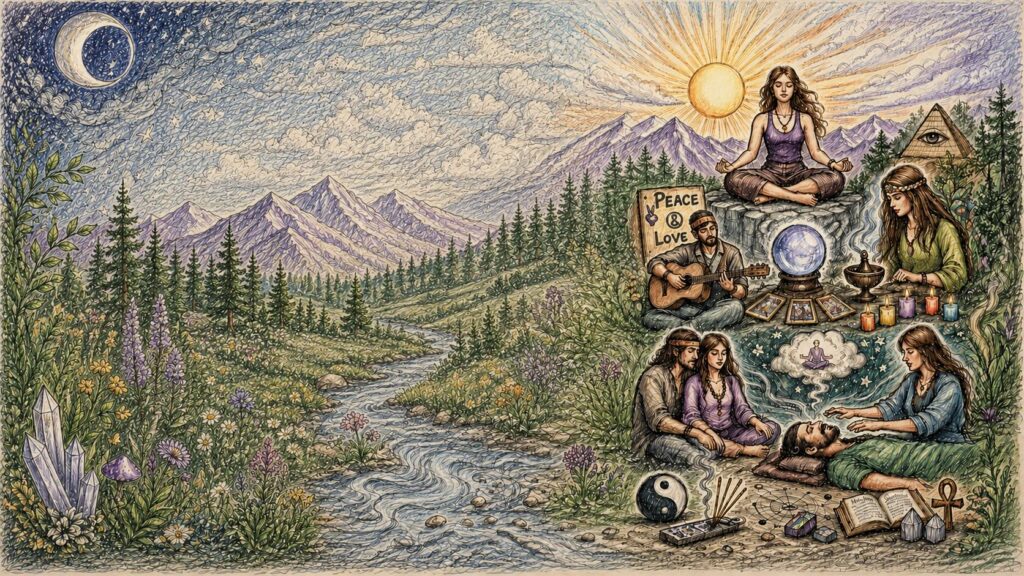
New Age thought emerged especially in the 1960s and ‘70s along with the sexual and spiritual revolution, of which rock and pop music has been one of the driving forces. Since that time, spirituality has been influenced by a merging of Eastern philosophies with Western mysticism and other pagan practices.574,575 New Age in Christianity merges New Age teachings with Christianity.
Authentic Christianity teaches that spirituality is a relationship with God through worship and obedience to His will as revealed in Scripture. The focus is to praise and adore our creator, which is reflected in a godly lifestyle and practices. Truth is revealed in Scripture. The Bible portrays sin as rebellion against God and the fundamental reason why humans are condemned to death, but Christ’s sacrifice is sufficient for sins – salvation cannot be obtained through works. True spirituality condemns pagan practices and exposes false doctrine. The Bible teaches that we can have direct encounters with God through prayer, His Word and the Holy Spirit, and true divine encounters align with Scripture. In true Christianity, music is for thanksgiving and praise and for reinforcing truth as found in Scripture.
The New Age, on the other hand, teaches that spirituality is oneness with the universe and awareness of one’s own inherent divinity, which is obtained through mystical knowledge. The focus is on one’s own divinity and power and obtaining personal desires. There is no such thing as absolute truth – it is a personal, internal experience. New Age theology typically holds that humanity is innately good, not inherently sinful or evil. ‘Sin’ is essentially ignorance of one’s innate divinity or true potential. Through a lifetime of transcendent experiences, people can become enlightened to the truth. Spiritual growth or ascension is accomplished through various works, including rituals and practices as well as material sacrifice, such as time, money, skills or work. Spiritual understanding is gained through experience. The New Age accepts and embraces beliefs and practices from a variety of religions. Encounters with God are obtained indirectly, such as through mediums. Divine encounters and mystical experiences reveal new truth and doctrine. In the New Age, music is used to induce a state of spiritual openness and transcendence.575,576
Enlightenment is achieved by seeking mystical or inner knowledge (gnosis), which is attained through personal experienceand intuition rather than from sacred texts, such as the Bible. Some examples of rituals and practices in the New Age include necromancy, mediumship, spiritism, astrology, channelling, meditation, crystal work and visualisation. Physical phenomena, such as trances and hearing voices, are often involved. Channelling is a method of obtaining esoteric knowledge by inviting a spirit into the body.576
When Christianity merges with the New Age, it undermines the sufficiency of Scripture and seeks truth from extra-Biblical sources. It looks to cultivate transcendent spiritual experiences through ‘Christian’ yoga, mystical experiences, the Enneagram and immersive worship experiences facilitated by repetitive melodies.576 (p145) It becomes all about experience. Experience supersedes scriptural knowledge. Leonard Sweet, a theologian and prominent figure in the Emergent Church movement, said:
“It’s not your job to teach people what is ‘good church music.’ It is your job to help people have an experience of God.” He goes on to say: “Churches in postmodern communities will be built, not around great preachers, but around great experiences. Preaching must cease to be… the representation of arguments that can be verbalised; rather, it must become a rushing mighty wind that blows through the congregation and makes it glow with an incandescence that cannot be ignored…”577 (p199)
Leonard disparages the use of words and intellect, reasoning that “Postmoderns rely on emotions for evidence, metaphors for truth and myth for direction.”577 (p200) In fact, he says, “It is not your job to help people decide what is right and wrong. It is your job to help bring people to Christ, who through the Holy Spirit can reveal to them what is right and wrong.”577 (p199)
While it is absolutely true that it is our job to bring people to Christ to be taught by the Holy Spirit, it does not abrogate the minister’s charge to “Preach the word! Be ready in season and out of season. Convince, rebuke, exhort, with all longsuffering and teaching (2 Tim 4:2).” Mrs White said, “Those whom God has set apart as ministers of righteousness have solemn responsibilities laid upon them to reprove the sins of the people. Paul commanded Titus: ‘These things speak, and exhort, and rebuke with all authority’… If those who are placed in important positions never reproved, never rebuked, there would soon be a demoralised condition of things that would greatly dishonour God.”132 (p358)
Though Leonard fixes these ideas in a ‘postmodern’ context, they have deep roots in the Holiness movement of the 1800s. Like Leonard, the Booths disparaged intellectual discourses and encouraged emotional experience through music and energetic preaching. Though the Holiness movement was not espousing New Age philosophy, denominations influenced by Holiness theology are more vulnerable to New Age influence. In his dissertation on the use of New Age practices by the church, Professor Chris Berg said:
“The Pentecostal and Charismatic Church have been a special target for NAM [New Age Movement] infiltration and have had to fend off incursions throughout their short histories. Holiness theology played a major role in the theological foundation of the Pentecostal church…”576 (p311)
Therefore, seeds for the merging of Christianity with the New Age were sown in the Holiness movement. Chris Berg’s research revealed that American Christians are susceptible now more than ever to New Age influence “due to their inherent distrust of Church authority, rejection of doctrine and distaste for Scripture.”576 (p310) As discussed in previous chapters, music lacking depth and breadth has contributed to rejection of doctrine and Scripture.
Chris Berg said, “The pressure to guarantee physical healing and other signs and wonders cultivated the temptation to look outside of Scripture and the Christian Church to secure new miracles as contemporary ministries dried up.”576 (p18) Bethel Church has been at the forefront of looking to the New Age and through its music and ministry has considerable influence on Christianity around the world, especially due to its affiliation with the Word of Faith movement and the New Apostolic Reformation. Bethel School of Supernatural Ministry trains thousands of people globally, spreading its practices worldwide.578
The Removal of Distinctions
A central tenet of the New Age removes the distinction between God and His creation. The Bible teaches that God is distinct from creation in that He is eternal and He brought everything else into existence, whereas, in New Age thinking, God, the universe, humanity and nature are all one interconnected essence. Humans are inherently divine and the self becomes one with the universe. Mother earth is highly esteemed and worshipped as part of the divine reality.575 Paul said that unbelievers: “…worshiped and served the creature rather than the Creator… For this reason God gave them up to vile passions (Rom 1:25-26).” God made many distinctions at creation, but when societies cease to worship God and turn to the worship of nature instead, one of the consequences is the loss of the unique divisions and roles given by God.
New Age non-duality of opposites teaches that apparent opposites such as good/evil, life/death and male/female are not truly separate but arise from and point back to a single, unified reality. The perceived world of separate things is an illusion. Peace is obtained when we transcend these distinctions.579
Gnosticism also teaches that divisions, such as male and female, have to be transcended to obtain salvation. Saying 22 of the Gospel of Thomas reads:
“…Jesus said to them, ‘When you make the two one, and when you make the inside like the outside and the outside like the inside, and the above like the below, and when you make the male and the female one and the same, so that the male not be male nor the female… then will you enter the kingdom.’”564,565
In a similar vein, saying 114 of the Gospel of Thomas states that “every woman who will make herself male will enter the kingdom of heaven.”564,565 This is a radical rejection of sexual differentiation as presented in the Genesis account. The god of Gnosticism, often revealed as the goddess Sophia, wants to join the opposites, bringing everything together as one and everything emanating from the divine spirit.
Contemporary Paganism also generally blurs the distinctions between male and female.580 Apparently, this is not new. Androgyny (mixing of male and female), for example, has been an integral element of pagan spirituality around the globe throughout the ages. Other distinctions in creation may also be blurred, such as the separation between humans, animals and plants. All contraries are collapsed and a person may identify with any creature.580,581
Therefore, pagan and mystical spirituality has always attempted to remove the distinctions that God set in place at creation, blurring the lines of morality. This brings about a sense of freedom from the constraints of creation. When the uniqueness of God and His creation are removed from our dialogue and music, Christianity begins to look more like pagan spirituality, and it becomes easier for Christians to embrace the philosophies and practices of pagan mysticism and the surrounding culture without even necessarily realising it.
In 1992 Peter Jones said, “The New Age has a coherent agenda orchestrated from a diabolical center, moving and reproducing ineluctably like algae in a lake.”582 (p97) More recently, Peter said instead of New Age, the new term is now ‘Integral Spirituality’ or ‘Progressive Spirituality.’ The agenda has now become worldwide rather than self-focused. Unlike the ancient Gnostics who were supposedly endowed with secret or esoteric knowledge only available to a select few, in modern Gnosticism, there is a great unveiling – secret knowledge is brought to the surface and made available to everyone, becoming normal spirituality.476
Unfortunately, Bethel Church is not the first and only example of New Age in Christianity. It is just the tip of the iceberg. While Bethel openly and unapologetically embraces the New Age, reflecting the great unveiling which is occurring in mystical spirituality, there is a vast amount of New Age practice in Christianity which remains concealed in cloaked language. A 2017 survey of American adults found that 60% of Christians believe in one or more of four common New Age beliefs, including: belief in reincarnation, astrology, psychics and the presence of spiritual energy in physical objects like trees.583
New Thought
New Thought has been embraced by many Christians. New Thought is a New Age philosophy adapted by Mary Baker Eddy from Phineas Quimby when she founded the Church of Christian Science in the 1870s. Quimby argued that it was possible for the mind to heal the physical body and Eddy combined his healing techniques with her understanding of the Bible and spirituality, which included monistic and pantheistic concepts. Her teachings laid the foundation for current New Thought philosophy, which combines positive thinking with success, prosperity and physical health. It teaches people that they can manipulate the physical world through the power of thought. This is one reason why Christians who have been influenced by a New Age worldview tend to focus on present self-improvement more than eternal life and salvation issues. Though Christian Science was largely rejected by mainstream Christianity, New Thought practice was later adopted by large portions of Christianity, especially Pentecostals and Charismatics, though most of these people probably have no idea of its New Age roots. The Word of Faith movement was founded by Kenneth Hagin in the 1960s who adapted the teachings of E. W. Kenyon. Key doctrines came from Christian Science, New Thought and the Holiness Movement.576 (p10-3, 27, 171-4)
The Holiness roots of Pentecostal and Charismatic denominations opened the way for New Thought and Word of Faith teachings. Phoebe Palmer, one of the founders of the Holiness movement, said in The Guide to Holiness to those who were seeking Christian perfection, “Resolve that you WILL HAVE IT NOW [capitals in original], and it may be yours at once.”584 (p241)Catherine Booth said, if you have faith and obedience:
“Then you can just put your hand out to God and have what you want. He won’t give His Spirit by limit unto you then. He won’t hold you back from any of the glorious enterprises to which your soul gushes out.”45 (p199)
This is the origin of name it and claim it theology. General Booth was of the opinion that every tune of secular music is divine simply by plundering it for ourselves:
“Not allowed to sing that tune or this tune? Indeed! Secular music, do you say? Belongs to the devil, does it? Well, if it did, I would plunder him of it. … Every note and every strain and every harmony is divine and belongs to us.”585
Likewise, Rick Warren’s statement that “It is the words that make a song sacred, not the tune,”223 (pp65-6) does not necessarily make it so. Chapter 5 of The Physics of Heaven (a book promoted and co-authored by leaders of Bethel Church) teaches that practices, such as spirit guides, trances, meditation, auras, power objects, clairvoyance and clairaudience have been ‘stolen’ by the New Age and have to be reclaimed for the church.567 (p49–50) Unfortunately, we cannot claim something for the church just by stating it or desiring it to be so. Claiming or wishing for something to be holy does not make it so.
Progressive Christianity
Even within the Seventh-day Adventist Church there are members and pastors who align themselves with Progressive spirituality which, according to Peter Jones, is just new terminology for the New Age. Adventist Today is a website run by Seventh-day Adventist members and pastors who promote Progressive Christianity. On their website ProgressiveChristianity.org is recommended to readers.586 On this Progressive Christianity website, theologian and practicing pastor, Bruce Epperly, says “We are all mystics, or mystics in the making.” He also says:
“…there is a mystical streak in progressive Christianity. Historically, liberal and progressive Christians have affirmed the continuity of all life and the immanence of God in the world. The continuity of life points, first, to the reality of life’s interconnectedness. We are part of the evolutionary process, finite and incomplete, but brothers and sisters with all life forms. We are star stuff, but we are also companions to dolphins, whales, monkeys, and fireflies. We share in the energy of air, earth, fire, and water, and experience the winds of the spirit blowing through all creation, including our own spiritual lives. Second, the immanence of God in the world points to the holiness of all things…”587
Therefore, Progressive Christianity evidently does have firm roots in New Age mysticism. In Bruce Epperly’s statement we see communicated the interconnectedness of God, humanity and nature as expressed in the New Age. This does not mean Progressive Christianity accepts New Age in its entirety, but it resembles a New Age tenet in some way. The infiltration of New Age philosophy into the broader Christian community has led to the erosion of foundational distinctions in God’s creation, such as the embrace of feminist ideals which has blurred the unique roles between males and females in the church.
Gnosticism has heavily influenced the New Age movement, sharing core beliefs. The seduction of Gnosticism, as with the New Age, is that we are like God – eternal, uncreated and divine. There is a divine spark in all of us according to Gnostic teachings. This fragment of divinity is believed to be trapped within a material world created by a lesser, ignorant divinity known as the demiurge who is intent upon keeping men and women ignorant of their true nature and destiny. When the divine spark achieves gnosis (knowledge) it can escape the material realm and realise its divine potential. It allows us to see the truth about everything. According to Gnostic texts, the true God is the spirit behind everything, but the false God is the creator of heaven and earth. He is a malevolent God who mistakenly thinks He is the supreme and only God. He is unaware that the goddess Sophia is the mother of the universe.476,588 Gnostic teachings are at the heart of what the devil told Eve: “You will not surely die. For God knows that in the day you eat of it your eyes will be opened, and you will be like God, knowing good and evil (Gen 3:5).”
Caitlin Matthews, author as well as priestess of Isis, explains that the character of the pagan goddess, Isis, became Sophia, the goddess of Gnosticism.589 This demonstrates how Gnosticism serves as a bridge for paganism to infiltrate Christianity.476Duncan Greenlees, a modern Gnostic, said “Gnosticism…In the early centuries of this era, amid a growing Christianity, it took on the form of the Christian faith, while rejecting most of its special beliefs. Its wording is therefore largely Christian, while its spirit is rather that of the latest paganism of the West.”590 (pvii)
The goal of the New Age is to bring all religions and nations together, not in uniformity of beliefs, but a shared spiritual experience and collective service. Peter Jones believes these are the two things driving occult spirituality, namely interfaith mysticism and social justice.476 One of the core values of Progressive Christianity is to “Seek community that is inclusive of all people, honoring differences in theological perspective, age, race, sexual orientation, gender identity/expression, class, or ability.”591 On September 16, 2024, addressing an interfaith crowd during a visit to Singapore, Pope Francis said “all religions are a path to God.” In response to backlash due to his comment, the pope said, “If you start to fight, ‘my religion is more important than yours, mine is true and yours isn’t’, where will that lead us?… There’s only one God, and each of us has a language to arrive at God. Some are Sikh, Muslim, Hindu, Christian, and they are different paths [to God].”592
However, though God can reach people of all faiths and we should respect people who differ from us, there is only one path to God (Jn 14:6). We must not honour beliefs and practices which oppose God. Anything that teaches a way that is contrary to God’s Word is anti-Christ and belongs to a system which opposes God. It is our duty to call people from a false system of belief to the true God.
The Threefold Union
Paul said, “Now the Spirit expressly says that in latter times some will depart from the faith, giving heed to deceiving spirits and doctrines of demons (1 Tim 4:1).” Evil spirits work through any medium to deceive people and lead them away from truth. In Revelation we read:
“I saw three unclean spirits like frogs coming out of the mouth of the dragon, out of the mouth of the beast, and out of the mouth of the false prophet. For they are spirits of demons, performing signs, which go out to the kings of the earth and of the whole world, to gather them to the battle of that great day of God Almighty.” (Rev 16:12-14)
Paul counselled Timothy, “remain in Ephesus that you may charge some that they teach no other doctrine (1 Tim 1:3).” There is a constant battle behind the scenes being waged by demons to lead us away from truth. Mrs White said:
“Remember that the nearer we approach the time of Christ’s coming, the more earnestly and firmly we are to work; for we are opposed by the whole synagogue of Satan. We do not need feverish excitement, but that courage which is born of genuine faith.”16 (p475)
Mrs White believed that spiritualism would become a significant issue in the end times. She stated that spiritualism would unite with Protestant churches and the Church of Rome to bring about religious persecution:
“Through the two great errors, the immortality of the soul and Sunday sacredness, Satan will bring the people under his deceptions. While the former lays the foundation of spiritualism, the latter creates a bond of sympathy with Rome. The Protestants of the United States will be foremost in stretching their hands across the gulf to grasp the hand of spiritualism; they will reach over the abyss to clasp hands with the Roman power; and under the influence of this threefold union, this country will follow in the steps of Rome in trampling on the rights of conscience.”159 (p588)
Fifty years after her death, certainly since the 1960s, spiritualism has been infiltrating into Protestant and Catholic churches. Also, Protestant denominations have been growing more sympathetic toward the Roman Church, even making preliminary calls to ‘end the protest.’593 If Mrs White’s prophecy is correct, this will eventually lead to infringement of religious liberty, then persecution will follow. Revelation warns, come out of her my people (Rev 18:4). Whether or not you believe Mrs White or not, we must separate ourselves from New Age thought, including avoiding the music of churches that have been affected by spiritualism.
In The Great Controversy we read:
“Fearful sights of a supernatural character will soon be revealed in the heavens, in token of the power of miracle-working demons. The spirits of devils will go forth to the kings of the earth and to the whole world, to fasten them in deception, and urge them on to unite with Satan in his last struggle against the government of heaven. By these agencies, rulers and subjects will be alike deceived… As the crowning act in the great drama of deception, Satan himself will personate Christ… In different parts of the earth, Satan will manifest himself among men as a majestic being of dazzling brightness, resembling the description of the Son of God given by John in the Revelation. Revelation 1:13-15. The glory that surrounds him is unsurpassed by anything that mortal eyes have yet beheld. The shout of triumph rings out upon the air: ‘Christ has come! Christ has come!’… In gentle, compassionate tones he presents some of the same gracious, heavenly truths which the Saviour uttered; he heals the diseases of the people, and then, in his assumed character of Christ, he claims to have changed the Sabbath to Sunday, and commands all to hallow the day which he has blessed. He declares that those who persist in keeping holy the seventh day are blaspheming his name by refusing to listen to his angels sent to them with light and truth…
…But the people of God will not be misled. The teachings of this false Christ are not in accordance with the Scriptures.”159 (p623-5)
There will come a time upon Jesus’ true second coming that those who thought they were right with Jesus will say, “Lord, Lord,” but Jesus will declare to them, “I never knew you; depart from Me, you who practice lawlessness (Matt 7:21-23)!” Mrs White says of these at Jesus’ second coming:
“The people see that they have been deluded. They accuse one another of having led them to destruction; but all unite in heaping their bitterest condemnation upon the ministers. Unfaithful pastors have prophesied smooth things; they have led their hearers to make void the law of God and to persecute those who would keep it holy. Now, in their despair, these teachers confess before the world their work of deception. The multitudes are filled with fury. ‘We are lost!’ they cry, ‘and you are the cause of our ruin;’ and they turn upon the false shepherds. The very ones that once admired them most will pronounce the most dreadful curses upon them. The very hands that once crowned them with laurels will be raised for their destruction. The swords which were to slay God’s people are now employed to destroy their enemies. Everywhere there is strife and bloodshed.”159 (p655)
God said to Ezekiel, if the watchman on the city wall:
“…sees the sword coming upon the land, if he blows the trumpet and warns the people, then whoever hears the sound of the trumpet and does not take warning, if the sword comes and takes him away, his blood shall be on his own head.” (Ez 33:3-4)
Seventh-day Adventists believe that Mrs White is God’s last day prophet who has sounded the trumpet warning. Whether we believe this or not, God’s message of warning has been watered down from the pulpit and in our music. We have been preaching and singing peace and safety when destruction is about to come upon us. Our people are not receiving the warning message. The spirit world is leading Christians into a false sense of security. We are not ready for the fierce and dreadful day of the Lord.