
Harmonising with God in Our Music and Practices
Part 1 - The Roots of Modern Christian Music
Chapter 1
Chapter 1
The Salvation Army Method
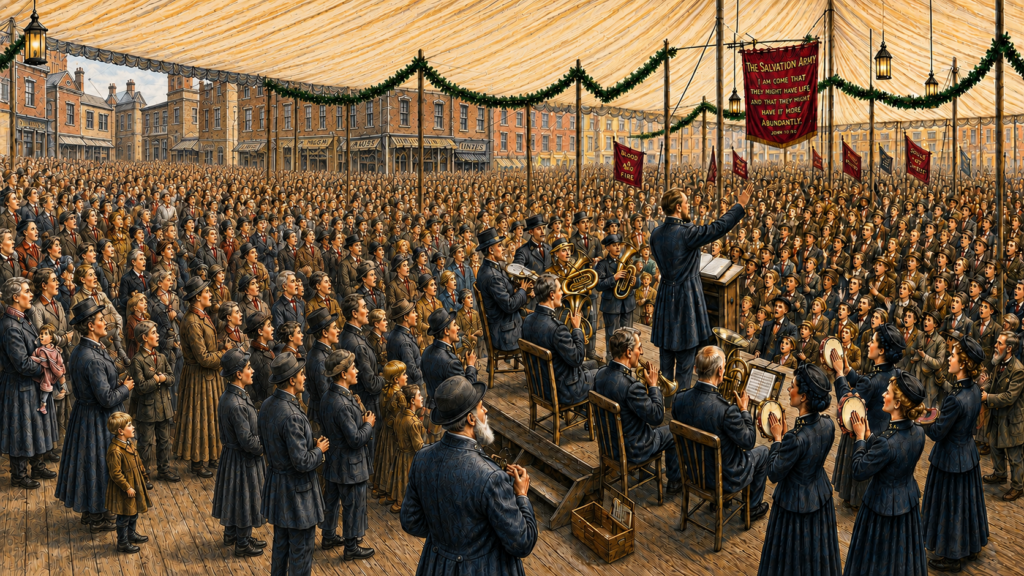

The Salvation Army may seem like an unusual place to begin, however, in its early years it was a leading mover and shaker, bringing about much change, not just in music, but in other significant areas of church practice. To better understand our current practices in church, especially the use of music, it is helpful to consider how we got to where we are today. In the 1800s, with the rise of gospel music, evangelists in various denominations were making effective use of music in their ministry. Dwight L. Moodyand his song leader, Ira D. Sankey, combined preaching and music to attract crowds numbering 10,000. Reports estimated a total of 900,000 visitors in a single evangelistic campaign alone in Philadelphia.1
During the Victorian era, there was a clear distinction between the secular and sacred. That all began to change with William and Catherine Booth, founders of the Salvation Army. According to Dr Pamela J. Walker, professor of history at Carleton University in Canada, the significant contribution of the Salvation Army to the changing religious and social culture of Victorian Britain is seldom appreciated.2 (pp xiii-1) It began as the East London Christian Mission in 1865 and adopted the name, Salvation Army, in 1878. William and Catherine were partners in the early evangelistic work of the church. They were serious about their Christianity, which influenced every aspect of their lives. Mrs Booth contributed significantly, both intellectually and practically, to the organisation. One of her most significant contributions was the unusual importance given to women in the organisation due to her influence. Pamela Walker said of Mrs Booth that “She exemplified a new model of Christian womanhood, articulating a new approach to female ministry and creating an influential career as an evangelist.”2 (p7) She built on her Wesleyan experience, which encouraged women to sing and pray, share their testimony and lead Bible classes.2 (p8)
William Booth, later known as General Booth, was also a prominent preacher, and like other revivalists of his time, made much use of music in his ministry. The Salvation Army we have today, which is largely charity based and with a somewhat conventional worship style by today’s standards, is not what it was in the early years. According to Pamela Walker:
“The tambourines, music-hall tunes, uniformed preachers and ecstatic services of the Salvation Army caused a sensation among believers and nonbelievers alike.”2 (p7)
The words of the music hall songs were sinful, but the popular tunes were easy to sing to, so General Booth played the same tunes and replaced the secular lyrics with sacred words.2 He was in favour of any style of music, as long as it sounded good. It was simply a means to an end. He felt that music, ranging from revivalist hymns to tavern-room ballads, in and of itself had no moral force. The General believed that the spiritual power of the associated text, regardless of the tunes chosen, made all the difference. He is quoted to have said: “You must sing good tunes. Let it be a good tune to begin with. I don’t care much whether you call it secular or sacred.”3 General Booth is also known to have said, “Why should the devil have all the best tunes?”4
Likewise, Christian rock music, later known as contemporary Christian music (CCM), which came into existence during the Jesus Movement of the late ‘60s and early ‘70s, has been regarded by church leaders as an effective means of capturing people’s attention, especially young people. In fact, Mark Powell, theology professor at Trinity Lutheran Seminary, in his book Encyclopaedia of Contemporary Christian Music, even goes as far as to say:
“…rock and roll, and by that I mean the whole enterprise, not just Christian rock, has done a lot more for the good of humanity in the last thirty-plus years than all the theologians on the planet.”5 (p7)
Opposition to the Salvation Army Method
Not surprisingly, many prominent Christians prior to the 19th century were opposed to this attitude to music. What would Martin Luther think of General Booth’s method and, further still, a professor of Trinity Lutheran Seminary praising the influence of rock music? Luther is another mighty Christian figurehead notably attributed with saying, “Why should the devil have all the good tunes?” However, according to Worship Leader Magazine and numerous scholarly sources, there is little evidence that Luther actually posed this question – it is a misconception of Luther.6 In fact, speaking of young people, Luther said in his own words that he endeavoured “to wean them away from love ballads and carnal songs and to teach them something of value in their place.”7 (p316) Jonathan Knight of Cedarville University, in his scholarly paper, Martin Luther’s Influence on Congregational Singing, states:
“Luther is often either accused of (or venerated for) borrowing extensively from secular music (bar songs) for his hymns. In reality, while Luther employed secular song forms in his hymn texts and musical idioms in his melodies, he did not simply re-write secular songs as hymns.”
Knight concludes from his research that:
“While Luther’s contemporaries, such as Hans Sachs, drew directly from secular music for melodic as well as textual material, Luther did not make this his practice, but rather made careful and creative use of many musical sources, which were mainly religious in origin.”8 (p40)
Luther recognised power in music to influence the heart toward either good or evil:
“For whether you wish to comfort the sad, to terrify the happy, to encourage the despairing, to humble the proud, to calm the passionate, or to appease those full of hate – and who could number all these masters of the human heart, namely, the emotions, inclinations, and affections that impel men to evil or good? – what more effective means than music could you find?”7 (p323)
Unlike General Booth, therefore, Luther recognised moral force in music. Many Christians since Luther’s time have also been concerned about the influence of secular music.
Emerging at the time of the Salvation Army was another radical and controversial movement – the Seventh-day Adventist Church. It arose out of the Advent movement and was officially established in Battle Creek, Michigan, in 1863. Prominent founders of the Seventh-day Adventist Church include Joseph Bates, James and Ellen White and John Andrews. This denomination provides a fascinating contrast for comparison with the Salvation Army. Like the Army, it departed from mainstream Christianity in some fundamental areas of practice, but the contention was centred mainly on doctrine rather than style of worship and evangelism. Thus, the Seventh-day Adventist Church was also viewed with suspicion and scepticism for its controversial practices but for very different reasons to the Salvation Army. It grew out of the Millerite movement, promoting the soon coming of Jesus, and abandoned several widely held Christian traditions, including Sunday keeping, and sought a fresh understanding of Scripture through earnest Bible study.
Like General Booth, James and Ellen White were also convinced of the power of music in their gospel ministry and were prepared to use it.9 (pp31-32) However, along with mainline denominations, the founders of the Seventh-day Adventist Church were critical of the Salvation Army methods. In fact, Mrs White was often strongly opposed to their practices and was quite outspoken on this topic.
Despite this, Mrs Booth and Mrs White shared similar backgrounds. They were born within two years of each other and were raised in the Methodist tradition. Both had extended periods of illness or injury in childhood. They both had limited formal education and both came from relatively humble working-class backgrounds. They also both had strong religious convictions from an early age.2,10,11 In adulthood, these two women continued to share much in common. Like Mrs Booth’s influence in the Salvation Army, Mrs White had much influence on the foundation and direction of the Seventh-day Adventist Church. Both were avid writers and preachers. They both promoted temperance.10,11
Also, like Mrs Booth, Mrs White was an advocate for women in gospel ministry and supported fair financial remuneration for their labour in the gospel work. However, the emphasis and prominence of their positions on the roles of women in church and society were quite different. While Mrs White encouraged women’s participation in personal ministry, Bible study and teaching, Mrs Booth was much more aggressive in her advocacy of women’s rights. She strongly encouraged women to preach and pushed for women to have equal roles to men in all areas of ministry and work. In her writings and other public discourse, Mrs Booth challenged church leaders of mainline denominations who held to traditional roles of men and women. She was remarkably successful at bringing about equal opportunities for women in the Salvation Army. Mrs White, on the other hand, though supportive of female participation in gospel work, also encouraged many of the traditional roles of women, including homemaking, and distanced herself from women’s rights movements. Her advocacy of women in ministry, though important, did not dominate her life and ministry as it did with Mrs Booth.
Another area of contention in the Seventh-day Adventist Church which persists today is their claim to the prophetic gift. Mrs White professed to have had divinely inspired visions – and many of them – which resulted in a vast number of books which Seventh-day Adventists refer to as the Spirit of Prophecy. Some of these writings concerned music and style of worship. For example, in 1900, she wrote:
“Better never have the worship of God blended with music than to use musical instruments to do the work which last January was represented to me would be brought into our camp meetings.”12 (p36)
She was addressing concerns over an influential Pentecostal-style movement which swept into the Seventh-day Adventist denomination in 1900. Mrs White’s opposition to the Salvation Army style of worship used at this camp meeting helped to bring an end to Pentecostal influences in the Seventh-day Adventist Church. However, most Christians outside of Adventism, and even some from within, doubt the credibility of her visions. What type of music was she referring to and are her claims in harmony with the Bible? Was she right or was she misguided or even deceptive about the source of her visions or inspiration in general? A quick Google search will reveal just how much of a contentious figure she continues to be, even to this day, with many Seventh-day Adventists defending her writings, while many Christians, especially former members, oppose her.
Despite this, the opposition to the Seventh-day Adventist Church and its prophet has probably never been quite as fierce as the hostility to the Salvation Army and its eccentric leader, General Booth, in its early days. However, there was general acknowledgement of the need to reach the poorer classes as the Salvation Army was doing. Until the arrival of the Jesus Movement in the 1960s, there remained a clear divide between the sacred and the secular13 but the Salvation Army was blurring this divide, which attracted criticism from much of the rest of Christianity. For Christians today, it is hard to understand what all the fuss was about. The use of secular entertainment methods to retain the youth and attract new converts is common practice in the wider Christian community today. But in the 19th century, it was not so. Bringing secular music and theatrics into the church was widely considered sacrilegious.
Opposition surrounding the Salvation Army went both ways. The Booths were often highly critical of mainline Protestant denominations and their methods. Even Adventists (who awaited the second coming), General Booth opposed with the following statement:
“The Pharisees of that day wanted a Christ Oh, yes! But he must be a reigning Christ. And now there are thousands talking about His second coming who will neither see nor receive Him in the person of His humble and persecuted followers. Christ manifested in flesh, vulgar flesh, they cannot receive. No, they are looking for Him in the clouds. What a sensation there would be if He were to come again in a carpenter’s coat. How many would recognise Him then, I wonder? I am afraid it would be the old story, ‘Crucify Him!’ ‘Away with Him!’ ‘Whoever denieth that Jesus is come (not did come) in the flesh is anti-Christ.’”14 (ch16)
Despite the backlash, the Salvation Army method proved to be a success in the first few decades, especially in spreading its message to working-class women and men who would rarely be found in traditional churches or chapels. Music, in particular, became Booth’s best help in the growth of his movement.3 Regardless, in the early years, opposition to the Salvation Army method was relentless, both in Christian and secular publications. Even the communities they were trying to reach and help often ridiculed the Army’s unconventional ecstatic worship. John Read describes the opposition as follows:
“The Army aroused opposition from clergymen, magistrates, politicians, and publicans. A ‘Skeleton Army’ was raised with serious and violent intent. Salvationists were jailed for proclaiming their faith in public. There were riots and questions in parliament. The Army featured in daily newspapers and weekly journals, and was the butt of satirical humor.”15 (p23)
The frontline members of the Army are to be commended for their tenacity in spreading the gospel amongst such fierce ridicule.
The opposition from other church denominations was not so much against the work the Salvation Army was doing for the poor but against their worship and evangelistic methods. There was widespread acknowledgement that social reform was required at the time to help improve the situation for the poorer classes. Mrs White, for example, encouraged church members to minister to the poor:
“The world is in need of workers who will labor as Christ did for the suffering and the sinful. There is indeed a multitude to be reached. The world is full of sickness, suffering, distress, and sin. It is full of those who need to be ministered unto – the weak, the helpless, the ignorant, the degraded.”16 (p254)
Before the existence of the Salvation Army, other Christian denominations were already doing a work amongst the poorer classes but with limited success. The Salvation Army played a significant role in reaching the labouring classes and helping to improve their situation. Salvationists petitioned the government for legislation of prostitution laws.17 They addressed domestic violence and marital relations2 and they encouraged men to quit drinking and put aside the money to support their families.
The opposition to the Salvation Army did not lie with their welfare work. Rather, the opposition from many at the time was against the Salvation Army methods, particularly the ecstatic worship. Charitable work, while it is a requirement of God, does not make an individual or an organisation methodologically or theologically correct. Even secular organisations often do noble work to help the poor. Many believed the Salvation Army method was wrong, despite the good they were doing for the poor. Below are examples of the grievances that individuals from various church denominations and secular organisations were expressing over the Salvation Army method:
Canon Farrar characterised some of the language of the Salvation Army as “grotesque and irreverent phraseology, calculated quite needlessly to disgust and to repel… The banners and placards, the effusive familiarity and colloquial language of the Salvationists were not to be excused by the pretext that they are necessary… It is not a question of more noise at all… We are speaking of … words and parodies and songs which are beyond question irreverent and profane.”18
Frances Power Cobbe, a prominent author, activist and women’s suffrage campaigner at the time, believed that “the part played by the Salvation Army in bringing the holiest things into the general carnival of equality and jocosity, is by no means trifling or innocuous.”19 (p188)
Thomas Huxley, English biologist, evolutionist and agnostic, regularly wrote against General Booth in newspapers and letters. In one particular correspondence, he wrote, “William Booth is a brazen-faced charlatan, a Pious Rogue, a tub-thumper and a masquerading hypocrite. He is sensual, dishonest, sanctimonious and a hypocritical scoundrel.”20 (40:42)
A correspondent for The Evening News, published in Sydney in 1884, describes a Salvation Army procession in a suburb of Adelaide, Australia, as “A monster demonstration… characterised by disgraceful blasphemy and buffoonery. The procession was headed by a brass band, and about 30 coryphées dancing and playing tambourines.” The newspaper describes how ‘Captain’ Gore, dressed in a red tunic, rode ahead of the procession mounted on a donkey in imitation of Christ’s entry into Jerusalem. The donkey would not cooperate, which attracted the ridicule and amusement of a gathering crowd numbering over 1000 people. He described the procession as being “of a disgusting character” at times, proceeding “amid the chants and hallelujahs of the soldiers” and “cries of ‘Amen’ and ‘Praise the Lord.’”21
A newspaper report in the Newcastle Morning Herald and Miners’ Advocate stated, “The climax was reached about 7 p.m., whilst the Salvation ‘Armyists’ were making their customary march down Hunter-street… Their musicians, as usual, poured forth incessant brain-distracting, bedlam-filling, blasts of discord…”22
M.A. Lewis, a frequent contributor to Macmillan’s Magazine, describes a typical Salvation Army service: “[The service] commences with a hymn sung standing, at a pace that would frighten a good old Wesleyan or Baptist out of his senses, and there is a roaring chorus, which is repeated over and over again with the greatest enthusiasm.”23 (p406)
Charles Waller in his 1882 pamphlet, The Salvation Army: How Should the Thoughtful Christian Judge This Movement, asserted that in the Army: “sensationalism is too prominent… there is something coarse and irreverent in the appeals to the senses made by the Salvation Army. What devotion, it is asked, can be stirred by the confused noise of brass instruments, drums and tambourines?”24 (p213)
Councillor Bannister of the Geelong West Borough Council raised the matter of Salvation Army disturbances in the community: “For several Sundays lately hideous noises were created by a band of religionists. The sounds were a nuisance, and the Sabbath was desecrated.”25
Benjamin Newton commented: “Surely no one will affirm that there is anything ‘venerable’ or of ‘good report’ in the screams, dancing and gesticulations that characterize the meetings of this body… To please and excite the flesh by stimulating its propensities and gratifying the cravings of the eye and ear, may and does, prepare the way for Satan.”26 (p213)
In 1894, in a Seventh-day Adventist publication, The Signs of the Times, Mrs White wrote: “Among the Salvation Army workers such methods as these have been employed; but it is more necessary that they should study and preach the word than act in a sensational way in order to draw the attention of the people.”27
How do we respond to these criticisms? Were they justified? Was General Booth and his Army wrong in their method of worship? Or were their detractors wrong in their opposition? This book will compare the views and practices of Mrs White and other Seventh-day Adventist founders with those of the Booths and other prominent Christians. The official statement of the Seventh-day Adventist Church is that “the Bible is the standard by which all teaching and experience must be tested.”28 Yet, the Salvation Army also holds to the Bible as its creed. There is much instruction in the Bible regarding worship and music, yet there is inconsistency in its interpretation. How can this be so when the Spirit of Truth was sent to guide believers into all truth (Jn 16:13)?
We cannot place our confidence in human wisdom, but we can trust in God’s Word. The Scriptures testify that one of the gifts of the Holy Spirit is the prophetic gift (Joel 2:28) and Adventists teach that this gift is an identifying mark of God’s end time people (Rev 12:17; 19:10). What a great blessing it would be to have an end time prophet to keep Christians grounded in Scripture and to guide us through the tumultuous last days! One of the fundamental beliefs of the Seventh-day Adventist Church is that the gift of prophecy was manifested in the ministry of Ellen G. White.28 They believe that “her writings speak with prophetic authority and provide comfort, guidance, instruction, and correction to the church,”28 guiding readers back to Scripture.29 She had much to say about music and worship. But who was Ellen White? Out of the two billion Christians in the world, how many have even heard of Mrs White, let alone accept her as a prophet? Even amongst Adventists, a growing number question the legitimacy of her claims. Why should we listen to her or any of the other opposers of the Salvation Army method over General Booth? But then again, who was General Booth and why should we accept his advice?
As with Mrs Booth, General Booth was also born in 1829, two years after Mrs White in 1827. General Booth and Mrs White were both converted and began their ministries early in life and were very passionate in their service for God. They both came out of Methodism and were important co-founders of church denominations that still exist today, though the Seventh-day Adventist Church has grown to be much larger. Their church organisations were both very involved in public evangelism and promoting a temperate lifestyle in the 1800s. They both encouraged and practised a vegetarian diet, although General Booth was less consistent in this regard. They both died within three years of each other – General Booth in 1912 and Mrs White in 1915. However, they differed in many of their methods, including their use of music, and were both controversial figures, which makes for an intriguing discussion.
Defiance in the Face of Opposition
Salvation Army officers are to be commended for their tenacity in the face of opposition. The ridicule at times was fierce. The Salvation Army’s enforcement of a stricter way of life for its members, including abstinence from the vices of drinking, gambling and salacious entertainment, was seen as a direct attack on social convention and threatened the profits of local businesses. Hoodlums formed semi-organised gangs, under the umbrella term Skeleton Army,30 to attack the Salvation Army. Army officers were pelted with food and old shoes. Gangs attacked outdoor events and processions. Salvationists became objects of ridicule in music halls, in popular theatre and in comic magazines.2 Gangsters were often imprisoned for their actions but so were Salvation Army members for their part in attracting opposition that led to public upheaval.30 David Earnshaw tells us that:
“The Salvation Army in 1882… reported 699 officers were assaulted, 251 of those were women and 23 were children. And in that year 85 salvationists were imprisoned for being a public nuisance, 15 were women. 60 of their buildings were totally trashed and were unusable and they had their first martyr, a young girl called Susanna Beatty, was kicked to death in London.”31 (39:12)
How many Christians today take their religion so seriously that they would be willing to share the gospel in the face of such ridicule and opposition?
If worship and revivalistic methods was a point of contention for the Salvation Army, the Advent message was cause of much ridicule for the early Advent movement. Adventists believed in the prophetic interpretation of the Bible as taught by Baptist preacher, William Miller, who believed that Jesus would return in 1844. James White describes an experience as a young itinerant preacher of an angry mob surrounding a schoolhouse where he was to preach. They threatened his life if he were to preach, but as he pressed forward through the angry crowd, he stated that his trust was in God. A universalist who disagreed with James’ theology had rallied the crowd. Christian universalism had gained traction in the United States as a theological movement. It is the belief that God will ultimately save everyone, no matter which religion they follow. Adventists were opposed to universalist teachings.
As James White stood before the congregation in prayer, a snowball whistled by his head and as he began to preach, he could barely be heard over the shouting of the mob. Many snowballs began to be hurled at him through the open windows. He raised his voice above the noise of the mob, saying:
“Repent and be converted, that your sins may be blotted out, or you will drink of the wrath of God. Repent, and call on God for mercy and pardon. Turn to Christ and get ready for his coming, or in a little from this, on rocks and mountains you will call in vain. You scoff now, but you will pray then.”
This seemed to quiet the crowd. Just the previous night, a spike was thrown at James and hit him on the forehead, falling on his Bible. He had put it in his pocket. Now, as he faced this angry mob once again, he pulled the spike out of his pocket and, holding it in the air, he continued to address the congregation:
“Some poor sinner cast this spike at me last evening. God pity him. The worst wish I have for him is, that he was this moment as happy as I am. Why should I resent his insult when my Master had them driven through his hands?”
He spoke of the love of God, the sacrifice of Christ and his undying pity for vile sinners. The shouting of the mob turned to silence and the room was filled with weeping.32 (p68-70)
Though this kind of opposition was not nearly as frequent as with the Salvation Army, the ridicule against Adventists was heightened when Jesus did not return in October 22, 1844 as predicted by William Miller – an event referred to as the Great Disappointment. Despite the ridicule, many Adventists, sure of the prophetic predictions of Scripture, turned to the Bible to see where they had got it wrong.
After further study and prayer, they concluded that the dating of the prophecy was correct but that they had got the event wrong. Rather than Jesus returning and the world ending, Seventh-day Adventists concluded that the ‘cleansing of the temple’ on October 22, 1844 was a fulfilment of the day of atonement and Jesus entered the sanctuary to begin a work of investigative judgement. They compared this experience with that of the disciples who accepted Jesus as Messiah at His first advent but, believing that He was to be crowned King, got the event wrong, leading to a great disappointment upon the crucifixion of Jesus.
These Adventists also came to believe in the perpetuity of the seventh-day Sabbath. It was out of this Advent group that the Seventh-day Adventist Church was formed. While Seventh-day Adventists do not believe that a date can be set for the coming of Christ, the doctrines of the sanctuary and the Sabbath have remained and have been controversial and widely rejected and even denounced by most other Christians.
Those belonging to the early Advent movement may not have always got their interpretation of Scripture correct, but one thing is certain: they were absolutely determined to throw off any tradition if they felt Scripture contradicted it. They studied and prayed, and prayed and studied, until they came to a unanimous decision. Even if the conclusion was an unpopular one, they stuck to it. Just as Salvationists were willing to have tomatoes hurled at them because of their style of worship, Adventists were willing to be ridiculed for keeping the seventh-day Sabbath because they believed it was scriptural. For Seventh-day Adventists, more important than the style of worship was the day that we worship on. Both denominations were striving to harmonise with God in their music and practices and, despite their unconventional practices, both have something to teach us about our own practices today. The goal of this book is to decide for ourselves where the harmony lies. Was General Booth correct in his belief that music in and of itself had no moral force? And what impact has this understanding of music and worship had on Christianity today?