
Harmonising with God in Our Music and Practices
Part 6 - Intensity
Chapter 20
Chapter 20
Loud Music
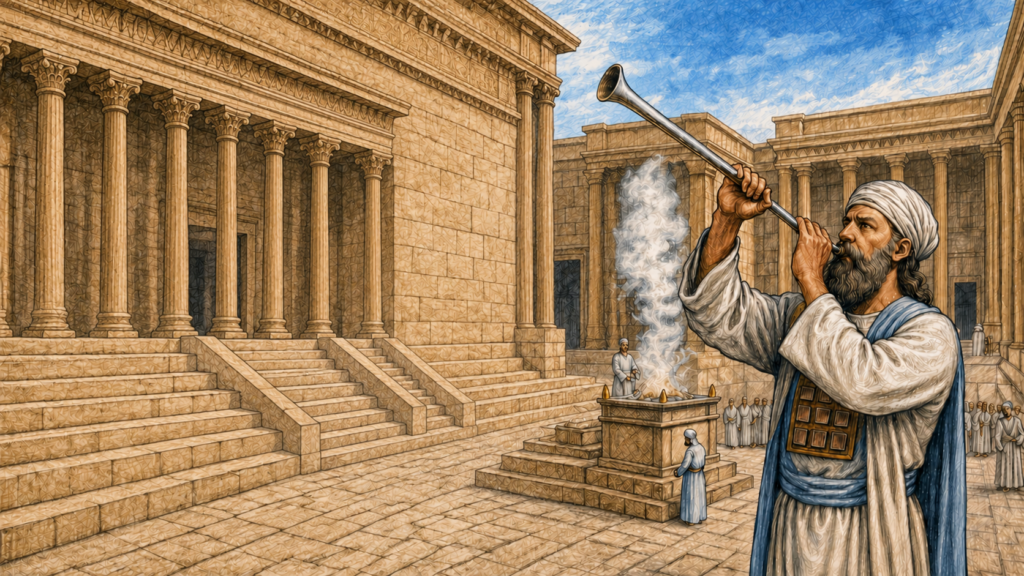
There are accounts of loud music in Old Testament religious ritual and worship, and some of the Psalms encourage shouts of praise. In the New Testament, on the other hand, there is no record of Jesus or the apostles ever using or promoting loud music, trumpets or other loud instruments, loud singing, shouting, or loud noise of any type. It is not loudness and flamboyance which is encouraged but “a gentle and quiet spirit, which is very precious in the sight of God (1 Pet 3:4).”
What is God telling us with this discrepancy between the Old and New Testaments? Absence of loud music in the New Testament record does not necessarily imply that loud worship is inappropriate, but it does demand an explanation. It compels us to reconsider the purpose and characteristic of loud music in the Old Testament. We need to find a way to harmonise the apparent conflict in practices between the old and new.
In her early ministry, Catherine wrote to William discouraging loud noise:
“Remember Caughey’s silent, soft, heavenly carriage. He did not shout, there was no necessity. He had a more potent weapon at command than noise. I never did like noise & confusion, only so far as I believed it to be the natural expression of deep anxiety, wrought by the holy ghost, such as the cries of the jailer, etc., etc. Of such noise, produced by such agency, the more the better. But, my Love, I do think noise made by the preacher & the Christians in the church is productive of evil only.”14
Despite Mrs Booth’s opinion on noise in church, the Salvation Army often used noise as one of its main attractions. As reported by one observer, compared with ordinary church services, the Salvation Army was “unmistakeably louder; the choruses undeniably longer.”2 (p97) Congregations would shout responses to the preacher.2 General Booth encouraged members to literally shout out in their meetings, in the streets and in their processions. They were to shout of the danger of judgement and shout of salvation for everyone who chooses it.369 (p12-3) A hymn published in The War Cry, the Salvation Army newspaper, promoted the virtue of noise and shouting:
“Some say I am too noisy,
I know the reason why,
And if they felt the glory,
They’d shout as well as I” 370 (p421)
As with Mrs Booth, Mrs White discouraged shouting and loud singing. She stated that: “It is not loud singing that is needed, but clear intonation, correct pronunciation, and distinct utterance.”196 (p143-4) She says that she was shown by the Lord that, just before the close of probation, “Every uncouth thing will be demonstrated. There will be shouting, with drums, music, and dancing.”12 (p36)Rather than shouting and loud music and singing, she encouraged soft and subdued singing:
“Some think that the louder they sing the more music they make; but noise is not music. Good singing is like the music of the birds – subdued and melodious.” The angels, she said, “delight to hear the simple songs of praise sung in a natural tone. The songs in which every word is uttered clearly, in a musical tone, are the songs that they join us in singing.”168 (p510)
She does not appear to completely discourage loud music, but it is not to be routine practice in worship. Perhaps there might be circumstances when loud praise is appropriate. For example, the second coming of Jesus is depicted as a loud event “with a shout, with the voice of an archangel, and with the trumpet of God (1 Thes 4:16).” One of the primary reasons people listen to loud music, despite extensive education about its harm to hearing, is because of the excitement it produces.371 In general, according to Mrs White, we are not to use music to create excitement, as outlined in an earlier chapter.
There are occasions when David and the Israelites sang and praised loudly – especially during joyous national celebrations. Some of the Psalms use imagery of this type of worship. Does that mean church worship should be loud? To answer that question, as with any question concerning the Bible, we must consider Scripture as a whole. For example, David sang about going into the house of God to make a burnt offering (Ps 66:13-15). When we read this psalm, we do not feel impressed to sacrifice an animal on an altar in church. This Psalm does not have to be taken literally to get anything from it, but we apply it to our lives figuratively because sacrificing animals is inappropriate for our time. The reason we do not apply it literally is because, after Jesus’ death and resurrection, we no longer sacrifice animals. Instead, we present our own “bodies a living sacrifice, holy, acceptable to God (Rom 12:1).” If we are to harmonise the Psalms with Jesus and the apostle’s ministry, the Psalms often have to be applied as metaphor. While we should not always turn to metaphor or allegory to explain Scripture, it is something we often do when appropriate.
The first experience Israel had in the very presence of God was very loud. There were “thunderings and lightnings, and a thick cloud on the mountain; and the sound of the trumpet was very loud, so that all the people who were in the camp trembled (Ex 19:16).” The Lord spoke to Moses, saying:
“…let them make Me a sanctuary, that I may dwell among them. According to all that I show you, that is, the pattern of the tabernacle and the pattern of all its furnishings, just so you shall make it.” (Ex 25:8-9)
As soon as the Tabernacle was erected “the glory of the Lord filled the tabernacle (Ex 40:34)” and God spoke “from above the mercy seat, from between the two cherubim which are on the ark of the Testimony (Ex 25:22).”
God also outlined the ordinances of the Tabernacle, which were given in great detail because it represented the saving work of Christ. Once the temple and the ordinances were set in place, God gave instruction for the use of trumpets in the Tabernacle which became permanently tied to the ordinance services (Num 10:1-10). In time, the Lord also instructed other instruments to be used in conjunction with the prescribed uses of the trumpet in the sanctuary services – the added instruments were cymbals, stringed instruments and harps (2 Chr 29:25). These instruments appear to have had a similar function to the trumpets in the sanctuary. Eventually, shouting and loud voice also became synonymous with the trumpet sound (Ps 47:5). Therefore, the trumpet blowing, loud clashing cymbals and shouting depicted in the Psalms, stems back to God’s original command in Numbers 10 concerning the trumpets. The earthly sanctuary was a copy of the heavenly sanctuary (Heb 8:1-5) and the heavenly sanctuary is also depicted, at least symbolically, with loud trumpet sounds (Rev 4:1) and loud voices (Rev 5:2,12).
What do we make of all this? God assigns trumpets, a loud instrument, for a very specific purpose in the temple. Later, He adds cymbals, stringed instruments and harps to be played with the trumpet in the temple. When we step back and look at the Bible as a whole, there emerges a very clear pattern of use of music. It is only in the temple periods that we hear of loud music. The Psalms and Revelation are full of temple imagery and, therefore, these books also included references to the use of trumpets, loud music and shouting. Loud music is essentially absent from all other Biblical periods, including pre-fall, pre-flood and patriarchal periods, the period of Egyptian exile, the gospels and the apostolic age. In fact, these periods have relatively few references to music at all.
The temple and all of its observances had practical purpose – such as providing rules for health and hygiene. More importantly the ordinances and ceremonies symbolically pointed to Christ. Therefore, we need to consider the practical and the symbolic purposes of loud music in the temple.
The trumpet was assigned by God to be blown over sacrificial offerings in the temple during joyous and memorable occasions (Num 10:10; Lev 23:23-25). This allowed everyone to hear when a special sacrifice was occurring. As discussed previously, ‘voice’ and ‘trumpet’ sound are often used interchangeably. God made the trumpet sound a symbol of the proclamation of His Word, especially relating to salvation, including warning (Ez 33:1-9). When Jesus, the Word of life, became the sacrificial lamb, it was to be trumpeted to the world. The early church did a wonderful job of proclaiming Jesus’ death and resurrection to the Jewish and pagan worlds. The literal shouting, trumpet blowing and clanging of cymbals over sacrifices and feasts in the temple ended when it was fulfilled in Jesus’ sacrifice.
At the dedication of Solomon’s temple, 120 priests sounded the trumpets, along with singers and musicians playing cymbals, stringed instruments and harps. It was a very loud event! Can you imagine being in the presence of 120 trumpets being blown in unison? It must have been a breathtaking experience! Everyone in Jerusalem and beyond within a radius of up to 2 kilometres or more would have been able to hear it.
When the real sacrifice was made and when the real temple, Jesus, was raised up on the third day (Jn 2:19), it was a much more momentous occasion even than the dedication of Solomon’s temple. The Son of God was alive! Everything was fulfilled! So, where was the noise? Mary Magdalene, Joanna, Mary the mother of James & the other women with them (Lk 24:10) were the first to blow the trumpets. Before long, the disciples were proclaiming the risen Lord. At Pentecost, the Holy Spirit came upon the believers and they were given the gift of speaking in other languages (Acts 2:1-4) so that they could proclaim the gospel to people from all nations and tongues (v5-12). This was the fulfillment of the Jewish Feast of Weeks or Feast of Firstfruits (Ex 34:22; Num 28:26).
The apostles and new converts were given many other gifts of the Spirit, including prophesying, ministering, teaching and other miraculous powers (Rom 12:6–8; 1 Cor 12:4–11). This gave them the ability to preach the Word with great power and authority. Curiously, music was not one of the spiritual gifts. The focus was on preaching (1 Cor 14:1), symbolised by the blowing of the trumpet in the sanctuary. The gospel was spread throughout the land and to the ends of the then known world. This was the loud shouting, the trumpet blasts and the clanging of cymbals. God commanded the Israelites to build a temple, sacrifice animals and celebrate feast days with the sounding of loud instruments. God appointed the Christian church to be the temple, to offer ourselves as living sacrifices and to celebrate Jesus’ sacrifice by preaching the Word and making disciples of all nations.
Like in the sanctuary observances, the Salvation Army literally made loud noise but it also fulfilled the symbolism of the temple ordinances by enthusiastically teaching, preaching and living the gospel message. Unfortunately, today, many Christians are making loud music in church while neglecting to fulfil the symbolic meaning of loud music by enthusiastically and energetically sharing the gospel with the community. We are to be the instrument. We are to be the loud noise. One of the challenges the Salvation Army faced was the scarcity of suitable people for carrying the work.57 Jesus said, “The harvest truly is plentiful, but the laborers are few (Matt 9:37).”
Just like the Israelites, we are to be a witness to others by observing God’s commands:
“Surely I have taught you statutes and judgments, just as the Lord my God commanded me, that you should act according to them in the land which you go to possess. Therefore be careful to observe them; for this is your wisdom and your understanding in the sight of the peoples who will hear all these statutes, and say, ‘Surely this great nation is a wise and understanding people.’” (Deut 4:5-6)
Unfortunately, Israel became renowned for its music, but it failed, on the whole, to lead other nations to a knowledge of God by its example. Likewise, by our neglect to follow God’s commands, we have failed to lead society to a knowledge of God; therefore, the world has become increasingly wicked.
The Feast of Trumpets was to serve as a spiritual wake-up call and a time for repentance. The Jews celebrated the Feast of Trumpets in September, prior to the Day of Atonement, after a long interval without festivals during the summer months. The Feast of Trumpets announced the soon coming Day of Atonement.372 Seventh-day Adventists believe the Day of Atonement was fulfilled in 1844. The Millerite Movement sounded a message proclaiming the soon coming of Jesus Christ. This was the midnight cry (Matt 25:6), the first angel’s message (Rev 14:6-7) according to Joseph Bates,239 and was the fulfilment of the Feast of Trumpets.373 It was a message that awoke Christians out of their slumber like no other movement since the time of the apostolic church. Up to half-a-million people joined the Millerite movement out of numerous denominations.
One of the frequent and valid criticisms of the Millerite and early Advent movement was their date setting for the second coming. Speaking of the second coming, Jesus said “But of that day and hour no one knows, not even the angels of heaven, but My Father only (Matt 24:36).” Despite this, in January 1843, William Miller announced that Jesus would return between March 21, 1843 and March 21, 1844.
As time drew near to the anticipated time for Jesus’ second coming, especially as the Millerites became more set in their date-setting, the movement became more controversial amongst the Protestant churches with which the Millerites belonged. Charles Fitch, a well-known Second Great Awakening revivalist who preached with Charles Finney, became convicted of William Miller’s teachings and joined the Millerite movement. In a fiery sermon in July 1843, Charles Fitch called for church members to ‘Come Out of Babylon.’ Those who opposed the teaching of the imminent return of Christ, he declared to be Antichrist. Though William Miller and other Millerite leaders never fully accepted Fitch’s message, it intensified the conflict and their churches became less willing to tolerate them. Congregations began to ban Millerite services. Millerites who refused to keep quiet were expelled from their churches, and ministers who preached the Second Advent were often de-frocked. When Jesus did not return by March 21, 1844, the Millerites re-calculated the date of the second advent to be October 22, 1844. After Jesus failed to return on this date, most Adventists gave up date setting, including William Miller.374,375
Though Seventh-day Adventists have always taught against date-setting for the second coming, many of the founders did come out of the Millerite movement, which was involved in date-setting. Not only that, some early Adventists after the 1844 disappointment promoted a shut door doctrine which taught that probation for the world had ended after October 22, 1844, based on the parable of the wise and foolish virgins (Matt 25:1-13). Ellen Harmon (later Mrs White) proclaimed her first vision in December 1844 when she was just 17 years old. Influenced by her Millerite experience and the shut door ideas, apparently, she initially misinterpreted the meaning of the vision as supporting the shut door belief.376
Though she later admitted her error, understandably, Mrs White has received much ridicule over this experience. In isolation, it does appear to discredit her. However, Mrs White maintained that she was never instructed in vision that the door of salvation was already shut for the world.376 Visions are not always interpreted for prophets. Daniel failed to understand visions given to him (Dan 8:27; Dan 12:9). The prophet Nathan misinterpreted the will of God when he told David to go ahead and build the temple (2 Sam 7; 1 Chr 22:8). Prophets are not infallible and should be assessed, not on flawlessness, but on the harmony of their teachings with Scripture – especially the teachings they claim to receive directly from God. If they are not shown by direct inspiration, they can misinterpret Scripture as with any genuine believer.
Like the early church, the Adventists truly believed in the second coming and were willing to sell their possessions as proof. But, just as the disciples misunderstood the purpose of Jesus’ first coming, the Millerites misunderstood the purpose of the Day of Atonement and the meaning of the term ‘cleansing of the sanctuary’. They thought that the cleansing of the sanctuary referred to Jesus’ second coming. Their anticipation of the second coming was a very wonderful experience, but when Jesus failed to return in 1844, it was a great disappointment. Adventists see this experience as fulfilment of John’s experience in vision of eating the little book which was sweet in the mouth but bitter in the stomach (Rev 10:9-10). Then God’s end time people were commanded to continue prophesying about many peoples, nations, tongues and kings (v11). Seventh-day Adventists believe that the three angels’ message is to be proclaimed loud and clear for all the world to hear to prepare the world for Jesus’ second coming.
The Definition of Loudness
It was a relatively short time after General Booth and Mrs White’s time that amplification was invented, coinciding with the birth of rock music in the 1950s. The Charismatic movement soon emerged in the early 1960s, which promoted loud and exciting worship style with an emphasis on emotional worship experience. Subsequently, religious revivals have also often tended to be driven by emotion unlike the revivals of the early 17th century which were characterised by deep conviction brought about by the searching of Scripture and investigation of the prophecies. Amplification of music allowed worship to become even louder than it had previously been.
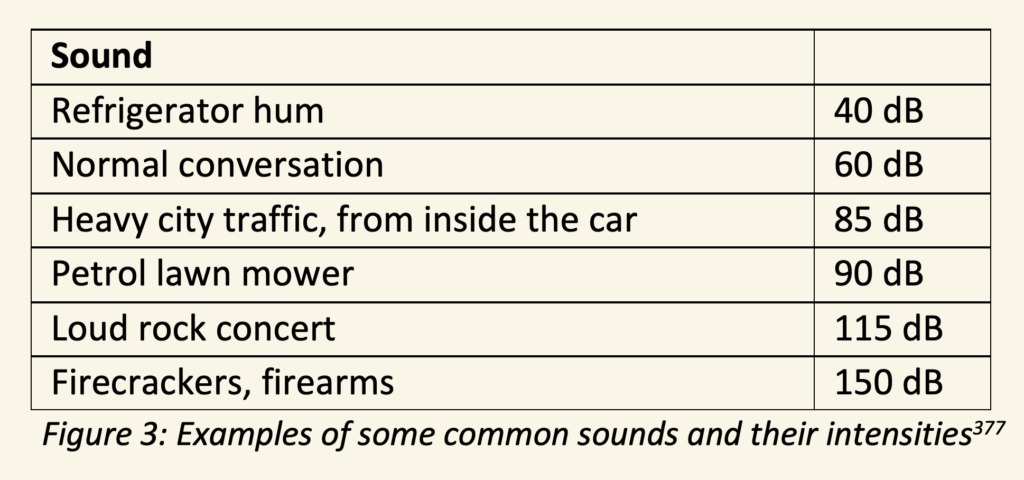
The human ear can detect a very wide range of intensity of sound, from very quiet to very loud. The decibel (dB) is a logarithmic scale used to express a very wide range of sound intensities using simple number measurements. Compared to 1 dB, 10 dB is 10 times more intense and 20 dB is 100 times more intense.377 Sound levels of 85 dB or greater can cause hearing damage but it depends on the duration of the exposure. See Figure 3 for some common sounds and their intensities.
The loudness of a modern-day trumpet can range between 80 to 120 dB.378,379 The loudness of a violin ranges from 82-92 dB.380 A standard drum set makes noise ranging between 90-130 dB. The impact of loud sounds on hearing depends on three main factors: sound intensity (volume), duration of exposure and distance from the sound source.377
Even when it comes to loudness, the situation was vastly different in the Hebrew temple than in a modern-day church setting. Temple worship was of a much grander scale compared to even the largest megachurch. One temple served the whole nation and, since they did not have speaker systems, the sound had to be loud enough to project from the musicians over a long distance to reach the people. The sound would have only been perceived as loud for the relative few who were up close. The rate of reduction of sound is approximately 6 dB for every doubling of the distance. If the sound of a trumpet is 110 dB 1m in front of the trumpet, it will only be 80 dB at 32m (equivalent intensity to a piano) and 62 dB at 256m (equivalent intensity to a normal human voice).380
Generally, temple music was likely played in the open air, which results in a lower volume than music played indoors with hard reflective surfaces.381 The high-frequency sounds that a trumpet makes are very directional;378,379 therefore, the sound of a trumpet is significantly louder directly in front of the trumpet than at the point of the trumpet player’s ears. If a trumpet is directed upward to project the sound out into the surrounding community, the noise level for those in close proximity would be reduced. Considering all of these factors, even if multiple trumpets were played at once, for the majority of the people, the sound would not be excessively loud.
Compare that with modern settings which are often indoors, with a relatively small crowd and with amplified sound systems – every individual present can easily be subjected to high decibel sounds. Indoor rock concerts can exceed 120 dB, reaching the pain threshold. The average contemporary church service playing modern worship music can range from 92 to 100 dB.382,383 According to the National Institute for Occupational Safety and Health (NIOSH) guidelines, permanent hearing damage can be caused by less than 2 cumulative hours of 92 dB sound or greater than 15 minutes of 100 dB sound in a 24-hour period.384
The Intensity of Loud Temple Music
People enjoy loud music because it arouses increased feelings of excitement.371 Referring to scientific studies, Barry Blesser describes how an altered state of consciousness is not only produced by drugs, tobacco and alcohol:
“A stimulus that changes our internal state need not be an illegal substance,” he says, “pleasurable responses to music correlate with activity in those brain regions implicated with reward and emotion. Raising the loudness of music, like a double shot of whisky, elevates the intensity of the experience.”
Research has found that the sacculus, a structure found in the inner ear, has direct connections to pleasure centres in the brain. Studies by Dr Neil Todd have found that the sacculus causes release of endorphins when stimulated by loud music, especially bass sounds, above 90 decibels. That is an important reason why people find, for example, loud drum sounds pleasurable. Unfortunately, sounds above 90 decibels also start to cause significant harm to hearing and potentially to other areas of our health, as will be discussed later. “The range of intensity between pleasure and damage is extremely small,” Blesser explains.385 (p4-5)
One of the fruits of the Spirit is self-control (Gal 5:23). Emotional self-control is a key aspect of emotional intelligence. At times, King David allowed his emotions to take over. For example, when transporting the Ark of the Covenant to Jerusalem the first time without consulting Scripture, emotion took precedence over obedience to Scripture. When he saw Bathsheba bathing and lusted after her (2 Sam 11:2-4) and when he ordered Uriah the Hittite to be sent to the front line (2 Sam 11:15), he was allowing his emotions to guide His decision making rather than obedience to God. On each of these occasions, it ended in disaster.
At other times, David exhibited great self-control and emotional intelligence. For example, when facing Goliath, rather than letting fear control him, he came in faith “in the name of the Lord of hosts, the God of the armies of Israel (1 Sam 17:45).” Also, while being pursued by Saul, David twice had opportunities to kill him, but he chose to spare his life because Saul was ‘the anointed of the Lord (1 Sam 24:6, 26:11).’ These are examples of great control over emotions, which is what made David a great soldier and conqueror. There is nothing wrong with emotions, but emotional intelligence gives us the ability to control our emotions and direct our energy into healthy and constructive activities, rather than allowing our emotions to control us.
Our emotions should be used to energise us for doing God’s will, but we can only know God’s will by deep searching of Scripture and by earnestly sharing it with others. While shouting and beating out loud music might stir us and make us feel good and even energise us, it does not provide sustained energy or prove our allegiance to God or guarantee we will use the energy for good causes. God desires that we truly seek after him with all our hearts so that we can know Him:
“For I desire mercy and not sacrifice, and the knowledge of God more than burnt offerings.” (Hos 6:6)
When the Jews were living in unfaithfulness, God asked the Israelites to take away the ‘noise’ of their songs and replace it with righteousness (Amos 5:23-24). There was nothing wrong with their method of music but the condition of their hearts – they were living lives unfaithful to God’s command. God prioritises the heart’s condition over musical expression.
The irony is, if God truly has counselled against loud singing, as suggested by Mrs White – instead, desiring our singing to be cheerful, yet solemn melodies; modulated and softened, like the music of the birds, subdued and melodious – by the very method of worship, if it is regularly loud and boisterous, we are disobeying Him. What He desires is that we diligently strive to know Him and to do His will rather than seeking an emotional experience. Rather than seeking after happiness, the Bible encourages us to “seek first the kingdom of God and His righteousness (Matt 6:33).” When we seek righteousness, then happiness and joy come automatically (Jn 15:9-11).
But isn’t sincerity enough? you might ask. Though David and the Israelites worshipped enthusiastically as they carried the Ark of the Covenant to Jerusalem, Uzzah died due to disobedience. Their disobedience was not deliberate, but they failed to diligently seek God’s rules for transportation of the Ark. Ignorance is no excuse if we have not bothered to put the effort in to studying the words of His prophets. Our worship is not sincere if we have not made His will priority. Loudness does not make up for slackness.
As noted previously, the sound of ancient Israel has been lost to antiquity.33 It is unhelpful to make value judgements on the performance of ancient Israelite music based on modern Western musical tradition.34 The purpose and definition of ‘loud’ to ancient Israel may have been very different to our time and setting. Barry Blesser proposes that the motive and objective of loud music varies among individuals and cultures.385 The primary purposes of loud music in many modern settings includes the creation of excitement and social cohesion, conveying a feeling of freedom and expression of cool persona.371,385 However, when God first established rules for music in the temple, its primary purpose was to communicate messages – to assemble people, command war and signal religious ritual and festive events (Num 10:1-10).
If you visited a village in one of the provinces of Cambodia, you would not be there long before you would hear the sound of festival music screeching out from one corner of the village and filling the whole community with its melody. Up close to the source of the music, even the locals might find the noise to be screechy and uncomfortably loud – but it achieves one of its primary objectives of calling the village to attention and letting them know that a ceremony is taking place and the type of ceremony – whether it be a wedding, funeral or other celebration. Buddhist temples are often the source of loud music in Cambodian communities – loud music calls people to the temple which is the focal point of many social and religious events.
Likewise, in Jerusalem, religion was the central focus of society and the temple was the nucleus of their religion. This is where music was played loud. They did not have flyers, phones, radios or television to announce events. The trumpet was an ideal instrument for the purpose of communicating to the Israelite community – for assembling and directing large crowds, announcing sacred events, alerting people of danger and signalling war. Its loud and piercing tone makes the metal trumpet the ideal instrument for commanding attention and provoking a range of emotions, especially happy and heroic.162
How does this compare with the purpose of contemporary Christian music (CCM) in church? For one thing, the emotions produced by temple worship was likely very different to CCM. Brandon Toews, author of popular drumming resources and contributor of Drumeo, a popular drumming education website, says that worship drumming is essentially no different to pop and rock drumming. He says that 99% of the skills required to play drum music for CCM is absolutely identical to rock and pop.212Rock and pop music, by definition, is very often played and sung loudly. Jewish temple worship was loud at times also. But this is where the similarity ends. The instruments used are very different. Rock has become synonymous with electronically amplified music, with a very strong drum beat and often loud guitars and vocals.386,387 It uses different instruments and has very different purpose and is driven by an ideology to break free from tradition and social norms and to make money. Rock musicians wanted to create a rebellious spirit in their music.201 (3:30)
As discussed previously, the study of the emotional characteristics of musical instruments has flourished in recent years. This research has shown that different musical instrument sounds have strong emotional characteristics. Studies have shown that the primary emotion of the drum is negative, including anger,337 making it an ideal instrument for producing a rebellious tone.
Loudness is another characteristic of music that influences emotions. Angry, scary and heroic emotions are enhanced by loud notes.339 Therefore, sounds that are not aggressive when played softly, may become aggressive when played loudly. For example, a loudly played piano note sounds angrier than the same note played softly. Also, when musical instruments, such as drums and electric guitars, are used to produce angry emotions, playing them loud intensifies the rebellious tones. Whereas, when instruments, such as trumpets, are used to produce heroic sounds, playing them louder intensifies the heroic tones, making them ideal for glorifying the King of Kings! Loving, calm, meek and sorrowful emotions are enhanced by soft notes,339 making the subdued sounds of stringed instruments, for example, ideal for expressing Christlike character.
Though David allowed other musical instruments, along with the trumpet, into temple activities according to the commands of God given through the prophets (2 Chr 29:25), experts say that there is no indication that drums were ever part of sanctuary worship. God was very specific about which instruments were to be played in the sanctuary, by whom and for what purpose. In contrast to the rebellious emotions of the base drum and electric guitar, the instruments of the temple – the trumpet, cymbals, stringed instruments and lyre – produce primarily emotions such as sombre, happy, joyful, sad, heroic and shy. Everything that was done in the temple had a set purpose and loudness had a specific purpose of representing communication of temple services to the community. It had to be loud for the practical purpose of communicating to the broader community.
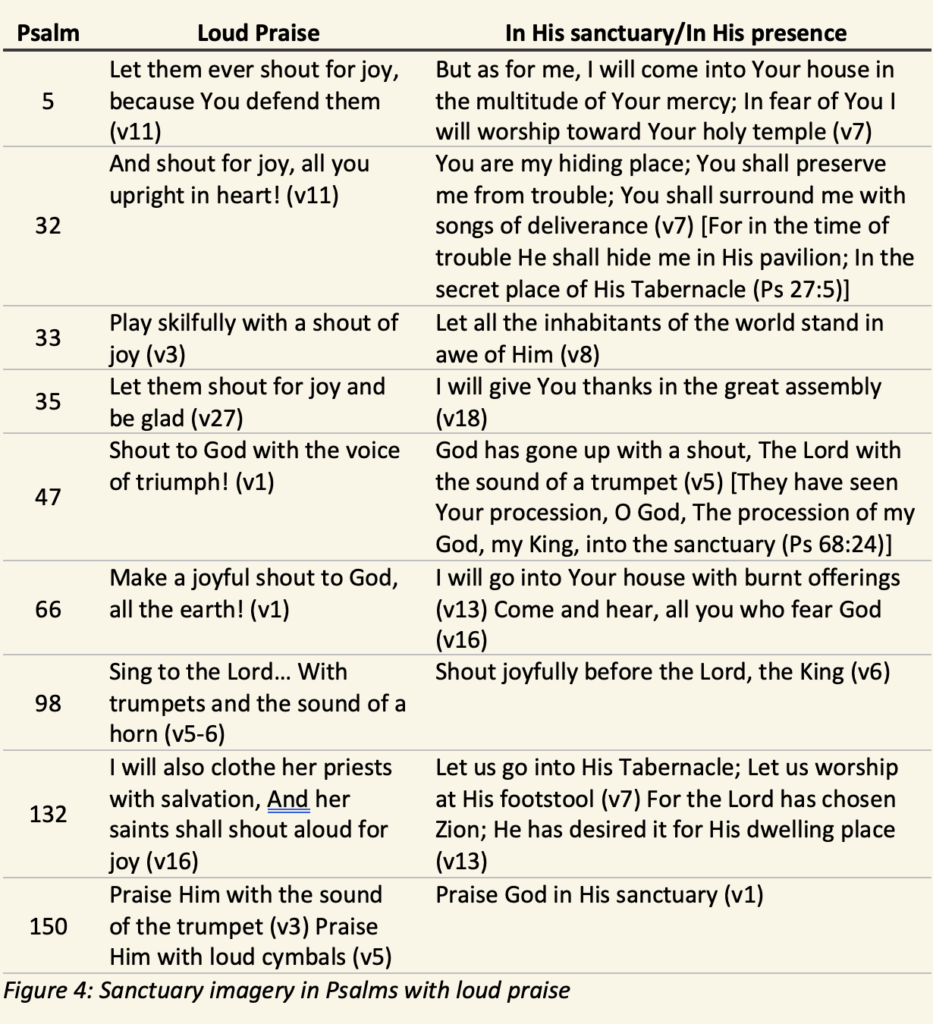
A number of Psalms call for loud praise, including Psalms 33, 47, 81, 98 and 150 along with others (see Figure 4). Just as the trumpet ‘shouted’ signals to the Children of Israel, the message of the Psalms uses temple imagery to figuratively shout a joyful, happy and heroic signal to the world and the universe, of God’s mercy and love. Psalm 33 calls for “all the inhabitants of the world stand in awe of Him (Ps 33:8).” Figuratively, the praise has to be ‘shouted’ aloud for all the earth to hear. Psalm 47 is an announcement to all peoples that God is the triumphant King over all the earth. It’s for all the world to hear. In Psalm 98, it’s a celebration of salvation going to all the earth. Again, the whole earth needs to hear it. In Psalm 150, the praise is to spread to the heavens and every breathing thing is called to praise God. These passages are calling to attention the whole earth and even the heavens – it has to be loud, not literally but metaphorically. Psalm 81 is another example of shouting but in this case, it announces a feast day. Likewise, Revelation uses the imagery of the temple in the seven trumpets which signal to earth and heaven important events that would take place (Rev 8-11).
The Proportion of Loud Sound in Temple Worship
Another important difference between Jewish temple music and contemporary worship music, apart from intensity, might be the proportion of loud sounds. In rock music, the drumbeat provides a strong and sustained pulse for the music. This was not always the case. Initially, in the evolution of the drum set the sound had to be dumbed down. When drum kits were first emerging during the development of rock and roll, drum sounds were relegated to the background. Drums were hidden at the back of the stage behind the other musicians. They were not played throughout the whole song and brush drumming kept the beat quiet to avoid drowning out the other instruments. With the invention of electrical instruments, amplifiers and microphones, all of the instruments and accompanying voice were able to be ramped up to match the sound level of the drum kit. From that point on, drummers could let loose and the loud drumbeat took centre stage and provided the backbeat for the whole duration of the song.327,328
Pop music has become progressively louder, less acoustic and more energetic ever since that time. The loudness of the most popular songs each year has been steadily increasing since the 1950s, especially in the last thirty years.388 One reason for this is that loudness sells because it is exciting and consumers demand ever increasing loudness.
It is likely that the loud sounds of Israelite temple music was much less sustained. According to Rabbi Jack Abramowitz, Torah Content Editor at the Orthodox Union, “The minimum number of trumpet blasts in the Temple on any given day was 21 and the maximum was 48.”389 Professor Kim Cunio is a composer and music historian and was head of the School of Music at the Australian National University from 2019-2023. He used a variety of sources, including ancient manuscripts and historical documents, such as the Talmud, to recreate the music of the Jewish temple in Jerusalem before its destruction by the Romans in 70 AD. Recordings were made in August 2006 at the Paddington Uniting Church in Sydney and are available on the ABC website.390
Kim Cunio’s performance opens with Psalm 150. Other than a burst of trumpet sound at the beginning, most of the song is relatively soft and melodic without trumpet sound and with clear enunciation of every word. If loud trumpet sounds are sustained throughout the whole song, quieter instruments may have been drowned out. Possibly more importantly, being cone-shaped, valveless and limited in the range of notes they could produce,34 (p54) trumpets were suited for non-musical signalling391 and possibly for solo trumpet interludes rather than sustained music.
Only a relatively small selection of Psalms has reference to trumpets, shouting and loud praise. Other Psalms are played solely with stringed instruments or flutes. In fact, there are up to 37 references to stringed instruments in Psalms, depending on translation (21 specifically to the lyre or harp), while there are only five references to trumpets and four references to tambourines.392 In Cunio’s rendition of 1st century Jewish temple music, even in songs with loud instruments, it is often the quieter instruments that predominate throughout most of the song.
Though even the loudest churches still have moments of quiet, on the whole, we have forgotten the value and power of silence in church for reflecting on God. We tend to have the notion that, if music is good for an experience, then more must be better. We do not utilise the quiet to our benefit like it once was. Dr Archibald D. Hart, Senior professor of psychology and dean emeritus at Fuller Theological Seminary said:
“If you don’t have time to contemplate, to think, to pause, then you are going to be misled. You’re going to make a lot of mistakes. There was a time when having a quiet time was the thing to do… Not many do that anymore.” He goes on to say that, “Without boredom, you can’t discover what is up there,” pointing to his head, “where the gifts are that God has given you.”393
The quiet time for reflection at church has been drowned out by long intervals of music. Mrs White referred to the Indiana camp meeting of 1900 as a bedlam of noise. Too much of a good thing can become a horrible thing. We need times of quiet, and plenty of it, to give ourselves time to think and process what we have seen and heard, rather than continually being fed by outside stimulus. Contemporary Christian music almost always includes sustained sounds of drums, electric guitars and amplified singers – loud music often dominates for a large proportion of a song and of the worship service as a whole. Though there are some lulls in the noise, loudness dominates.
The Pitch of Loud Temple Music
A third important difference between the loudness of temple music compared with contemporary Christian music is the pitch. The silver trumpet was a long instrument with a mouthpiece and broad conical or bell-shaped end and seems to have possessed a fairly shrill tone.227 Conversely, contemporary Christian worship songs, as with secular rock tunes, are usually dominated by bass tones.394 There are a number of properties of bass sound that sets it apart from high frequency sound. Bass sound is felt as much as it is heard.395 Our ears are less sensitive to low frequency sound and require a higher volume to have the same perception of loudness as high frequency sound.396,397
Sound is usually measured using the A-weighted decibel (dBA) scale which is weighted more toward the high frequency sounds which are more readily perceived by our ears. Using the dBA scale, the loudness of bass sounds is underestimated.398 (p5) As noted earlier, the World Health Organisation (WHO) recognises the potential harmful effects of noise when there is a large proportion of low-frequency components. The WHO guidelines on noise recommends:
“When prominent low-frequency components are present, noise measures based on A-weighting are inappropriate. The difference between dBC and dBA will give crude information about the presence of low-frequency components in noise, but if the difference is more than 10 dB, it is recommended that a frequency analysis of the noise be performed.”325 (p.xiii)
Another important property of bass sound is its ability to penetrate through and around objects, resist absorption and travel further distances. A frequent cause of complaints to governing authorities is bass noise associated with music from community venues. Due to the considerable amount of bass energy in modern music and its ability to pass through a building facade with greater ease than higher frequencies, it often results in a pronounced bass beat penetrating walls in the complete absence of other components of the music. This noise can be disturbing even at very low levels,398 especially since low frequency sound is often perceived as more annoying than high frequency sound.320,399 That is why, when you are lying in bed late at night and a car drives by in the street playing loud music, all you hear is the thumping bass sounds which can easily penetrate the car doors and windows, pass around trees and shrubs, penetrate through the house walls and windows and enter your ears. The high frequency sounds, even though they are also loud, are absorbed within the car.
Andrew Wright, in a presentation in engineering psychology under Dr Steffen Werner at the University of Idaho, compares high frequency sound with a butterfly and low frequency sound with a T-Rex. The intensity of a sound is measured by the wave amplitude of the sound and is recorded in decibels. A higher amplitude wave has more energy and causes greater pressure variations. Andrew compares a low decibel sound (a quiet sound) with a tired, listless animal; whereas a high decibel sound (a loud sound) has much more energy and is like an active, angry animal. His analogy helps to illustrate the importance of frequency when combined with intensity: a loud, high frequency noise is like an angry butterfly, while loud, low frequency noise is like an angry T-Rex.400 That is one reason why loud bass sound causes the ground to rumble and the walls of the building to shake and you can feel the vibrations penetrating into your body.395,397
This may also explain why prolonged exposure to low-frequency noise (bass sounds) can lead to adverse health effects including headaches, increased heart rate, anxiety, vertigo and fatigue.401 These are non-specific symptoms which people often suffer from and for which a cause is often not found. There are many idiopathic conditions that medical scientists are yet to find a cause for. Who knows if intense low frequency sounds may prove to be a common cause of some of these conditions in the future. Let’s face it, the deep bass sounds of modern songs have generally only been made artificially available due to modern technology. Almost always, when we deviate from nature, we ultimately discover serious health consequences as a result. Like processed foods, sustained bass sounds have been artificially concentrated to a level which is unnatural. In the future, this may well prove to be the cause of many complaints of headache, fatigue and other ailments just as poor food choices can cause numerous maladies. Music in general is played at a loudness level and indulged in to an extent which is unnatural due to artificial amplification and recording technology.
In her book, Extremely Loud – Sound as a Weapon, journalist, Juliette Volcler, reveals how the military has learned how to:
“…exploit sound’s biological effects, since sound waves – which are nothing more nor less than mechanical vibrations – can harm the ear and the entire body at certain frequencies and certain intensities.”402 (p1)
Dr Bart P. Billings is a retired US Army Colonel and former military psychologist who served in the US Army for 34 years and founded the International Military and Civilian Combat Stress Conference. Controversially, he has been outspoken against psychotropic treatment for returning veterans arguing that these treatments cause more harm than good. Military personnel are frequently exposed to high intensity (loud)/low frequency sound vibration. Vibroacoustic disease (VAD) is a term coined by Mariana Alves-Pereira, Nuno Castelo Branco and colleagues to describe disease due to frequent exposure to low frequency sound which can affect multiple organs of the body, including neurological, muscular and cardiovascular systems. Dr Billings describes patients who exhibit signs, symptoms and organ damage typical of VAD but are incorrectly diagnosed with post-traumatic stress disorder (PTSD). He believes that the impact of loud, low-frequency sounds is underappreciated and that the diagnosis and treatment of VAD needs to be improved. Earmuffs protect the ears, but the rest of the body remains unprotected.403
In summary, the loud sound of Israelite temple worship likely had a very different purpose and provided a very different experience to the loud sound of contemporary Christian music. In other words, the loud sound of contemporary Christian worship likely has little resemblance to loud temple music of ancient Israel. In temple worship, the purpose of loud sound was to communicate messages to the surrounding community. Only those close to the musicians would have perceived the music as loud. It also had symbolic meaning of ‘loudly’ communicating the gospel message to the whole world. The purpose of loud sound in contemporary Christian worship, on the other hand, is primarily to intensify the emotions and create excitement, and all present are exposed to the loud sounds. The loud music of Jewish temple music was likely also much less sustained, with just short, infrequent bursts of loud sounds, whereas contemporary Christian worship is often filled with frequent sustained segments of loud music. Finally, ancient Israelite temple music was likely dominated by higher frequency sounds, whereas contemporary Christian music is very often dominated by bass sounds, which tends to lead to louder volumes, increased excitement and potential harms to our health. We will discuss more about the harms of loud music in the next chapter.