
Harmonising with God in Our Music and Practices
Part 5 - Restrictions on Instruments
Chapter 19
Chapter 19
Aggression

Drums and electric guitars tend to tell a different story to our own – one that does not belong to Christians. Anger and aggression are not emotions that we embrace. Over and over, the Bible advises against anger. Here is a small sample:
“The discretion of a man makes him slow to anger, and his glory is to overlook a transgression.” (Prov 19:11)
“He who is slow to anger is better than the mighty, and he who rules his spirit than he who takes a city.” (Prov 16:32)
“So then, my beloved brethren, let every man be swift to hear, slow to speak, slow to wrath; for the wrath of man does not produce the righteousness of God.” (Jas 1:19-20)
“Do not hasten in your spirit to be angry, for anger rests in the bosom of fools.” (Ecc 7:9)
“Cease from anger and forsake wrath; do not fret – it only causes harm.” (Ps 37:8)
“The Lord is merciful and gracious, slow to anger, and abounding in mercy.” (Ps 103:8)
“I desire therefore that the men pray everywhere, lifting up holy hands, without wrath and doubting.” (1 Tim 2:8)
There is much scriptural support, therefore, for removing aggressive tones from the music we play in church. Anger should seldom be expressed, yet it is rumbling along in the background, and sometimes even the foreground, of the majority of contemporary Christian songs these days. It may not generally be as prominent as in hard rock, and occasionally it may be quite subtle, but it is still there.
It is possible to tone down the aggressive emotion of drums and electric guitars by the way they are played, such as using different chord and scale techniques on electric guitars,350 however, Christian drummers and guitarists frequently use similar techniques to secular rock musicians. Because these instruments produce naturally aggressive tones, unless there is deliberate effort to remove them, they come through in the music. If you have a listen to, say, Way Maker, it is likely when the drums pick up that you start to feel more energised. The term ‘drum up excitement’ is an idiom for creating excitement and interest in something and is a fitting expression for this because the drum is a powerful instrument for creating excitement. The aggressive sounds excite and energise us, just like in a movie, fighting scenes and car chases excite us. We should not be driven by aggression, yet it is the drum that leads the rhythm.
In his best-selling book, The Sonic Boom, Beckerman advises managers to carefully choose every sound – sound that will draw attention to the essence of their brand, rather than randomly selecting music that simply sounds good based on gut instinct alone and without a clear goal. Most importantly he says:
“Don’t make the even bigger mistake of picking music because you think it makes you or your brand seem cool or relevant. If you choose a song because you like some of the lyrics and you don’t pay attention to what the song is really about, your potential customers will spot the disconnect in a hot second. They might even tune out your brand forever.”165 (p82)
Again, this conflicts with General Booth’s assumption that only the lyrics count when it comes to communicating a spiritual message. He believed we should use any tune that will get the attention of the people. However, Beckerman’s advice simply conveys what studies had already revealed at the time. As early as 1993, research had shown that it is critically important for business advertising to align the emotional tone and meaning of the background music with the core message being communicated. In fact, when music-message congruency is low, attention-gaining music tends to distract from the message, the research found.351 This directly supports Beckerman’s advice.
Companies have been slow to acknowledge this fact, and so have church organisations. Church leaders would do well to consider the implications of these research results. Our music is telling the wrong story. People join initially because it sounds good, but then, like Sean McDowell’s friend who discovered contemporary Christian rock was telling the same story as Coldplay and gave up his faith, new converts walk out the back door in their droves. Some do not even make it past the foyer on the way in because they ‘spot the disconnect in a hot second’ – they want to hear a different story and experience than they get at the night club.
Our story is one of peace and hope. Jesus said:
“Blessed are those who hunger and thirst for righteousness, for they shall be filled. Blessed are the merciful, for they shall obtain mercy. Blessed are the pure in heart, for they shall see God. Blessed are the peacemakers, for they shall be called sons of God.” (Matt 5:6-9)
God prefers a gentle spirit:
“I, therefore, the prisoner of the Lord, beseech you to walk worthy of the calling with which you were called, with all lowliness and gentleness, with longsuffering, bearing with one another in love.” (Eph 4:1-2)
We are to be filled with the fruit of the Spirit:
“…love, joy, peace, longsuffering, kindness, goodness, faithfulness, gentleness, self-control.” (Gal 5:22-23)
As far as it is possible we should live at peace with others in society as counselled by Paul:
“If it is possible, as much as depends on you, live peaceably with all men. Beloved, do not avenge yourselves, but rather give place to wrath; for it is written, ‘Vengeance is Mine, I will repay,’ says the Lord.” (Rom 12:18-19)
We fight, not with aggression but with kindness:
“If your enemy is hungry, feed him; if he is thirsty, give him a drink; for in so doing you will heap coals of fire on his head.” (Rom 12:20)
We defend ourselves with:
“…the sword of the Spirit, which is the word of God.” (Eph 6:17)
It was love that caused Jesus to offer up his body on the cross and anger and aggression that put Him there. When Paul and Silas were unfairly treated and thrown into prison, instead of retaliating, they prayed and sang hymns. Paul also took pity on the jailer (Acts 16). Paul advised Timothy:
“And a servant of the Lord must not quarrel but be gentle to all, able to teach, patient, in humility correcting those who are in opposition.” (2 Tim 2:24-25)
Mrs White said:
“Work disinterestedly, lovingly, patiently, for all with whom you are brought into contact. Show no impatience. Utter not one unkind word. Let the love of Christ be in your hearts, the law of kindness on your lips.”196 (p41)
Though there were likely quite a few pagan converts to Christianity still serving in the Roman army, pacifism was a dominant view amongst our forefathers in the early church before the time of Constantine.352–354 Despite this, Christians were falsely accused of murder and cannibalism. Athenagoras’ defence against this false accusation was Christian’s renouncement of “the contests of gladiators and wild beasts” and the unwillingness of Christians even “to see a man put to death… lest we should contract guilt and pollution.” Christians were not even to look upon killing, let alone participate in violence, for it was deemed “that to see a man put to death is much the same as killing him.”355 (p147)
What would the early church fathers think of Christians today watching movies with violence and murder, such as the movie, Gladiator? Jesus equated lust with adultery and hate with murder. It would then stand to reason that taking pleasure in scenes of violence on TV and movies would equate with participating in it. If we frequently witness violence in the things we watch, we become de-sensitised to the angry tones of music, but our story is not one of violence but of non-violence. Lest anyone is not convinced that early Christians would extrapolate real acts of violence and immorality to include acted out scenes in movies, the 4th century Christian apologist, Lactantius, viewed stage performances as an even greater corrupting influence than witnessing real acts of violence:
“If, then, it is in no way permitted to commit homicide, it is not allowed us to be present at all, lest any bloodshed should overspread the conscience, since that blood is offered for the gratification of the people. And I am inclined to think that the corrupting influence of the stage is still more contaminating.”256 (p187)
Persecution
After Constantine legalised Christianity, when armed with the authority granted them by the state and, perhaps, motivated by different sentiments than their forebears, the first acts of aggression Christians began to participate in was violence against so-called heretics. When Arianism was approved by the church, Trinitarians were persecuted, and when Trinitarianism was approved, Arians were persecuted. Sabbath keepers have also been persecuted by the church, beginning in the 4th century when the Roman Catholic Church shut out from the church anyone who was keeping the seventh-day Sabbath.266 (p316) This has been the trend ever since, down through the ages. Roman emperor, Justinian the Great, used military force and Roman law to establish Christianity across his empire. Systematic religious persecution was used against those who did not uphold orthodoxy, including Arians and Monophysites, amongst others.356 (p8-9) In his paper entitled, The Early Church Persecution of Paganism and Heresy, Willis G. Swartz concludes:
“Christianity, for more than three centuries persecuted by paganism, gradually emerged supreme, only to become almost as aggressive a persecutor as its former enemy. After the sixth century, all serious opposition to the Roman Church lay effectively crushed.”357
The closer the church was united with secular powers, the more the church persecuted its opponents. Christians who did not hold to the teachings of the Roman Church, such as the Waldenses, were persecuted and forced to hide away in the forests and mountains. The Inquisition was a powerful and cruel institution set up by the Catholic Church to root out and punish heresy throughout Europe and the Americas. It began in the 12th century and continued until the 19th century. The population, including Christians, Jews and Muslims, was beaten into submission to the church’s doctrines.358,359 Aggression is one of the biggest blights against Christianity. Enforcing religious doctrine by law is a form of aggression, yet we have not learnt from history but embrace aggressive tones in our music.
Revelation talks about the woman, God’s church, escaping from persecution by fleeing into the wilderness for 1260 days (Rev 12:6,14). Using the day-for-a-year principle, Adventists understood prophetic days to equal literal years. This interpretation is taken from various passages. For example, Ezekiel was to lay on his side a day for each year of Israel’s iniquity (Ez 4:4-6). For each day the Children of Israel spied out the land of Canaan, they were to spend a year wandering in the wilderness, forty years in total (Num 14:32-34). Therefore, Adventists believe God’s remnant faithful people would receive protection in the wilderness from the antichrist for 1260 years.
Martin Luther and numerous other reformers, including John Huss and John Wycliffe who preceded him, identified the papacy as the antichrist. It was this understanding that triggered the Protestant Reformation. Until recent times, a broad spectrum of conservative evangelical Protestants believed the papacy to be the antichrist of Bible prophecy. Professor Dennis Pettibone said:
“Luther interpreted Daniel 2 and 7 as depicting four great empires, culminating with the Roman Empire, which would be divided, after which the antichrist would arise. His own generation, he believed, was symbolized by the toes in the image of Daniel. The little horn arising out of the Roman Empire he identified as the papal antichrist.”360
Whether or not someone holds to Luther’s view of the antichrist, the Roman Catholic Church has admitted to and apologised for former acts of aggression, such as during the inquisitions. After the fall of the Western Roman Empire to the Germanic tribes in 476 AD, especially under the Arian Ostrogoths from 493-537 AD, the power of the Roman Catholic pope was significantly limited. The greatly diminished Roman empire was reduced to Byzantine in the east. After the capture of Rome in 537 by Justinian’s forces, the Roman Papacy was dominated by Byzantine, increasing the power of the papacy. The Justinian code legally established the Roman pontiff as head over all of Christendom.
The church and the state were firmly meshed and this persisted until Napoleon Bonaparte’s French troops captured Rome, seized the pope and put him in prison in 1798. This, coupled with the secularising influence of the French Revolution, effectively put into motion the rapid demise of the Papacy’s temporal power. This time period, from 538 to 1798, equals exactly 1260 years as prophesied and includes the Dark Ages in Western Europe. During this period, anyone who opposed the authority of the church was persecuted, but many Christians sought refuge in the wilderness. It was because of this oppression by the church that the American forefathers built into the constitution separation of church and state. They did not want a repeat of religious persecution. The Seventh-day Adventist Church is the only major denomination which still adheres to the reformer’s historicist interpretation of Revelation. They interpret the collapse of papal imperial power as the fatal wound received by the beast power in Revelation.
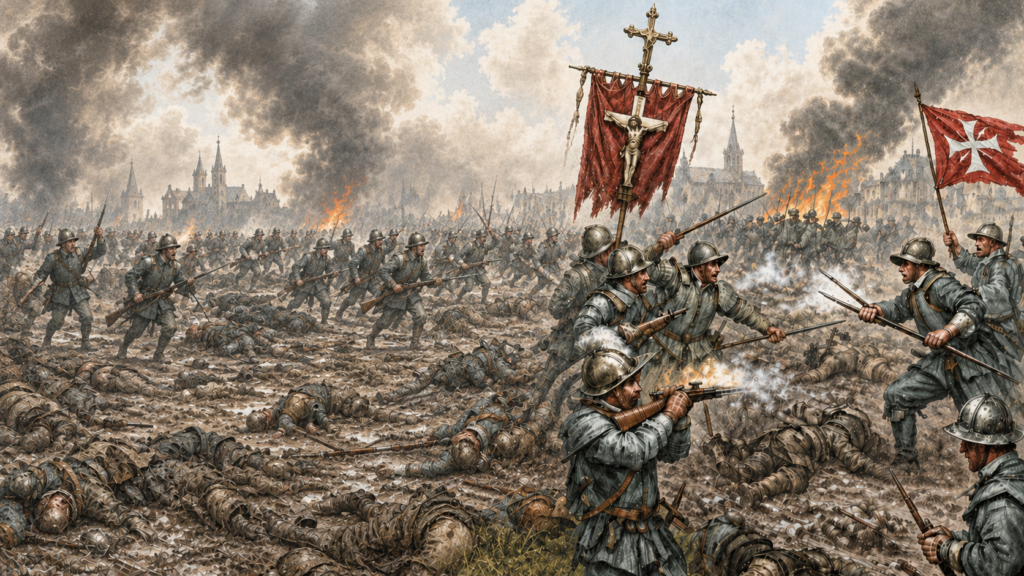
The Reformation, which began in 1517, was an attempt to reform the church of its many corrupt practices. Unfortunately, by 1560 Europe had descended into religious division and intolerance as it had never experienced previously. The upholding of church doctrine by force and threats became accepted also amongst Protestants. The Catholic Inquisition was an institution of the church established to persecute heresy. However, many Protestants were equally hostile to Catholics. Although aggression was usually directed at Catholics, different Protestant groups often detested one another also. In order to gain dominion over their opponents, church organisations would develop close ties with monarchs which provided them with legal, military and material means to secure territory. The end result of this union of church and state was the protracted European wars of religion which spanned two centuries and millions lost their lives. During this period, some part of Europe was at war 90% of the time and the most powerful dynasty, the Habsburgs, were at war two-thirds of the time. It included the Thirty Years War, the most devastating religious war in European history, which reduced the population of German Lands by up to 40%. Great suffering and horrific acts of violence were inflicted on both soldiers and civilians.361
Down through the centuries, from the time of Constantine through to the European wars of religion, Christianity was living the wrong story – a story of aggression, military conquest and forced allegiance. The military conquest of Canaan by the children of Israel does not give Christians the right to attack opponents. Abraham’s descendants had to wait 400 years before God gave them direct authority to attack Canaan, “for the iniquity of the Amorites is not yet complete (Gen 15:16).” Jesus told Peter to put the sword away (Jn 18:11). It is only by direct command from God that we should wilfully attack others. Though we should share our beliefs with fellow believers and humbly compare our understanding of Scripture, we should not attack others who have a different opinion to our own. In the Salvation Army, preachers were instructed to avoid speaking disparagingly of any religious body, including papists, infidels, publicans or any class of sinners.2 (p100) Mrs White said:
“We should not, upon entering a place, build up unnecessary barriers between us and other denominations, especially the Catholics, so that they shall think we are their avowed enemies. We should not create a prejudice in their minds unnecessarily, by making a raid upon them…. From that which God has shown me, a great number will be saved from among the Catholics.”168 (p573)
In fact, Mrs White believed:
“There are many among the Catholics who live up to the light they have far better than many who claim to believe present truth, and God will just as surely test and prove them as He has tested and proved us.”168 (p144)
Every effort should be made to dissociate aggression from the name of Christianity, starting with our style of music. We are to do what we can to preserve pure doctrine, but not by force. God has a set time to bring punishment on the wicked. Punishing the wicked is not our job but, rather, it is our responsibility to lovingly warn people of God’s coming judgements. Only after centuries of forced allegiance to the church with periods of widespread bloodshed and poverty did civil powers finally start to clamp down on religious intolerance and explosions of religiously inspired violence.361 This led to a period of increasing religious toleration,357 allowing for the great religious revivals of the 18th and 19th centuries from which the Salvation Army and Seventh-day Adventist denominations emerged, along with others.
Unfortunately, Willis G. Swartz describes how in modern times, “Physical persecution has almost entirely disappeared. But the spirit of intolerance is far from destroyed.”357 That was in 1927. Today, there is increasing talk of intolerance toward others, both inside and outside the church. Mrs White said that because of the failure of professed Christians to actively engage in missionary work, there was widespread unbelief, deep iniquity and unparalleled wickedness seen in the world. If it was true in her time, it would be even more true today. She goes on to explain how failure to carry out our duty as Christians has brought intolerance into the church:
“And not only in the world do we see the result of the church’s neglect to work in Christ’s lines. By this neglect a condition of things has been brought into the church that has eclipsed the high and holy interests of the work of God. A spirit of criticism and bitterness has come into the church, and the spiritual discernment of many has been dimmed.”16 (p296)
The increased wickedness in the world, partly due to our failure as a church to influence the world, has led to increasing talk amongst evangelicals of removal of restrictions on separation of church and state and backing political leaders who will enforce religious law. Some secular commentators recognise the concerted effort of the conservative majority to force back religion into the United States political system.362 The lessons from the past have been forgotten. If we want to live the right story, we need to start singing the right story. We have to develop an ear for what is aggressive and be motivated and inspired instead by what is meek rather than what is rebellious.
Pacifism
There were, however, amongst the Protestant churches of the 16th and 17th centuries, pacifist organisations, such as the Brethren, the Quakers and the Anabaptists. They were considered radicals because of their strict adherence to the Scriptures, being willing to lose their lives for their beliefs but not willing to take lives. Likewise, we ought to remove the angry rhetoric from our conversations, preaching, YouTube channels, vaccine protests and anti-abortion and anti-LGBT protests and we should remove the aggressive tones out of our music; while, at the same time, we must lovingly share our beliefs and push back against immorality and false teachings. When we present arguments for a young earth creation, it should not be with ridicule and derision toward evolutionists, but we should present the plain facts as we see it with loving concern for those who are ignorant of truth.
Though the Salvation Army has traditionally avoided clashing with other denominations, especially over doctrine, they did not always shy away from confrontation with the general public or government authorities, including the police. They felt they were at war with the immorality and evils of society, which kept people in poverty and on the pathway to hell. They were willing to oppose anyone who stood in the way of attracting the attention of the people and righting the wrongs.
For example, Kate Booth, the General’s eldest daughter, along with Maud Charlesworth, were taken into custody and questioned in Switzerland for holding sensational meetings. They were attracting rowdy crowds who were attacking Salvationists in the streets. The authorities banned the Salvation Army from holding meetings and expelled Kate and Maud from Geneva. Despite this, Kate Booth later returned to Switzerland where she was jailed for continuing to hold Salvation Army meetings. The disputes gave the Salvation Army widespread publicity and eventually, as with other areas of the world, they gained sympathy from the general public.2 The Booths were also willing to confront Christians who, they felt, were not living up to their Christian duties to humanity, a sentiment often expressed in Catherine’s book, titled Aggressive Christianity.
The Salvation Army found themselves embroiled in a major scandal when they enlisted the support of a tabloid journalist, W. T. Stead, to expose the evils of the child sex trade. At the time, there were several thousand child prostitutes in the East End of London and girls less than 13 years of age were being exported to other parts of Europe. Officials denied the evils, or even the existence, of a widespread child sex trade in Britain. Mrs Booth, his son, Bramwell and wife, Florence, designed a scheme to ‘buy’ a child for prostitution to reveal the existence of the practice to the general public and pressure the government to take action. General Booth was rather opposed to the scheme due to its involvement of scandalous journalism. The campaign succeeded – the public became outraged and The Criminal Law Amendment Act was passed – but it came at a cost. A number of those involved in staging the abduction found themselves on trial and sentenced, including Stead, who spent 3 months in prison. Though no Salvation Army officers were sentenced, it did tarnish the name of the organisation.
Seventh-day Adventists, on the other hand, tended to be pacifists when it came to civil and military matters, but were willing to be embroiled in doctrinal arguments with other believers. Trevor O’Reggio, professor of church history at Andrews University, describes how some of the Seventh-day Adventist beliefs have their roots in radical Protestantism influenced by the Anabaptists. He goes on to say:
“Adventists would later be one of the principal champions of religious liberty among Protestants… The spirit of Anabaptism permeated early Adventism…What is incontrovertible is that early Adventists emerged from the groups constituting the radical tradition of Protestantism that were influenced by the Anabaptists.”
Examples of radical groups from which Adventism emerged, include Christian Connexion, Baptists and Methodists.363 This connection with Anabaptism has carried over into Adventist beliefs about pacifism and religious liberty. Desmond Doss, a conscientious objector during World War II is an exemplary case of pacifism. Though ridiculed by fellow soldiers he became a hero when, on ‘Hacksaw Ridge,’ he risked his own life and miraculously saved the lives of many of the very people who ridiculed him. Two great legacies of the Anabaptist movement are freedom of conscience and separation of church and state.364
Though Adventists have historically appealed to governments for religious freedom, when it came to their own liberty, Mrs White cautioned against becoming overly passionate. Early Adventist leaders, while advocating tirelessly for religious liberty, remained law abiding and diplomatic. Below are various responses from Mrs White regarding reactions from church members when Sunday law threatened their freedom. Sunday law enforcement was especially severe in the southern states of the United States in the 1880s and 1890s. Some Seventh-day Adventists at the time were inclined to defy the law by continuing to work on Sunday. This attitude was opposed by Mrs White. Instead, they were counselled to avoid irritating their neighbours who revered Sunday by, for example, hanging out washing on that day. They were to avoid attracting attention and giving occasion to be called lawbreakers, thereby accelerating increasingly rigid laws, limiting freedom further. Rather, they were to ‘love the brotherhood’ and to act in a ‘manner in which Christ would work’. They were to keep the peace by refraining from work that gives offence:
“Those who compose our churches have traits of character that will lead them, if they are not very careful, to feel indignant, because on account of misrepresentation their liberty in regard to working on Sunday is taken away. Do not fly into a passion over this matter but take everything in prayer to God. He alone can restrain the power of rulers. Walk not rashly. Let none boast unwisely of their liberty, using it for a cloak of maliciousness, but as the servants of God, ‘Honor all men. Love the brotherhood. Fear God. Honor the king (1 Pet 2:17).’
This advice is to be of real value to all who are to be brought into strait places. Nothing that shows defiance or that could be interpreted as maliciousness must be shown.”365 (p193-4)
“In regard to the Southern field, the work there must be done as wisely and carefully as possible, and it must be done in the manner in which Christ would work. The people will soon find out what you believe about Sunday and the Sabbath for they will ask questions. Then you can tell them, but not in such a manner as to attract attention to your work. You need not cut short your work by yourself laboring on Sunday….
Refraining from work on Sunday is not receiving the mark of the beast…. In places where the opposition is so strong as to arouse persecution, if work is done on Sunday, let our brethren make that day an occasion to do genuine missionary work.”366 (p69-70)
“If they should come here and say ‘You must close up your work and your presses on Sunday,’ I would not say to you, … ‘Keep your presses going,’ because the conflict does not come between you and your God.”367
“We should not feel it enjoined upon us to irritate our neighbors who idolize Sunday by making determined efforts to bring labor on that day before them purposely to exhibit an independence. Our sisters need not select Sunday as the day to exhibit their washing.”90 (p399)
“I will try to answer your question as to what you should do in the case of Sunday laws being enforced.
The light given me by the Lord at a time when we were expecting just such a crisis as you seem to be approaching, was that when people were moved by a power from beneath to enforce Sunday observance, Seventh-day Adventists were to show their wisdom by refraining from their ordinary work on that day, devoting it to missionary effort.
To defy the Sunday laws will but strengthen in their persecution the religious zealots who are seeking to enforce them. Give them no occasion to call you lawbreakers…. One does not receive the mark of the beast because he shows that he realizes the wisdom of keeping the peace by refraining from work that gives offense….
Sunday can be used for carrying forward various lines of work that will accomplish much for the Lord. On this day open-air meetings and cottage meetings can be held. House-to-house work can be done. Those who write can devote this day to writing their articles. Whenever it is possible, let religious services be held on Sunday. Make these meetings intensely interesting. Sing genuine revival hymns, and speak with power and assurance of the Saviour’s love.”196 (p232-3)
“Take the students out to hold meetings in different places, and to do medical missionary work. They will find the people at home and will have a splendid opportunity to present the truth. This way of spending Sunday is always acceptable to the Lord.”196 (p238)
According to Mrs White’s advice, there is no justification for breaking civil law in the name of religious liberty alone. Paul exhorts Timothy to pray for kings and all who are in authority, that believers may lead a quiet and peaceable life in all godliness and reverence (1 Tim 2:1-2). Peter says, “Therefore submit yourselves to every ordinance of man (1 Pet 2:13).” Paul also says “Let every soul be subject to the governing authorities. For there is no authority except from God, and the authorities that exist are appointed by God (Rom 13:1).” He also says, “Bless those who persecute you… Do not be overcome by evil, but overcome evil with good (Rom 12:14,21).”
Sometimes we have to give up our own rights to maintain peace. We are to avoid a rebellious spirit. God will defend our liberty if He so chooses. That is not to say we should not use peaceful and lawful means to protest against laws that limit our religious freedom. Partly due to the work of Seventh-day Adventists in the 1880s, religious freedom in the United States was upheld for all.
What we should be much more concerned about than our own freedom is the breaking of God’s law. This is where the church has failed in this Laodicean age. Hollywood, and the entertainment industry in general, has been walking all over God’s law, becoming more brazen as the years go by and the church has been effectively silent. Where is the peaceful lobbying and the protests against the blatant immorality? It is not to be readily found. Instead, Christians are sitting in their homes and in cinemas supporting the industry, watching movies full of violence, immorality and taking God’s name in vain, thinking nothing of it, enjoying the entertainment instead. Jesus said that being angry toward others without a cause puts us in danger of the judgment (Matt 5:21-24). Likewise, by indulging in entertainment that disregards God’s law, we are complicit in it.
When it comes to God’s law, we must never bend. We must never give into appetite and watch the movie anyway, despite it containing profanities. If Sabbath keepers are compelled to break the Sabbath, they ought to obey God rather than men (Acts 5:29). When Peter and John were commanded by the authorities not to teach in the name of Jesus, they answered and said to them, “Whether it is right in the sight of God to listen to you more than to God, you judge. For we cannot but speak the things which we have seen and heard (Acts 4:18-20).” If they submitted to the authorities, they would have been disobeying the Great Commission and the church would not have grown. The authority of religious and civil rulers is not absolute. Here there is no ambiguity in Mrs White’s writings when the law opposes God’s plain commands:
“The adherents of truth are now called upon to choose between disregarding a plain requirement of God’s Word or forfeiting their liberty. If we yield the Word of God and accept human customs and traditions, we may still be permitted to live among men, to buy and sell, and have our rights respected. But if we maintain our loyalty to God it must be at the sacrifice of our rights among men, for the enemies of God’s law have leagued together to crush out independent judgment in matters of religious faith and control the consciences of men….
The people of God will recognize human government as an ordinance of divine appointment and will by precept and example teach obedience to it as a sacred duty so long as its authority is exercised within its legitimate sphere. But when its claims conflict with the claims of God we must choose to obey God rather than men. The Word of God must be recognized and obeyed as an authority above that of all human legislation. ‘Thus saith the Lord’ is not to be set aside for a ‘Thus saith the church or the state.’ The crown of Christ is to be uplifted above all the diadems of earthly potentates.”368 (p34)
“Satan offers to men the kingdoms of the world if they will yield to him the supremacy. Many do this and sacrifice heaven. It is better to die than to sin; better to want than to defraud; better to hunger than to lie.”62 (p495)
…better to give up immoral worldly entertainment than to sing the tune of the enemy.