
Harmonising with God in Our Music and Practices
Part 4 - Instruments
Chapter 13
Chapter 13
Musical Instruments
So far, we have talked a lot about worship and music in general but not a lot about musical instruments specifically. There is surprising silence regarding musical instruments in the gospels and epistles. There is no record of Jesus ever using or promoting drums, cymbals, trumpets or any other musical instruments in His ministry. Neither is there any record of the apostles specifically using or encouraging the use of musical instruments in the church or as a means of attracting people to the faith, though there is mention of singing in general. This by no means suggests that Jesus never or rarely allowed for or encouraged the use of instruments in His ministry. Given the importance of music in the lives of the Jews and the fact that Jesus never spoke against instruments, it is difficult to imagine that Jesus would not have used singing and music in his life and ministry. But everything in the Bible is there, or not there, for a reason and God expects us to take every word of Scripture into consideration (2 Tim 3:16).
Why the relative silence on musical instruments in the Gospels and Epistles? How do we harmonise this with frequent references to musical instruments in the Psalms and Old Testament worship? Jesus is our example and the gospels were written as they were for a reason. This chapter will explore ways to harmonise the Old and New Testaments with scriptural evidence as well as with help from science.
Martin Luther was in favour of the use of instruments in church and encouraged the training of church members, including children, in the use of musical instruments. He strongly encouraged preachers and schoolteachers to be trained musicians. Some reformers, however, such as John Calvin and Huldrych Zwingli had a much stricter view of music and its emotional influence and did not allow the use of instruments in church.268
There was much debate in the 1800s regarding the place of musical instruments in church. Some denominations prohibited them altogether. In the official Salvation Army publication, The War Cry, General Booth testified of the central role of musical instruments in their worship: “we have proved the great utility of musical instruments in attracting crowds to our open-air and indoor meetings.”3 Likewise, from the very beginning, the Seventh-day Adventist Church welcomed the use of instruments in their worship services.9 Mrs White encouraged the use of musical instruments at camp meetings and in local churches9 (p80) and was in favour of the use of all kinds of musical instruments:
“Let the talent of singing be brought into the work. The use of musical instruments is not at all objectionable. These were used in religious services in ancient times. The worshipers praised God upon the harp and cymbal, and music should have its place in our services. It will add to the interest.”168 (p500)
In her comments on the General Conference of 1905, she said:
“I am glad to hear the musical instruments that you have here. God wants us to have them. He wants us to praise Him with heart and soul and voice, magnifying His name before the world.”269
A Bedlam of Noise
Mrs White did, however, sometimes have a problem with how instruments were used. The Seventh-day Adventists at the 1900 Indiana camp meeting who belonged to the Holy Flesh movement “worked themselves up to a high pitch of excitement by the use of musical instruments.”61 S. N. Haskell described what he saw at this camp meeting as “a mixture of truth and error, with much excitement and music.”270 (p102) In response to the Holy Flesh movement, Mrs White said:
“The Lord desires to have in His service order and discipline, not excitement and confusion. We are not now able to describe with accuracy the scenes to be enacted in our world in the future; but this we do know, that this is a time when we must watch unto prayer; for the great day of the Lord is at hand. Satan is rallying his forces. We need to be thoughtful and still, and to contemplate the truths of revelation. Excitement is not favorable to growth in grace, to true purity and sanctification of the spirit.”12 (pp33-6)
To S. N. Haskell, she replied:
“The Holy Spirit never reveals itself in such methods, in such a bedlam of noise. This is an invention of Satan to cover up his ingenious methods for making of none effect the pure, sincere, elevating, ennobling, sanctifying truth for this time. Better never have the worship of God blended with music than to use musical instruments to do the work which last January was represented to me would be brought into our camp meetings. The truth for this time needs nothing of this kind in its work of converting souls. A bedlam of noise shocks the senses and perverts that which if conducted aright might be a blessing. The powers of satanic agencies blend with the din and noise, to have a carnival, and this is termed the Holy Spirit’s working.”12 (p36-7)
Some modern-day commentators on the 1900 Indiana camp meeting have suggested that descriptions like ‘bedlam of noise,’ ‘shrieks’ and ‘shouting’ describe total auditory chaos rather than music. It is argued that this chaotic noise along with descriptions of ‘half insane,’ ‘fanatical excitement,’ ‘hysterical’ and ‘fairly shaking as though they had the palsy,’ describes extreme Pentecostal practices. The implication then would be that loud and ecstatic worship music is appropriate in church, as long as the sound is of comprehensible tunes and that the conduct is not comprised of extreme behaviours, such as shaking uncontrollably or running about hysterically.
This understanding is dependent, however, on the interpretation of subjective terms, such as ‘hysterical,’ which can easily be misinterpreted by the influence of our own modern context which is far removed from the event. The way we describe what we hear and see depends on our experience. Author and professor of music at the University of Liverpool in the UK, Michael Spitzer, notes:
“When those stratospheric high notes belted out by Whitney Houston… are performed in parts of the world that haven’t been exposed to that style of singing, such as in South Asia or most of Africa, they really do sound like screams. Growing up in a Western musical culture, we learn not to be afraid of these sounds, and even to like them.”271
If we peel away the subjective descriptions which are difficult to interpret, we are left with a more accurate objective description of what was happening at the 1900 Indiana camp meeting. For example, S. N. Haskell reported that the Holy Flesh revival effort was “simply a complete copy of the Salvation Army method.”270 (p102) His wife reported that they played “dance tunes to sacred words…” and they shouted “‘Amens’ and ‘Praise the Lord,’ ‘Glory to God,’ just like a Salvation Army service.”61Since we have much documentation of 19th century Salvation Army worship, it is clear from these objective descriptions that the eyewitnesses were not describing chaotic sounds or extreme Pentecostal practice but typical worship and music seen within Holiness denominations like the Salvation Army in the late 1800s before Pentecostalism even existed. Salvation Army musicians were well trained – the General insisted that they play good music. It was not random beating and shouting out of chaotic nonsensical noise as some have suggested.
These objective descriptions are equivalent to the descriptions of modern-day contemporary worship – sacred words put to pop music, congregational shouting of ‘Praise God!’ and ‘Amen!’, hand waving and jumping up and down. It was exciting, loud and up-beat worship that most Christians had never witnessed prior to the 19th century. To these Christians, it was fanatical, hysterical and insane. Eyewitnesses of Salvation Army worship used very similar descriptors as were used to describe the 1900 Indiana camp meeting, such as: ‘confused noise,’ ‘sensational,’ ‘nonsensical rhymes they call hymns,’ ‘clapping of hands and stamping of feet,’ ‘intemperate bawlings out of Hallelujahs,’ ‘noisy meetings,’ ‘screaming,’ ‘shouting ejaculations,’ ‘irreverence,’ ‘shocking,’ ‘over excitement,’ ‘carnival,’ ‘jocosity,’ ‘loud tones’ and ‘shrieking.’2
The unique Pentecostal element at the 1900 Indiana camp meeting was the ‘through the garden experience.’ Individuals would fall to the ground and then were carried to the rostrum where they were surrounded by singing, praying and shouting members. Once the individual revived, he was a born son of God fully cleansed from sin and sinful tendencies.60 (p447) This is equivalent to what would later be termed baptism of the Holy Spirit in Pentecostalism and grew out of Holiness theology. In fact, these practices were already common in revivalist meetings in other denominations, including the Salvation Army. These were the bodily manifestations they were seeking as a sign that they had achieved instantaneous sanctification and removal of original sin.
Paul Hamel, former music department chair at Andrews University, describes how the physical manifestations of the 1900 Indiana camp meeting are, once again, very much part of the contemporary religious scene. He describes how:
“many popular churches are using jazz and rock music in their services. In order to evaluate the influence of this kind of religious music, I have attended a few such services. In them the music is central and it almost, if not entirely, excludes everything else. In its persistence, its beat and its highly amplified sound, the music pervades and controls almost absolutely. Usually, it is not long after the music begins until hand clapping starts in rhythm to the music. Soon feet are also responding and before long the entire body seems to be affected by the musical stimulation. I have seen worshipers lie on the floors of their churches, rolling, jerking and shouting.”9 (p45)
For General Booth, as with the Holy Flesh movement, the noise and excitement created by the musical instruments had a central purpose: the “beating and blowing is to get people first into the barracks and then to the Penitent Form.”3 The penitent form is a vacant bench at the front of a meeting where those who wanted to repent of their sins and turn to Christ could identify themselves and receive prayer.272 Pamela J. Walker describes how:
“Music was essential to all these gatherings. Salvationists sang and played a variety of instruments… All the songs, whether written expressly for the Army or popularized by Moody and Sanky and others, were easy to sing and expressed in words and music a distinct emotional state. Songs were used to sustain a sinner’s conviction of sin or to give voice to a convert’s hallelujahs.”2 (p101)
Therefore, the primary purpose of Salvation Army music was to lead people to repentance. “But,” said Mrs White, speaking of Salvationists, “it is more necessary that they should study and preach the Word than act in a sensational way in order to draw the attention of the people.”27 Though Mrs White encouraged the use of musical instruments in worship, it was the preaching of the Word that was to lead people to conviction, rather than the music. She did not always approve of the way musical instruments were used and she never spoke positively about the drum. Speaking of outdoor meetings at Gisborne, New Zealand, in 1893 she wrote of the success they had in attracting considerable crowds without the need for drums and putting on a spectacle to gain attention:
“Quite a number of the Salvation Army were present on these occasions. They can learn that meetings can be held in the open air without the drum, without the jumping and the gesticulations that create a laugh and rob the service of God of its solemnity. Our meetings were very orderly, and we know that much prejudice was swept away.”146 (p115)
In her response to the 1900 Indiana camp meeting, Mrs White made the following statement:
“The things you have described as taking place in Indiana, the Lord has shown me would take place just before the close of probation. Every uncouth thing will be demonstrated. There will be shouting, with drums, music, and dancing. The senses of rational beings will become so confused that they cannot be trusted to make right decisions. And this is called the moving of the Holy Spirit.”12 (p36)
S. N. Haskell recalled the instruments used by the Holy Flesh movement at this camp meeting: “They have an organ, one bass viol, three fiddles, two flutes, three tambourines, three horns, and a big bass drum, and perhaps other instruments which I have not mentioned.”270 (p102) The tambourine is a type of percussion instrument resembling a shallow hand drum with metal jingles around the edge. Drum kits were not invented by then, but individual bass drums were being used to good effect by the Salvation Army to attract a crowd and contribute to the excitement and ‘jocosity’ and lead people to conviction and repentance.
No explanation is given by Mrs White for the apparent censoring or singling out of the drum as undesirable. Did she mean for this censoring to be applied to all situations and to our time today? Her references to drums mentioned above concerned evangelistic programs contemporary to her time as well as church worship just before probation ends. The references were also in the context of Salvation Army style worship, Holy Flesh worship and the worship of people in the end time just before probation ends – the central issue in regard to music in these contexts was the excitement.
Instruments Mentioned in the Bible
What does the Bible have to say about musical instruments? There is often ambiguity when it comes to the naming of instruments in the Bible and the identity of certain music instruments is often disputed.227 Hence, the inconsistency which is often seen in the translation of instruments. However, despite this, there is much that we do know, thanks to Biblical scholarship and archaeology. The musical instruments used by the Hebrews were very similar to that of the ancient Egyptians and Assyrians.273
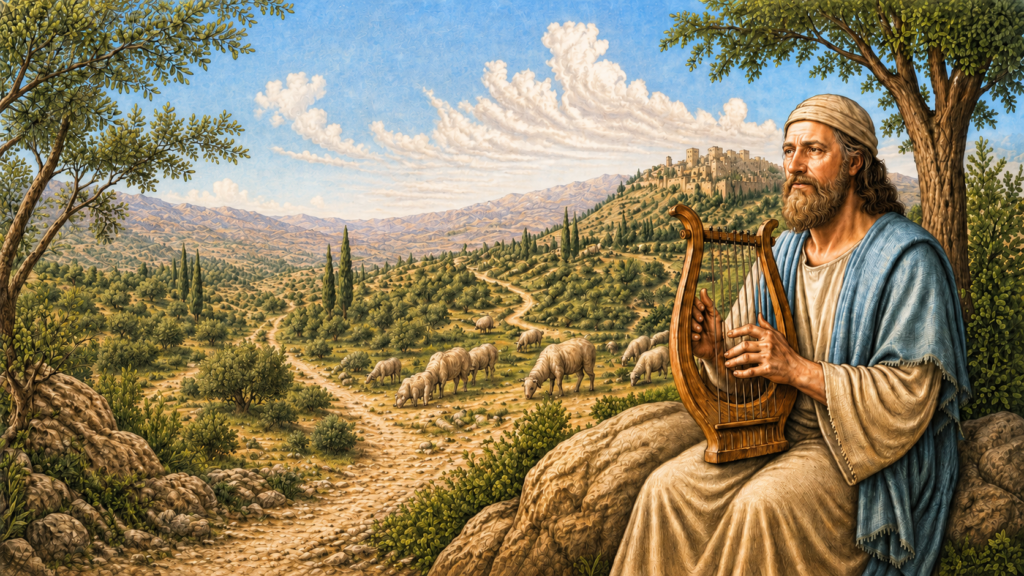
The lyre, often translated as harp, was the instrument of choice for ancient Israel and the primary instrument of their musical culture, especially with regards to melodic music.228 (p.iv) The most frequently mentioned instrument in the Old Testament is the shofar, a naturally occurring goat or ram’s horn. The shofar is very often simply translated as ‘trumpet’ in English versions of the Bible.227 (p26) Metal trumpets, and in particular, silver trumpets are also commonly mentioned in the Bible. For simplicity, we will use the term ‘trumpet’ in this book to mean either the shofar or the metal trumpet, as they are often used in similar contexts and for overlapping purposes, although they did have their distinctive uses. Being cone-shaped and valveless, the silver trumpet and shofar would probably have been able to produce only the second, third and fourth notes of the harmonic series.34 (p54) The tambourine was a small, rounded frame drum, much like modern tambourines, except without metal jingles attached to the side. It is the only type of drum known to the region of ancient Israel.227 (p29-30) Other instruments mentioned in the Bible include: the flute, wood clapper, rattle, cymbals and bells among others. In the coming chapters, we will discuss in more detail some of the instruments of the Bible.