
Harmonising with God in Our Music and Practices
Part 4 - Instruments
Chapter 14
Chapter 14
The Trumpet
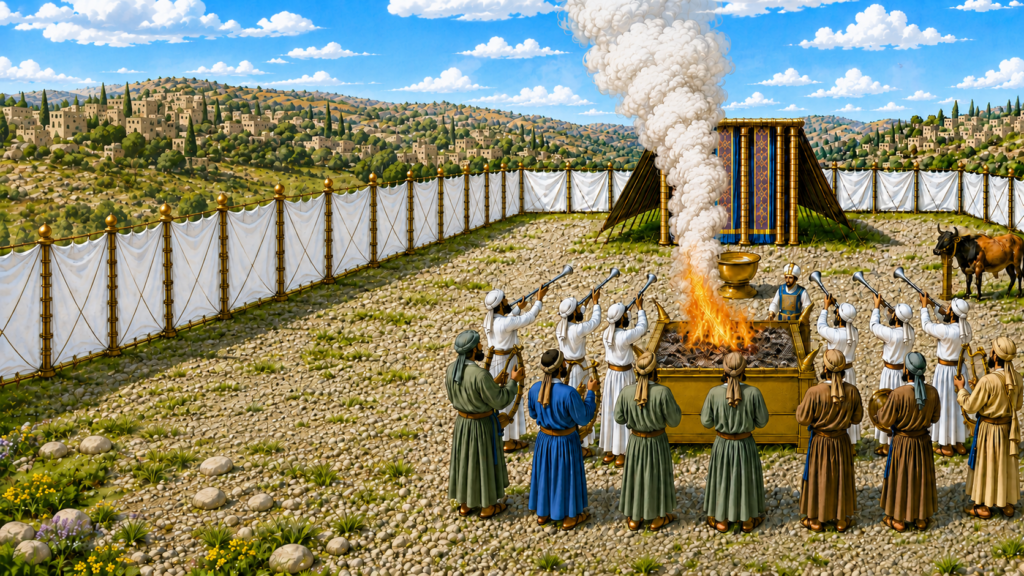
The trumpet is the first and primary musical instrument assigned by God for use by His people. The very first reference to the trumpet in the Bible is when God appeared to the Children of Israel at Mount Sinai with thunder, lightning, a thick cloud of smoke and very loud trumpet sounds (Ex 19:13,16&19). This sets the stage for God’s use of music amongst His people. The trumpet sound became a means of communication between God and His people. From that point onward, the trumpet would be an important means of communicating important messages to the Children of Israel.
The blast of the trumpet is likened to voice (Is 58:1; Rev 4:1)227 (p28) and loud voice or shouting is often used as a synonym for the trumpet sound, such as in Psalm 47:5: “God has gone up with a shout, The Lord with the sound of a trumpet.” When God called Ezekiel to give a message of warning to His people, He associated His word with the sound of a trumpet (Ez 33:6-8). Indeed, the trumpet served a very practical purpose of communication, since the children of Israel did not have telephones or a mail service and the written language was still in its infancy. The trumpet is the instrument of choice for this purpose because of its ability to communicate specific signals across long distances.
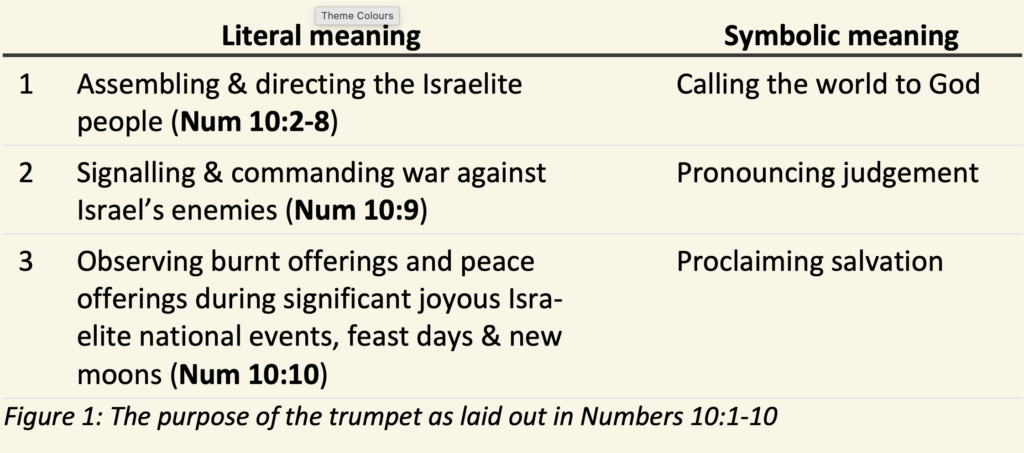
When all references to trumpets used by God’s people in the Bible are analysed, they can be grouped into three practical uses according to God’s command in Numbers 10:1-10:
- Assembling & directing the Israelite people
- Signalling & commanding war against Israel’s enemies
- Observing burnt offerings and peace offerings during significant joyous Israelite national events, feast days & new moons
In general, the trumpet was used for these specific purposes only, as instructed by God (see Figure 1).
Apart from directing crowds or signalling war, the trumpet was almost exclusively used in connection with the temple and its services. Even for directing people, it was often used to gather people to the sanctuary. The trumpet was used to praise and worship God but only in the context of these special purposes of national and religious significance. In time, God allowed other instruments, including cymbals, stringed instruments and harps, to be used along with the trumpet (2 Chr 29:25-30). Singers also joined in with the music and the whole assembly would worship (v28). Therefore, the use of music in temple worship evolved from simply the blowing of trumpets to the use of multiple instruments, along with singing. Despite the addition of other instruments and singers and the whole congregation joining in with the worship, the function of the music remained the same as when God first assigned the trumpets for use in the temple: for observing burnt offerings and peace offerings during significant joyous Israelite national events, feast days & new moons. As with trumpets, cymbals are also loud and when all instruments are played together, along with shouts of joy, it can add to the effect of the trumpet.
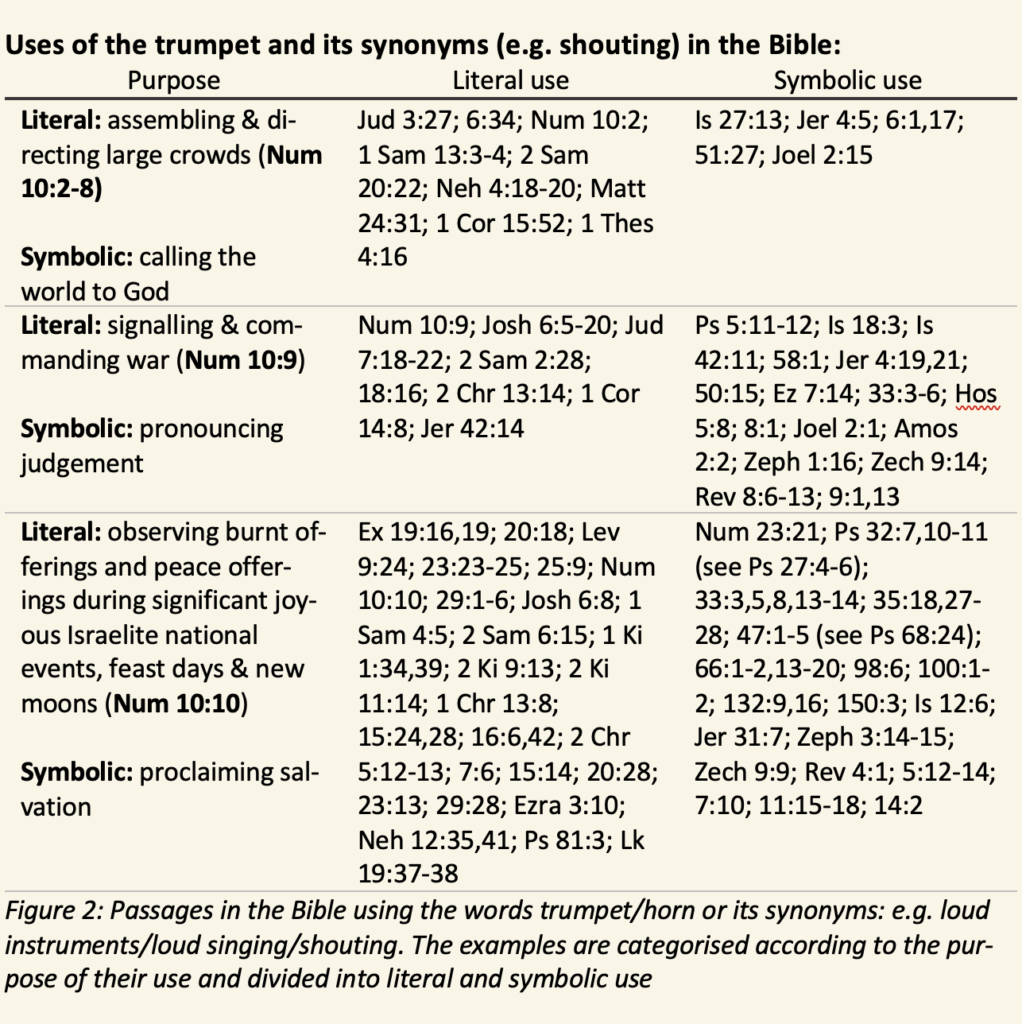
As with other items associated with the temple, the trumpet has symbolic meaning. Every item in the sanctuary and every ritual associated with the temple was a metaphor or a symbol of a certain aspect of God’s plan of salvation. For example, the unleavened bread represents Jesus’ sinless life, the slain lamb represents Jesus’ crucifixion, and the lampstand represents the church because it shines the light of truth to the world. Likewise, the trumpet was a metaphor for communication of God’s plan of salvation to the world – calling the world to God, pronouncing God’s judgement and proclaiming salvation. Just as the bread, the lamb and the lampstand were object lessons to illustrate the redemptive work of God in the world, the trumpet and shouting were object lessons symbolising the communication of God’s redemptive work. Below are some examples of literal and symbolic uses of the trumpet in the Bible (including shouting and associated instruments and singing). The examples are categorised according to the three main uses assigned by God in the temple as found in Numbers 10.
Symbolism of the Trumpet:
1. Calling the World to God
Command:
“Make two silver trumpets for yourself; you shall make them of hammered work; you shall use them for calling the congregation and for directing the movement of the camps… The sons of Aaron, the priests, shall blow the trumpets; and these shall be to you as an ordinance forever throughout your generations.” (Num 10:2&8)
Examples:
When Nehemiah was directing the rebuilding of the wall, he commanded the builders: “Wherever you hear the sound of the trumpet, rally to us there (Neh 4:20).” When Jesus returns as King, there will be a literal trumpet call and a shout (loud command) as He returns to gather His people:
“For the Lord Himself will descend from heaven with a shout, with the voice of an archangel, and with the trumpet of God. And the dead in Christ will rise first. Then we who are alive and remain shall be caught up together with them in the clouds to meet the Lord in the air. And thus we shall always be with the Lord.” (1 Thes 4:16-17)
Here again, we see ‘loud command’, ‘voice’ and ‘trumpet call’ being associated together. When Israelite leaders blew the trumpet, the Children of Israel were to gather at the temple and when Jesus returns at His second coming, a trumpet will sound to gather God’s people, including the dead in Christ.
Symbolic use:
The trumpet was also often used figuratively in the Bible for calling and assembling God’s people spiritually. For example, the prophet Joel said:
“So rend your heart, and not your garments;
Return to the Lord your God,
For He is gracious and merciful,
Slow to anger, and of great kindness…
Blow the trumpet in Zion,
Consecrate a fast,
Call a sacred assembly;
Gather the people,
Sanctify the congregation.” (Joel 2:13,15-16)
Of the Israelite exiles, Isaiah declared:
“So it shall be in that day: The great trumpet will be blown; they will come, who are about to perish in the land of Assyria, and they who are outcasts in the land of Egypt, and shall worship the Lord in the holy mount at Jerusalem.” (Is 27:13)
There is no literal trumpet in Jerusalem that can be heard in Assyria and Egypt – this is not possible – but God’s people are called to Him out of bondage through the words of His prophets. The words of the prophets, in this case, is the trumpet call. Likewise, the angel cries “mightily with a loud voice… Babylon the great is fallen (Rev 18:2).” And another voice says, “Come out of her my people (Rev 18:4).” Metaphorically, the trumpet sound and loud voice in these examples symbolise God’s Word being preached with the power of the Holy Spirit to draw people out of bondage with the world and false religion and into a true relationship with God.
(See Figure 2 for more examples)
Symbolism of the Trumpet:
2. Pronouncing judgment
Command:
“When you go to war in your land against the enemy who oppresses you, then you shall sound an alarm with the trumpets, and you will be remembered before the Lord your God, and you will be saved from your enemies.” (Num 10:9)
Example:
When Judah was ambushed by Jeroboam, King of Israel, and the battle line was at both front and rear:
“they cried out to the Lord, and the priests sounded the trumpets. Then the men of Judah gave a shout; and as the men of Judah shouted, it happened that God struck Jeroboam and all Israel before Abijah and Judah. And the children of Israel fled before Judah, and God delivered them into their hand.” (2 Chr 13:14-16)
Ironically, it was the northern kingdom of Israel that was the enemy and God drove them away at the sound of the trumpet and the shouts. Anyone who oppresses God’s people is the enemy, including professed followers of God.
Symbolic use:
Warning and judgement is probably the most widely recognised figurative meaning of the trumpet in the Bible. Of His own people, God declared “Cry aloud, spare not; lift up your voice like a trumpet; tell my people their transgression, and the house of Jacob their sins (Is 58:1).” God used the metaphor of the trumpet to illustrate Ezekiel’s role as watchman for the house of Israel. He said:
“…if the watchman sees the sword coming and does not blow the trumpet, and the people are not warned, and the sword comes and takes any person from among them, he is taken away in his iniquity; but his blood I will require at the watchman’s hand.” (Ez 33:6)
God then interprets the meaning of the trumpet in this illustration:
“I have made you a watchman for the house of Israel; therefore, you shall hear a word from My mouth and warn them for Me. When I say to the wicked, ‘O wicked man, you shall surely die!’ and you do not speak to warn the wicked from his way, that wicked man shall die in his iniquity; but his blood I will require at your hand.” (Ez 33:7-8)
God clearly interprets the blowing of the trumpet here as a metaphor for declaring His word. But it is not just God’s rebellious people that are to be warned. Isaiah declared:
“All inhabitants of the world and dwellers on the earth: when he lifts up a banner on the mountains, you see it; and when he blows a trumpet, you hear it.” (Is 18:3)
As a church, it is our job to sound the alarm to the world. If we do not declare God’s Word to the lost, they will die in their iniquity and their blood will be on our hands. The seven trumpets of Revelation are God’s judgements on the world. When the Israelites went into battle and blew the trumpet it was a pronouncement of doom for the enemy because God would fight for the Israelites. Likewise, the seven trumpets of Revelation 8-11 are symbolic of God’s judgement on the world because of their opposition to Him and His people. We are living in the time of the last trumpets. Seventh-day Adventists believe it is their job to proclaim the three angels’ message with a loud voice so that all may have the opportunity to repent, turn to God and avoid receiving the wrath of His judgement. In Testimonies for the Church, volume 9, we read:
“Do not divest the truth of its dignity and impressiveness by preliminaries that are more after the order of the world than after the order of heaven. Let your hearers understand that you hold meetings, not to charm their senses with music and other things, but to preach the truth in all its solemnity, that it may come to them as a warning, arousing them from their deathlike sleep of self-indulgence. It is the naked truth that, like a sharp two-edged sword, cuts both ways. It is this that will arouse those who are dead in trespasses and sins.”196 (p142)
General Booth by no means neglected to warn his hearers of the coming judgement. In fact, this was the main emphasis of his preaching. He so vividly captured the scenes of judgement that the anguish invoked in his listeners sometimes caused them to literally tear up whatever they had in their hands.
Mrs White also warned her readers and listeners of God’s judgement. This has caused some to see Mrs White as a stern and judgemental person. However, others see in her writings saturation with love for God and for her saviour. Her most widely read book is the Christian classic, Steps to Christ, which discusses how to come to know Jesus Christ at a personal level. It is listed on the popular website, Godtube, as one of the top 10 selling Christian books of all time, amongst other classics, such as Pilgrims Progress, by John Bunyan and The Lion, the Witch and the Wardrobe by C.S. Lewis. It is estimated to have sold 60 million copies in 160 languages.274 This is apart from her other classic on the life of Christ, The Desire of Ages, which, for many years, some Adventist sources say, was listed by The Library of Congress in the United States as the best book on the life of Christ. Her other works never fail to discuss the profound love of Christ for His creation.
It is in the nine-volume series, Testimonies to the Church, that readers come across some of Mrs White’s harshest judgements, especially in the first few volumes. These are very often directed at individuals and often come close to home for each reader as they relate to the very sins that she was calling out in individuals. Some people use this as a reason to disregard Mrs White as overbearing and unloving.
However, one of the primary jobs of prophets is to call out people’s sins, such as that of David when Nathan publicly confronted him over Uriah the Hittite and Bathsheba (2 Sam 12:7-9). Jesus, Himself, often publicly declared the sins of individuals, especially the Pharisees, and warned of judgement. As God explained to the prophet Ezekiel, if a prophet hears a word from God but fails to “speak to warn the wicked from his way, that wicked man shall die in his iniquity; but his blood I will require at your hand (Ez 33:8).”
If we are used to solely hearing messages of grace and mercy in songs and sermons, the voice of prophets, such as we read in the major and minor prophets of the Old Testament, will seem excessively harsh. Mrs White describes how she was shown in vision errors in people’s lives that were leading them and others astray. If she truly was receiving warnings from God, she had no choice but to sound the warning to these individuals, many of whom affirmed the veracity of her visions and were grateful that they were given the opportunity to repent and turn to God.
If she was a genuine prophet, she was doing her job of blowing the trumpet – sending a warning to help save sinners. She did, however, warn that those who are not prophets are not to judge others in this way. That is why she could, on the one hand, point out errors in the Salvation Army method, while on the other hand, instructing Seventh-day Adventist members not to judge Salvationists:
“Neither is it our work to condemn them and speak harsh words against them. There are precious, self-sacrificing souls in the Salvation Army. We are to treat them kindly.”47 (p184)
When we see someone living in sin, we are to gently warn in a loving way. We do not know the hearts of individuals, so we cannot judge as God judges through His prophets. However, we are obligated to humbly and gently help our fellow Christians, in a tactful way, to see the error of their ways, according to Biblical methods and in an orderly manner (Matt 18:15-20). If we turn a blind eye to sins in the church, the blood of those who are lost as a consequence is on our hands (Acts 20:26-27; Jam 5:19-20).
(See Figure 2 for more examples)
Symbolism of the Trumpet:
3. Proclaiming Salvation
Command:
“Also in the day of your gladness, in your appointed feasts, and at the beginning of your months, you shall blow the trumpets over your burnt offerings and over the sacrifices of your peace offerings; and they shall be a memorial for you before your God: I am the Lord your God.” (Num 10:10)
Examples:
When Hezekiah became king, he restored the temple worship, including blowing the trumpet over the burnt offering as commanded by God:
“And he stationed the Levites in the house of the Lord with cymbals, with stringed instruments, and with harps, according to the commandment of David, of Gad the king’s seer, and of Nathan the prophet; for thus was the commandment of the Lordby His prophets. The Levites stood with the instruments of David, and the priests with the trumpets. Then Hezekiah commanded them to offer the burnt offering on the altar. And when the burnt offering began, the song of the Lord also began, with the trumpets and with the instruments of David king of Israel. So, all the assembly worshiped, the singers sang, and the trumpeters sounded; all this continued until the burnt offering was finished. And when they had finished offering, the king and all who were present with him bowed and worshiped. Moreover, King Hezekiah and the leaders commanded the Levites to sing praise to the Lord with the words of David and of Asaph the seer. So, they sang praises with gladness, and they bowed their heads and worshiped.” (2 Chr 29:25-30)
King Hezekiah assigned the blowing of trumpets precisely according to the command of God in the law of Moses along with accompanying instruments according to the commandment of the Lord by His prophets. The loud praise commemorates the blessings of God’s mercy and grace. After returning from Babylonian exile, the Jews again restored the temple music “according to the ordinance of David king of Israel (Ezra 3:10; Neh 12:45)” as approved by God. The praise to God given in song was always according to God’s specific instruction.
Examples of days of gladness (joyous national events), include: dedication of Solomon’s temple (2 Chr 7:6); dedication of the rebuilding of the wall of Jerusalem (Neh 12:31-36); laying the foundation of the second temple (Ezra 3:10-11) and the anointing of kings, such as King Solomon (1 Ki 1:34). These can all be regarded as types that were fulfilled in Christ’s kingdom, the antitype.
Symbolic use:
Many uses of the trumpet are found in Psalms, which focuses a lot on God’s mercy and grace. Psalms uses a lot of poetic language, very often in the context of temple worship and ritual. Though references to shouting and trumpets in Psalms can be taken literally, the meaning is also very symbolic. In the literal setting of the earthly temple, the trumpet would sound from the temple and the Israelite people would gather at the temple. From the temple, God would give instructions to His people. Also, sacrifices were made to provide forgiveness for their sins and trumpets were blown over these offerings.
But instead of referring to the temple in a literal sense, Psalms generally refers to these same activities in a spiritual sense involving the whole world. The whole world is called to assemble, figuratively, in praise before God. For example, in Psalm 33, we are admonished to “Sing to Him a new song; Play skillfully with a shout of joy (v3).” A few verses after this, we are given the context of this praise: “Let all the inhabitants of the world stand in awe of Him (v8).” This is temple imagery of God’s people gathering at the temple. Reading further along, we find out where God is located: “The Lord looks from heaven; He sees all the sons of men. From the place of His dwelling He looks on all the inhabitants of the earth (v13-14).” Therefore, God’s people are assembled before God who is seated in His sanctuary in heaven. And what is God doing? “He fashions their hearts individually; He considers all their works (v15)”. In other words, He is instructing His people, making them into a holy people. As they gather, His people are also reminded of His mercy: “Behold, the eye of the Lord is on those who fear Him, on those who hope in His mercy, to deliver their soul from death (v18-19)”
Therefore, in Psalm 33, we see temple worship symbolically represented. Remember, shouting is a synonym for the trumpet. The shout goes out – this is the trumpet call. God’s people all over the world, spiritually speaking, assemble before God who is looking down from His sanctuary in heaven. As they behold Him, their hearts are changed and He gives them hope in His salvation. The purpose of singing and shouting in Psalm 33, as with many other Psalms, symbolises the call for the world to come to God to witness His salvation.
In the literal earthly temple, the trumpet was blown at the temple. It signalled to the people to gather at the temple and it let the people know that a sacrifice was being made, a temple festival was being celebrated or another joyous event was taking place. This was symbolic of the saving work that Jesus would do for us which gives us great joy. The trumpet sound communicated the joyous event to the community.
Psalm 32 begins with the blessings of forgiveness of transgression: “Blessed is he whose transgression is forgiven, whose sin is covered… (v1-5).” Further along, we discover the setting of this forgiveness: “You are my hiding place; You shall preserve me from trouble; You shall surround me with songs of deliverance (v7).” My hiding place refers to the temple (see Ps 27:4-6) – this is where we receive forgiveness. The end result of this forgiveness is joyous thanksgiving as we find expressed at the end of the chapter: “Be glad in the Lord and rejoice, you righteous; and shout for joy, all you upright in heart! (v11).”
In Psalm 98, ‘all the earth (v4)’ is called to ‘shout joyfully before the Lord (v6)’:
“…All the ends of the earth have seen the salvation of our God.
Shout joyfully to the Lord, all the earth;
Break forth in song, rejoice, and sing praises.
Sing to the Lord with the harp,
With the harp and the sound of a psalm,
With trumpets and the sound of a horn;
Shout joyfully before the Lord, the King.” (Ps 98:3-6)
It is not physically possible for the whole earth to gather together before the Lord at His temple, as the Israelites did. There is no literal trumpet, no literal shouts and no literal procession or gathering of people at the temple. But in a spiritual sense, the psalmist is calling all people in the world to shout joyfully before the Lord for the salvation that he brings to the world.
God was present with the Hebrew people in the temple and when a burnt offering was made, the trumpets were sounded. Symbolically, we also see these three elements in the Psalms as we have seen with the above examples. When shouting or trumpets appear in the Psalms, there is also a call to come before God in His sanctuary, to witness His mercy and receive forgiveness and salvation. In the Psalms, however, it involves the whole earth.
In Psalm 150, we see these same three elements in the first three verses. God is praised “in His sanctuary (v1).” He is praised for “His mighty acts (v2),” which includes His atoning work. And He is praised “with the sound of the trumpet (v3),” along with other accompanying instruments. Also, the whole earth is involved, in fact, “everything that has breath” is to praise God (v6). The context is very poetic. It is not literally possible for ‘everything that has breath’ to praise the Lord ‘in His sanctuary.’ The trumpet blowing and cymbal clashing, therefore, is a metaphor for praise. John said, “let us not love in word or in tongue, but in deed and in truth (1 Jn 3:18).” In Amos 5, God told the Israelite people that He did not accept their burnt offerings (v22) or the melody of their stringed instruments (v23). Instead, He said “let justice run down like water, and righteousness like a mighty stream (v24).” Therefore, we primarily praise God through our actions. The best way to sing God’s praise to the world is to live a life of righteousness and justice and to share truth with others.
Psalm 66 is a song of praise to God for His wonderful works and His deeds toward the sons of men. Figuratively speaking, David invites the whole earth to “make a joyful shout to God (v1)” as he enters into God’s “house with burnt offerings (v13).” After symbolically making the offering, he then says, “Come and hear, all you who fear God, and I will declare what He has done for my soul (v16).” When we look upon Jesus’ sacrifice, the longing of our hearts is to share with others what He has done for our souls. This is what the trumpet being blown over the burnt offering symbolises – the joy that gushes out of our souls as we share the good news of salvation with others. It is not possible for all the earth to literally join with David in sacrifice and praise in the sanctuary; however, spiritually speaking, when all believers around the world share the good news of Jesus’ sacrifice, we are blowing the trumpet in all the earth.
Sometimes the temple imagery is not obvious, but whenever there is shouting and trumpets in Psalms, invariably it is in the context of the temple. For example, Psalm 47 opens with, “Oh, clap your hands, all you peoples! Shout to God with the voice of triumph (v1)!” The context of this shouting is given further down:
“God has gone up with a shout,
The Lord with the sound of a trumpet.
Sing praises to God, sing praises!
Sing praises to our King, sing praises!” (v5-6)
We know from Psalm 68 that this is a procession of singing and music accompanying God as He goes up into His sanctuary:
“They have seen Your procession, O God,
The procession of my God, my King, into the sanctuary.
The singers went before, the players on instruments
followed after;
Among them were the maidens playing timbrels.”
(Ps 68:24-25)
It is not only in Psalms that we find symbolic use of the trumpet as proclamation of salvation. For example, we see shouting, a synonym for the trumpet, figuratively used in this messianic passage:
“Rejoice greatly, O daughter of Zion!
Shout, O daughter of Jerusalem!
Behold, your King is coming to you;
He is just and having salvation,
Lowly and riding on a donkey,
A colt, the foal of a donkey.” (Zech 9:9)
The sacrificial offering, which was symbolically represented in the temple with the sound of a trumpet, is prophetically heralded here by the trumpet sound, by a shout, as He enters Jerusalem on a donkey in preparation for that great sacrifice which was forecast from the foundation of the world.
When the Lamb ascends to heaven, having made the ultimate sacrifice, the trumpet sound is still proclaiming His mighty act, “saying with a loud voice:
‘Worthy is the Lamb who was slain
To receive power and riches and wisdom,
And strength and honor and glory and blessing!’”
(Rev 5:12)
(See Figure 2 for more examples)
In summary, the Bible likens the sound of the trumpet to words and voice. The trumpet is also very often used interchangeably with expressions such as ‘shout’, ‘loud voice’ and ‘loud command.’ God assigned the trumpet in the temple for three purposes of communication: to assemble people, to command war and to blow over the sacrificial burnt offerings and peace offerings during special occasions. The use of the trumpet in the temple, with God’s approval, evolved to include other instruments, shouting and singing but the original purpose remained the same – to praise God for His mighty works of salvation which came about via sacrifice.
Very often, the trumpet and its synonyms, such as shout, are used symbolically in the Bible to gather God’s people to Him – not literally, but spiritually – and to pronounce judgement on God’s enemies. The blowing of the trumpet over sacrifices is also very often used metaphorically in the Bible, especially in Psalms, for proclaiming God’s salvation to the whole world. God’s people are His instruments to achieve this end – for we are to sing and shout his praise, figuratively speaking, all around the world. The gift of salvation is so great that it has to be ‘shouted’ so that the whole world can hear it.
Though the psalms were literally accompanied with instruments and song, when the psalms use ‘trumpets’ and ‘shouting’ as lyrics, the language is very poetic and figurative. The burnt offering was a freewill offering and the whole offering was completely burned up. The sacrifice was a symbol of Jesus’ sacrifice, but the giver also had to give up something. When we give something valuable for God, it shouts our praise. Paul said to “
(Rom 12:1).” We praise God – we sing, we shout, we blow the trumpet – by giving of ourselves, by offering our lives in service to God. Therefore, the trumpet is symbolic of our praise in action, living a life that demonstrates our love for God. The trumpet is also symbolic of our voice, carrying the gospel message to a fallen world by whatever means – in personal testimonies, in sharing with our neighbours, in preaching, in Bible studies and in the lyrics of our songs.