
Harmonising with God in Our Music and Practices
Part 3 - How to Praise God
Chapter 12
Chapter 12
A Day for Special Praise

If we are to worship God in spirit and in truth, we must ensure that we worship Him according to the truth of His Word. As discussed previously, we cannot have true joy unless we are living in obedience to our Lord’s commands. We are to search Scripture to ensure we are abiding by His will. But how do we know we are interpreting Scripture correctly? One person believes rock music is acceptable for worship of God because the Israelites sang and danced exuberantly when moving the ark of the covenant (1 Chr 13:8); while another person believes rock music is unacceptable because Paul says not to conform to this world (Rom 12:2). But neither of these passages provide a direct command from God concerning music. So who is to say one person’s view is correct and the other incorrect?
We often draw conclusions about God’s will based on philosophical arguments, which are prone to human error and have less certainty. How then can we know what God’s will is with more certainty? It is much safer to be guided by the direct commands of God. His command is like light, giving us clarity: “For the commandment is a lamp, and the law a light (Prov 6:23).” His command opens our eyes to truth: “The commandment of the Lord is pure, enlightening the eyes (Ps 19:8).” When we know what God’s command is, it gives clarity to the rest of Scripture.
General Booth’s primary motive in his life and ministry was to preach in such a way and do whatever it took to encourage people to say yes to God’s gracious invitation and thus avoid the fires of eternal torment. He had a heart for saving the lost. According to the Bible, those who avoid the fires of hell “are those who keep the commandments of God (Rev 14:12).” They “follow the Lamb wherever He goes (v4).” Jesus said, “My sheep hear My voice, and I know them, and they follow Me (Jn 10:27).” They have the testimony of Jesus (Rev 12:17) which is the spirit of prophecy (Rev 19:9). Therefore, they also listen to His true prophets. Jesus followed His Father by being obedient to His commands: “But that the world may know that I love the Father, and as the Father gave Me commandment, so I do (Jn 14:31).”
As their name suggests, Seventh-day Adventists have a lot of regard for the seventh-day Sabbath. This is not a popular message. Just as the Salvation Army received much ridicule for their style of worship, Seventh-day Adventists received much criticism for Sabbath keeping. Still today, seventh-day Sabbath keeping is by far the minority practice, though there are some prominent public figures who keep the seventh-day Sabbath, including world renowned retired neurosurgeon, Dr Ben Carson and the late Charlie Kirk, a conservative Christian political activist who was fatally shot while this book was being written.
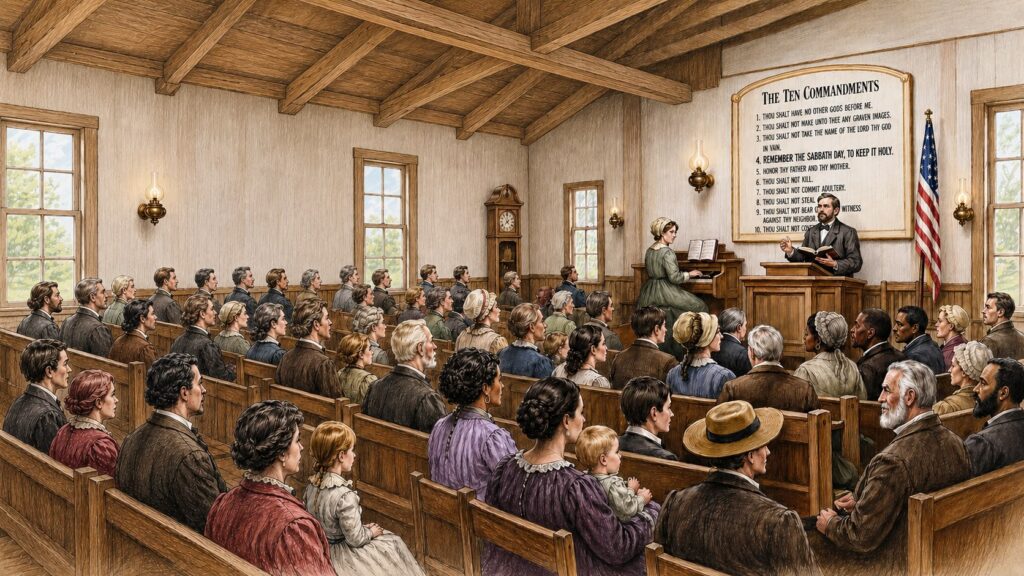
From the story of Uzzah and the transport of the ark to Jerusalem, we learned that obedience is more important to God than songs of praise, therefore, we need to ensure we are obedient in our worship. For many Seventh-day Adventists, if we are to worship God correctly, even more important than the style of worship is the day in which we worship, since they believe there is clear command concerning the Sabbath. Following is a brief outline of Seventh-day Adventist reasoning for Sabbath keeping.
The Sabbath was first introduced to Adventists of Washington, New Hampshire, as early as 1844, by Sister Preston, a Seventh-day Baptist. Elder Joseph Bates, one of the founding fathers of the Seventh-day Adventist Church, began teaching the Sabbath in 1845. James White read a little pamphlet that Joseph Bates had written on the topic and became convinced of the Sabbath also.32 In Revelation, Joseph Bates and James White saw an end-time call to Sabbath worship in the proclamation of the three angels as found in chapter 14.239 The first angels’ message reads as follows:
“Then I saw another angel flying in the midst of heaven, having the everlasting gospel to preach to those who dwell on the earth – to every nation, tribe, tongue and people – saying with a loud voice, ‘Fear God and give glory to Him, for the hour of His judgment has come; and worship Him who made heaven and earth, the sea and springs of water.’” (Rev 14:6-7)
Central to the gospel message in these verses is a call for people to worship ‘Him who made heaven and earth, the sea and springs of water.’ Adventists see a glaring sign here to what is meant by worship. This phrase is actually a quote from the fourth commandment which is a command to worship the creator by honouring His day. The fourth commandment is an admonition to keep the seventh day holy, “For in six days the Lord made the heavens and the earth, the sea, and all that is in them, and rested the seventh day (Ex 20:11).” In turn, the fourth commandment is a quote from the creation story. At the foundation of the world, on the seventh day, God had finished creating “the heavens and the earth, and all the host of them… Then God blessed the seventh day and sanctified it (Gen 2:1&3).” It was set apart for a special purpose to worship God.
God refers to the seventh day as His holy day (Is 58:13). Jesus said He is Lord of the Sabbath (Mk 2:28). Therefore, Adventists hold that the seventh-day Sabbath is a direct command from God. From the foundation of creation, God set it apart as a holy day. The seventh day still exists today and, without a clear command from God stating that the seventh day is no longer holy, Seventh-day Adventists are not satisfied to ignore it.
Martin Luther upheld the ten commandments but believed the Sabbath could be kept on any day.240 (p161) General Booth also believed in keeping Sunday as a Sabbath day of rest:
“Now I had strong notions in my youth and for long after – indeed, I entertain them now – about the great importance of keeping the Sunday, or Sabbath as we always called it, clear of unnecessary work…I still think we ought to abstain from all unnecessary work ourselves, and, as far as possible, arrange for everybody about us to have one day’s rest in seven. But, as I was saying, I objected to working at my business on the Sabbath, which I interpreted to mean after twelve o’clock on Saturday night. My relatives and many of my religious friends laughed at my scruples; but I paid no heed to them, and told my master I would not do it, though he replied that if that were so he would simply discharge me.”57 (p19)
Pastor David Earnshaw referred to General Booth as very legalistic because he refused to do paid employment on the ‘Sabbath.’31 Is simply following the law legalism? Christianity.com defines legalism as attempting to:
“…secure righteousness in God’s sight by good works… Legalism focuses on God’s laws more than relationship with God. It keeps external laws without a truly submitted heart. And legalism adds human rules to divine laws and treats them as divine.”241
There is no hint that General Booth believed he could win salvation by keeping the Sabbath or any other law of God. Therefore, he probably was not a legalist. We tend to overcompensate for legalism by referring to any form of obedience to God’s commands as legalism.
The Israelites worshipped God with great enthusiasm before the ark of the covenant while completely ignoring God’s command. Before we even think about how we should worship God with music, we first must ensure that we are following His commands, which includes the day we are to set aside for worship. Seventh-day Adventists regarded the ten commandments as still binding. Many well-known reformers and preachers believed the same. John Calvin said:
“…we must not imagine that the coming of Christ has freed us from the authority of the law: for it is the eternal rule of a devout and holy life, and must, therefore, be as unchangeable, as the justice of God, which it embraced, is constant and uniform.”242 (p277)
Dwight L. Moody said:
“Jesus never condemned the law and the prophets, but He did condemn those who did not obey them… The people must be made to understand that the Ten Commandments are still binding, and that there is a penalty attached to their violation.”243 (p15-6)
Charles Spurgeon said:
“Jesus did not come to change the law, but he came to explain it, and that very fact shows that it remains, for there is no need to explain that which is abrogated.”244
If the commandments are still binding, Sabbatarians ask, would not the day also be binding? Therefore, they regard the seventh day as a special day belonging to God, rather than the first day or any other day. Regarding the fourth commandment, Charlie Kirk said:
“I will challenge the Christian church because I believe this is the most ignored commandment of the decalogue to our own detriment.”245 (3:50)
Before his premature death, Charlie Kirk wrote a book called, Stop, In the Name of God: Why Honoring the Sabbath Will Transform Your Life. He said he would like to carry on the tradition of bringing the teachings of the seventh-day Sabbath to millions of people.245
But, if we are under grace, why do we need to continue to keep the law, especially knowing that “Christ has redeemed us from the curse of the law (Gal 3:13).” Firstly, Paul said “the law is holy, and the commandment holy and just and good (Rom 7:12).” A psalmist said, “Great peace have those who love Your law (Ps 119:165).” David said:
“The law of the Lord is perfect, converting the soul;
The testimony of the Lord is sure, making wise the simple;
The statutes of the Lord are right, rejoicing the heart;
The commandment of the Lord is pure, enlightening the eyes;
The fear of the Lord is clean, enduring forever;
The judgments of the Lord are true and righteous altogether.
More to be desired are they than gold,
Yea, than much fine gold;
Sweeter also than honey and the honeycomb.
Moreover by them Your servant is warned,
And in keeping them there is great reward.” (Ps 19:7-11)
If the law is perfect, holy, just, pure and good, and if the law makes us wise, warning us and enlightening the eyes, and if the law is like much fine gold and sweeter than honey, rejoicing the heart and giving great peace, why then did Paul call the law a curse? The law is a curse to sinners because “the wages of sin is death (Rom 6:23)” and sin is transgression of the law (1 John 3:4). Fortunately, Jesus cancelled the debt owing to us, “having wiped out the handwriting of requirements that was against us, which was contrary to us (Col 2:14).” Therefore, we can once again enjoy the benefits of the law without the penalty owing to us due to transgression. That is wonderful news, worthy of songs of praise! Though David lived long before Christ, by faith He believed he was forgiven – he knew he was under grace:
“For as the heavens are high above the earth,
So great is His mercy toward those who fear Him;
As far as the east is from the west,
So far has He removed our transgressions from us.” (Ps 103:11-12)
Therefore, though he knew he was a sinner and he felt the weight of his transgressions, David could rejoice in the law because he knew he was under grace. David establishes the law. That is the beauty of Jesus’ sacrifice – He upheld the law while freeing us from our debt – but it came at a great cost, and hence, the great penalty that comes to those who make void the law for which Christ paid such a dear price to uphold. Jesus said:
“Whoever therefore breaks one of the least of these commandments, and teaches men so, shall be called least in the kingdom of heaven; but whoever does and teaches them, he shall be called great in the kingdom of heaven.” (Matt 5:19)
Similarly, Paul said: “Do we then make void the law through faith? Certainly not! On the contrary, we establish the law (Rom 3:30-31).”
The other reason we obey the law is because, when we give our lives to Jesus, we become slaves to righteousness rather than slaves to sin:
“What then? Shall we sin because we are not under law but under grace? Certainly not! Do you not know that to whom you present yourselves slaves to obey, you are that one’s slaves whom you obey, whether of sin leading to death, or of obedience leading to righteousness? But God be thanked that though you were slaves of sin, yet you obeyed from the heart that form of doctrine to which you were delivered. And having been set free from sin, you became slaves of righteousness.” (Rom 6:15-18)
Having said all that, we are no longer bound by Moses’ ceremonial laws but only by God’s commands:
“Circumcision is nothing and uncircumcision is nothing, but keeping the commandments of God is what matters.” (I Cor 7:19)
Therefore, since the seventh-day Sabbath was laid down at creation, Sabbatarians believe it belongs to the commandments of God which still matter. Mrs White’s husband, James White, in his book, Life Incidents, argues that the Sabbath day was altered by a corrupted church, especially around the 4th and 5th centuries.
Joseph Bates and other early Adventist pioneers asserted that not one text in the New Testament taught a change of the Sabbath from the seventh to the first day of the week.32 Many people have cited Romans 14:5 as a reason to regard the seventh day as no more holy, blessed or special than any other day:
“One person esteems one day as better than another, while another esteems all days alike. Each one should be fully convinced in his own mind.”
Sabbath keepers are quick to point out that this verse does not mention the words ‘holy’, ‘Sabbath’ or ‘seventh day.’ Without looking at the context, we do not know if Paul is referring to worship days, Sabbath days, fasting days, festival days or some other days. In fact, the context of this passage is mostly about food, suggesting that Paul is referring to days of fasting, which was a contentious issue during Paul’s time (there is no hint in the New Testament that the perpetuity of the Sabbath day was ever under dispute). In that case, the verse would read “One person esteems one day as better than another [for fasting], while another esteems all days alike. Each one should be fully convinced in his own mind [which day is most appropriate for fasting].” Therefore, it is argued, this passage certainly cannot be used to overrule the seventh-day Sabbath. It is certainly not a clear command to overturn the Sabbath.
Colossians 2:16-17 is another significant passage used against the perpetuity of the holy Sabbath day. Before we take a look at this passage, it is important to point out that Adventists acknowledge that there are different uses of the word ‘sabbath’ in the Bible. There are two types of Sabbaths in the Old Testament – the weekly Sabbath of the ten commandments and the festival Sabbaths. An example of a festival Sabbath is the Day of Atonement: “the tenth day of this seventh month shall be the Day of Atonement (Lev 23:27)… It shall be to you a sabbath of solemn rest (v32).” On the Day of Atonement, the priest killed the goat of the sin offering, which was for the people (Lev 16:15). Therefore, this festival sabbath, the Day of Atonement, pointed forward to Jesus’ sacrifice. It was not the real thing, but a ‘shadow’ of something to come. This is true of all of the festival sabbaths – they looked ahead to Jesus.
The other type of Sabbath is the seventh-day Sabbath:
“Remember the Sabbath day, to keep it holy (Ex 20:8)… For in six days the Lord made the heavens and the earth, the sea, and all that is in them, and rested the seventh day. Therefore, the Lord blessed the Sabbath day and hallowed it (v11).”
The seventh-day Sabbath, therefore, points backward to creation. The festival Sabbaths look ahead to Jesus our saviour and the sacrifice that He made for us – they were a shadow of things to come. The seventh-day Sabbath, on the other hand, looks back to creation, acknowledging God as our creator, the one we worship – the one ‘who made heaven and earth, the sea and springs of water.’ Therefore, the seventh-day Sabbath is not a shadow of things to come but a memorial of creation. With that context in mind, let us take a look at Colossians 2:16-17:
“So let no one judge you in food or in drink, or regarding a festival or a new moon or sabbaths, which are a shadow of things to come, but the substance is of Christ.”
Since this passage does not mention ‘seventh day,’ we have to determine from the context if the word ‘sabbaths’ in this text is referring to the seventh-day Sabbath, the festival sabbaths, or both. If the festivals were pointing ahead to Jesus, then this verse is clearly referring to the festival sabbaths which were a shadow. Jesus was the substance because He fulfilled the festivals. Some may question the accuracy of this interpretation; however, since the verse does not explicitly state ‘seventh-day’ Sabbath, there is too much ambiguity to emphatically render the seventh-day Sabbath obsolete. Abolishing an institution of God requires a clear and unambiguous divine command. Therefore, Seventh-day Adventists insist that this passage cannot be used to overrule the Sabbath. It is not a command to end the Sabbath. Besides, if Paul did mean the seventh-day Sabbath, Adventists argue, it would have caused a huge uproar in the early church, since the Sabbath was such an important part of Jewish law and culture. However, we see no such backlash.
The Origin of the Change of the Sabbath
So, what do Adventists propose was the cause of the Sabbath change? Historical records show that the change was a gradual process which, Adventists say, came about by prejudice and persecution. According to Socrates, the historian (not the philosopher), in about 439 AD, most Christians were still observing the seventh-day Sabbath:
“…although almost all churches throughout the world celebrate the sacred mysteries on the sabbath of every week, yet the Christians of Alexandria and at Rome, on account of some ancient tradition, have ceased to do this.”246 (p289)
By this time, four centuries after Christ, it is estimated that the church had grown to at least 30 million members (mostly gentiles) or greater than half the population of the Roman empire.247 Christianity had also spread to vast areas of the Roman empire and beyond, including Britain in the west, Persia in the east and Ethiopia in the south. The majority of these believers, apparently, were still keeping the seventh-day Sabbath. The Christians in Rome and Alexandria, however, were observing Sunday instead.
Seventh-day Adventists hold that the change of the Sabbath in Rome and Alexandria did not come about due to sound exegesis. Unfortunately, the early church fathers were only human. There existed amongst some of them hatred and contempt toward Jews. Justin Martyr, for example, was very intolerant of the Jews. He claimed that the Jews were sick with spiritual disease, cursed & rejected by God.248 (p22) Justin Martyr provides clear and unambiguous affirmation that, by the mid-2ndcentury, Christians in Rome were regularly observing Sunday.249 (p65) There are few references to Sunday keeping prior to this time and those that we have are ambiguous and highly controversial and cannot be used emphatically to show that Christians were keeping Sunday in the first or early 2nd century.
For example, the Didache and the letters of Ignatius are frequently cited to support an early tradition of Sunday keeping in the church. Sabbath keepers have pointed out a number of theological concerns with these documents. For example, the Didache instructs followers of Christ to fast on Wednesday and Friday instead of on Monday and Thursday like ‘those of the hypocrites’. Paul said not to judge concerning fasting days. Concerning baptism, it teaches to baptise by pouring water on the head three times if running water is not available.250 (p5)
The Roman Catholic Church exalts the writings of the church fathers and establishes authority for its doctrines from these ancient texts. The Catholic Encyclopedia, for example, states that the Ignatian letters bear to the Divine origin of Catholic doctrine.251 (p644) Numerous modern-day scholars, however, question the reliability of these documents. Even John Calvin denied the authenticity of the Ignatius letters and recognised their inconsistency with Scripture:
“With regard to what they pretend as to Ignatius, if they would have it to be of the least importance, let them prove that the apostles enacted laws concerning Lent, and other corruptions. Nothing can be more nauseating, than the absurdities which have been published under the name of Ignatius; and therefore, the conduct of those who provide themselves with such masks for deception is the less entitled to toleration.”252 (p138)
In his Dialogue with Trypho, Justin wrote of the Jews:
“…it was by reason of your sins and the sins of your fathers that… God imposed upon you the observance of the Sabbath.”253 (p178)
Sabbath observers point out that God blessed the Sabbath day (Gen 2:3) and that it is to be a delight (Is 58:13). But Justin’s prejudice toward the Jews caused him to distort the Sabbath as a curse from God, rather than a blessing. Consequently, he felt justified in ridding the church of Jewishness, including Sabbath keeping. His views had profound influence on Christian thought. So much so that the Jewish Virtual Library identifies Justin Martyr’s writings as “the origins of Christian anti-Semitism.”254 We must not judge Justin’s sincerity as a Christian, for he was martyred for his faith, and only God knows the heart of any individual. But he was misled in his zeal for Christ, which caused him to condemn the race that killed his saviour. Likewise, we must not let our zeal for Christ cause us to hate those who are not like-minded with us.
Though earlier records are disputed, Sunday keeping was undeniably practised by Christians in Rome and possibly Alexandria by the mid-2nd century and seventh-day Sabbath keeping was discarded in these places. However, Sabbath observers still maintain that this is no reason to assume that they got this tradition from the apostles or that all Christians at the time were in favour of replacing Sabbath keeping with Sunday observance. We cannot put our trust in extra-Biblical sources or even the forefathers of the church, they argue, but we must always turn to Scripture for guidance. Besides, much of the historical record of Sunday keeping in the early church comes from Rome; therefore, it can appear to the casual observer that most Christians by this time period no longer considered the seventh day a holy day. However, as highlighted by Socrates, the change in the Sabbath was not widespread initially. The majority of Christians were still observing the seventh-day Sabbath as a holy day but were also gathering on Sunday to celebrate the risen saviour. Sozomenus, Roman lawyer and historian of the Christian Church, confirms that Sabbath keeping was still widespread across Christendom, apart from in Rome and Alexandria, as late as the 4th and 5th centuries:
“Assemblies are not held in all churches on the same time or manner. The people of Constantinople, and almost everywhere, assemble together on the Sabbath, as well as on the first day of the week, which custom is never observed at Rome or at Alexandria.”255 (p390)
Therefore, as late as the 5th century after Christ, Christians were keeping Saturday and Sunday. This was the origin of the weekend. The Apostolic Constitutions, a collection of authoritative instructions for Christian conduct written in the 4th century, provides advice on the days to be observed: “keep the Sabbath, and the Lord’s day festival; because the former is the memorial of the creation, and the latter of the resurrection.”256 (p469) The fact that the weekend became a permanent tradition around the world demonstrates just how widespread and influential the practice of Sabbath keeping was in the early church and helps to bolster the Sabbatarian claims.
Rev. James C. Moffat, professor of church history at Princeton Theological Seminary, in a book on the history of Scotland, wrote:
“It seems to have been customary in the Celtic churches of early times, in Ireland as well as Scotland, to keep Saturday, the Jewish Sabbath, as a day of rest from labor, and Sunday, commemorative of the Lord’s resurrection, as one of rejoicing, with exercises of public worship. In that case they obeyed the fourth commandment literally upon the seventh day of the week – the day on which the Lord lay in the grave and did not understand the precept about resting from labor to apply to the day of rejoicing over his resurrection. On the latter, people did not feel under obligation to refrain from any of their ordinary occupations consistent with their attending upon public worship. The queen insisted upon the single and strict observance of the Lord’s Day. People and clergy alike submitted, but without entirely giving up their reverence for Saturday, which subsequently sank into a half-holy day preparatory for Sunday.”257 (p140)
Present day Sabbath keepers cite Polycarp as a Sabbath keeper,258 along with his church at Smyrna, identified in Revelation as a faithful church (Rev 2:8-11), although there is no absolute proof they were Sabbath keepers. Polycarp is an important example of Sabbath keeping for those arguing for the Sabbath, because he lived at the time of Justin Martyr in the 2nd century and was an apostle of John the Apostle. Polycarp fought against heresy. He wrote a letter to the Philippians, between 110-140 AD, affirming adherence to the commandments of God. This letter was considered so valuable to the early Church that, even two centuries later, the early Christian theologian and historian, Jerome, attested to its widespread circulation amongst the Churches of Asia.259 (p35-6)
So why did Christians gradually change from Sabbath to Sunday observance? In the first few centuries after Christ, Christians faced persecution because of the Sabbath. In 135 AD, for example, the Roman Emperor, Hadrian, expelled Jews and Jewish Christians from Jerusalem and prohibited them from practising any Jewish rites, including circumcision and Sabbath keeping. This persecution, apparently, did not stop them from keeping the Sabbath. Instead, Christians from Palestine spread throughout Asia to form the Eastern Church and continued to observe the Sabbath.260 Some of the fiercest persecution against Jews and Christians began in Rome. This is where we see the first definite records of Sunday observance amongst Christians. Justin Martyr, for example, who was a pagan convert to Christianity in the 2nd century, was in favour of Sunday worship. The questions put forward by Adventists are: did persecution in Rome cause Christians to become biased against Jews and Sabbath keeping? And did this bias lead to distortion of their understanding of Scripture?
Those promoting Sunday observance in the early church looked for evidence in the Bible against Sabbath keeping to justify the change. However, Adventists question their hermeneutical methods. For example, some early church fathers argued that individuals in Genesis, such as Adam, Noah and Abraham, did not keep the Sabbath.261 (p152-3) However, Scripture does not tell us if they kept the Sabbath or not. We do know that Abraham was obedient to God’s commandments: “Abraham obeyed my voice and kept my charge, my commandments, my statutes, and my laws (Gen 26:5).” However, we do not know exactly what these commandments were. We are not told. He may have kept the Sabbath, or he may not have kept the Sabbath.
Persecution of Christians in the early church came to an abrupt end when Roman emperor, Constantine the Great, granted religious tolerance to Christians in the Edict of Milan in 313 AD. Consequently, Christianity increased in popularity, but paganism was still prominent. Though Constantine professed a belief in Christ, he continued to revere the Pagan sun god, Sol Invictus. On March 7, 321 AD, Constantine declared Sunday a day of rest:
“On the venerable Day of the sun, let the magistrates and people residing in cities rest, and let all workshops be closed.”262 (p872)
With this secular endorsement, church authorities in Rome established laws which discouraged Sabbath observance across the vast empire extended across southern Europe, Britain, the Near East and North Africa. The focus of change began in Rome but gradually radiated out to distant parts of the empire and beyond. For example, in the early 5th century, Pope Innocent I decreed that the Sabbath be a day of fasting.263 (p343) This destroyed the joy of Sabbath observance. The church, at other times, prohibited religious meetings on Sabbath as well as celebration of the Lord’s Supper on Sabbath. Many pagan practices began to come into the church around this time. Some Seventh-day Adventists identify this time period with the church in Pergamos, the compromising church, as found in Revelation chapter 2. This would lead into a dark period in church history where the Scriptures were kept from the common people and those who opposed the church were persecuted.
The Seventh-day Adventist Church controversially identifies the church at this dark time – the Papacy – as the little horn power of Daniel 7. One of the reasons for this is that it arises after the 10 horns of the fourth beast, as described:
“The fourth beast shall be a fourth kingdom on earth, which shall be different from all other kingdoms, and shall devour the whole earth, trample it and break it in pieces. The ten horns are ten kings who shall arise from this kingdom. And another shall rise after them; he shall be different from the first ones, and shall subdue three kings. He shall speak pompous words against the Most High, shall persecute the saints of the Most High, and shall intend to change times and law. Then the saints shall be given into his hand for a time and times and half a time.” (Dan 7:23-25)
Seventh-day Adventist’s interpretation of this prophecy goes as follows: the fourth beast is readily identified as the Roman empire, since it was the fourth consecutive empire following Babylon. After the fall of Western Rome, the empire was divided into 10 kingdoms, represented by the 10 horns. Three of these kingdoms – the Ostrogoths, Vandals and Heruli – were overthrown by Eastern Rome as the Papacy was coming to power. This was represented in the vision by three of the 10 horns being plucked up by the little horn. Daniel’s prophecy also identifies the little horn power as one that “shall intend to change times and law (v25).” The fourth commandment, the Sabbath commandment, being the only commandment with a time component.
They continue to describe the fulfilment of this prophecy as follows: when seventh-day Sabbath keeping was still widespread in the 4th and 5th centuries, the Roman empire was declining in power and eventually fell to the German barbarians in 476 AD. This was when Rome was divided into 10 kingdoms, just as prophesied. Simultaneously, the Roman Catholic church was rising in power and began boldly exercising its authority, declaring that they officially changed the Sabbath to Sunday. The Papacy arose out of the church in Rome, where the Sabbath had already been discontinued. Once the church of Rome had the authority of the state, it then used this authority to enforce Sunday law on all Christians. For example, Eusebius of Caesarea in the 4th century, said: “All things whatsoever that it was duty to do on the Sabbath, these we have transferred to the Lord’s day.”264 (p86),265
Instead of the popular modern view that the little horn of Daniel 8 is Antiochus IV Epiphanies, Adventists hold to the traditional view that it is symbolic of the Papacy, as described: the little horn power of Daniel chapter 8 which arises out of the Greek empire, is identical to the little horn power which arises out of the Roman Empire in chapter 7. This movement, therefore, which undermines Christ, His law and His followers was already at work before the time of Christ. It was seen in the workings of the Jewish establishment when it united with Rome to put Christ to death. Paul said that the antichrist was already at work in His time (2 Thes 2:7; 1 Jn 4:3). The little horn power was seen working in the early Roman church when it stopped honouring God’s holy day and it was seen in the emerging Papacy when it began to institute laws to force the end of Sabbath keeping. It would ‘intend to change times and law (Dan 7:25).’ In 364 AD, for example, the Council of Laodicea established the first Sunday law:
“Christians shall not Judaize and be idle on Saturday but shall work on that day; but the Lord’s day they shall especially honour, and, as being Christians, shall, if possible, do no work on that day. If, however, they are found Judaizing, they shall be shut out from Christ.”266 (p316)
Due to these measures, eventually, the Roman Catholic Church essentially eliminated Sabbath keeping across all of Christendom, apart from a remnant faithful who continued to uphold the Sabbath, including some of the Waldenses.
Seventh-day Adventists are certainly correct that the Roman Catholic Church believes that the Scriptures do not authorise the change of Sabbath to Sunday but that the church changed the day by the authority given to them by Christ through apostolic succession. In the Convert’s Catechism, it reads:
“We observe Sunday instead of Saturday because the Catholic Church transferred the solemnity from Saturday to Sunday.”
According to the Convert’s Catechism, the church claims to have received authority from Christ to substitute Sunday for Saturday:
“The church substituted Sunday for Saturday, by the plentitude of divine power which Jesus Christ bestowed upon her.”267 (p50)
By claiming to have the authority of Christ on earth, while undermining His law, Adventists say that it is speaking “pompous words against the Most High (Dan 7:25).” In his book, Life Incidents, James White quotes from The Doctrinal Catechism to demonstrate the Roman Catholic Church’s claim to such authority. The compliance of Christianity with Sunday keeping Catholic leaders declare to be proof of the Catholic Churches authority, as stated in Stephen Keenan’s doctrinal catechism for the Catholic Church:
“Had she not such power, she could not have done that in which all modern religionists agree with her; she could not have substituted the observance of Sunday the first day of the week, for the observance of Saturday the seventh day, a change for which there is no scriptural authority.”32 (p221)
The little horn power would also persecute the saints of the Most High for a time, times and half a time (Dan 7:25). Comparing this verse with Revelation 12:6 and 12:14, Biblical scholars have recognised ‘time, times and half a time’ to equal 1260 days. Using the day-for-a-year principle, Adventists interpret this to mean that the saints would be given into his hands for 1260 years. During the transition of power in Rome following the fall of the Western Roman Empire in 476 AD to the Arian Christian Germanic tribes, the political independence and influence of the Roman Pope was limited. However, after Emperor Justinian defeated the city of Rome in 538 AD, the authority of the papacy in Rome was strengthened and re-established. Adventists identify this as the beginning of the 1260-year time period. The Papacy quickly grew in civil authority and maintained this power in Europe until the pope was put in prison by Napoleon Bonaparte in 1798. A total of 1260 years, fulfilling precisely the prophecy of Daniel 7.
Hence is the reason, Adventists maintain, that the majority of Christians now worship on a day different to that which was instituted by God at creation. This is not to say that Adventists regard Catholics and other Sunday keepers, and even popes, as bad people because they reject the seventh-day Sabbath – although Adventists have often given this impression. Just as with the Salvation Army, Mrs White urged members not to judge Catholics. They are not to judge them, but neither are they to join them. Rather, they are to call all Christians out of the apostate system which opposes God’s law. Referring to the corrupted political and religious system of the world in the end time, God says, “Come out of her my people, lest you share in her sins, and lest you receive of her plagues (Rev 18:4).” God has His people scattered everywhere and, therefore, we should not judge people just because they belong to an organisation different to our own.
Sabbath keepers claim that the change of the Sabbath is not founded on Scripture but on human wisdom. The veneration of Sunday as a memorial of Jesus’ resurrection is a human institution. However, Jesus already established a special memorial in remembrance of His death and resurrection, the Lord’s supper (Lk 22:19-20; 1 Cor 11:23-26). God gave us an institution – the Sabbath – to remember Him as our creator and He gave us an institution – the Lord’s supper – to remember Him as our saviour. These He commanded and these we must keep in honour of Him. In the beginning God made a distinction between the first six days and the seventh day: “God blessed the seventh day and sanctified it (Gen 2:3).” However, we have removed the distinction that God created, making the seventh day no different to any ordinary day.
In these last days, God is calling His people out of Babylon. He is calling us out of a religious system that undermines God’s law. He is calling His people back to true worship of Him who made heaven and earth, the sea and springs of water. In other words, He is calling His faithful followers to worship him on His holy day. Seventh-day Adventists believe that their denomination has been given the special task of proclaiming the three angels message to the world – including calling Christians back to worshipping the creator on His holy day – the seventh-day Sabbath. The decalogue does not include a command about style of music or worship, but it does include a command about the day of worship. First things first, they would argue, we need to harmonise ourselves with God’s commands and only then should we seek to get the style of worship correct. Having said that, the Bible also gives much instruction concerning music and we will discuss this further in the coming chapters.
Consequently, for the Sabbatarian, there are many questions concerning Sabbath-keeping in the early church. If the apostles are the ones who changed the Sabbath to Sunday, why did they not say so? If the majority of Christians in the 2nd century had already stopped keeping the seventh-day Sabbath, why did the Roman Catholic church have to bring laws in to prohibit Sabbath keeping in the 4th century? If the only Sabbath keepers in the early church were Jews, why were they told not to Judaise by keeping their own Sabbath? If it was only the relatively small number of Jewish Christians keeping the Sabbath, where did the widely practised weekend tradition come from? If the apostles changed the Sabbath to Sunday and the majority of Christians by the 2nd century were keeping Sunday instead of Saturday, why did church Bishops living in the 4th and 5th century say that they changed the day of worship? If the apostles established Sunday keeping and the early church followed the tradition they established, why did Socrates and Sozomenus say in the 4th century that almost everywhere Christians were still keeping the Sabbath? If Sunday keeping gradually evolved without a clear command from God, would not that make it a human institution?
Sabbath keepers also have many questions concerning the seventh day. If the seventh day exists because God created it and if He blessed it and made it holy when He created it, why do we not treat it as holy? If God blessed the seventh day at creation, in what way was it to be a blessing if it was not established to be a blessing for His creation? If God meant for the Sabbath to only be a symbol of rest in Him, why did He create a separate physical day of the week that He called blessed and sanctified? If God made the seventh day holy at creation, would it not remain holy until He removes the holiness? If God made marriage sacred at creation and if He also made the seventh day sacred at creation, why do we only treat marriage as sacred today? Why would God set apart the seventh day as holy and blessed at creation but not expect it to be treated as holy and blessed for the first two-and-a-half thousand years, and then only by a select few of people for a limited time? If there is no command in the Bible for Sunday keeping, why not keep the day that God made holy at creation instead of a day established by human tradition? If, at creation, God made a distinction between the seventh day and the other days of the week, should not that distinction remain until God removes it? If Genesis clearly states that God Himself made the seventh day holy, should we not put aside tradition and honour God by assuming it is still a sacred and blessed day, since there is no clear and unambiguous statement to the contrary in all of Scripture?