
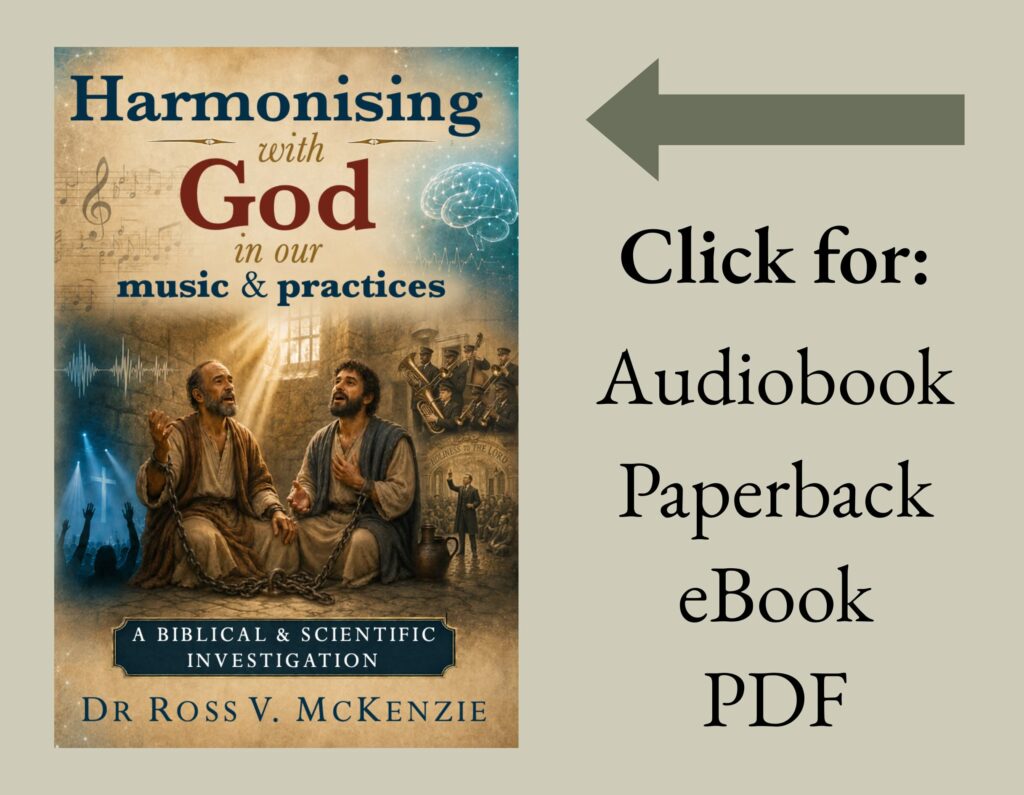
Harmonising with God in Our Music and Practices
By Dr Ross V. McKenzie
Preface
As a young person, I was always attracted to practical Christianity. On my father’s side of the family, Aunty Ruth, whom I admire, had worked for Sydney City Mission, a Christian welfare organisation. I saw myself doing that same kind of work one day. On my mother’s side, grandma was brought up in the Salvation Army. Mum and her siblings tagged along as grandma played the tambourine downtown in the Salvation Army band – much to mum’s embarrassment, as she was teased at school the next day. Grandma’s Salvation Army background explains why grandpa was never allowed to bring alcohol into the house. It also explains why grandma always took an interest in the poor family down the road.
My immediate family was not particularly religious. My father was agnostic, but we did attend church at times – the Baptist Church. Mum was always playing music, especially country music, which included a lot of gospel – this was one of the biggest spiritual influences in my younger years. I vividly remember falling in love with Jesus as a five-year-old after overhearing my older brothers talk about how Jesus died for us, which they had learned at school. I have been fortunate to have retained that simple child-like faith throughout my life and have never doubted that God loves me and that I am saved. Unfortunately, however, I sometimes took God’s grace for granted as a young person.
Growing up, I was sent to the only Protestant Christian school in our small country town – the Seventh-day Adventist primary school. Here I learned a different side of Christianity which was very Bible-focused. I was later baptised a Seventh-day Adventist and started studying theology but, drawn by a practical theology, I left my academic studies to go volunteer in war-ravaged Cambodia in the late 1990s. There I remained for the next decade. Though there was a lot I liked about the Seventh-day Adventist Church, I sometimes wondered if I would fit better in the Salvation Army.
Returning to Australia to study medicine, I found that church seemed different. The pews were half-empty, especially of young people and church leaders were trying new ways to attract the youth, including new music and worship styles. Many of the people I grew up with had grown sceptical of the Bible. After being immersed in the poverty and strife of Cambodia for ten years, church in Australia seemed indifferent to many of the problems of the world, unless it touched close to home. My experience in Cambodia challenged my understanding of God and life. I wasn’t sure if I even recognised who God was myself. When I read the Bible, which wasn’t often enough, God’s character didn’t always seem to resonate with the songs we sing, and the songs often denied the reality of life. I was so busy in Cambodia ‘working for God’ and trying to live the practical gospel that I hadn’t taken much time to study God’s Word and get to know Him better. As a result, I didn’t truly know Him and He was not able to mould me into His likeness. I suspected I wasn’t the only church member with this problem but I wasn’t convinced that changing the style of music was the answer. But what was the solution? When it came to music style, I wasn’t sure what was appropriate for church – I was sitting on the fence – and accepted any style, really.
William Booth, co-founder of the Salvation Army, had some controversial opinions about music. When I read his biographies, I found myself relating to William Booth, including his practical theology. Also, I realised I had made many of the same mistakes that he made. Comparing him with Ellen White, co-founder and prophet of the Seventh-day Adventist Church, I found that she also had a lot to say about music. But I hadn’t read many of Ellen White’s writings up to that point, so who should I believe? That eventually led me on a deep Biblical, scientific and historical investigation. I wanted to know what type of music is appropriate for church, and, more broadly, how we can get closer to God and better harmonise with Him and His character. I was prepared to change my beliefs and even denomination if I had to.
After failing my first interview for medicine at Monash University in Melbourne, I decided to travel and work. Eventually, I found myself in Cambodia where I did volunteer work for the next 10 years. Before heading to Cambodia, I bought a Maton guitar and taught myself to play so I could use music for outreach. I eventually started a small not-for-profit organisation with a mini food factory to provide work experience and income for students. Each morning at work, we sang praise songs and read from the Bible. Eventually, some of my staff gave their hearts to Jesus.
I have seen first-hand the devastating effect that corruption and genocide have had on family and friends in Cambodia but also the untold suffering caused by our poor lifestyle choices in Australia. The Bible talks much about the poor and suffering because God is not only interested in saving people’s lives but also preventing and relieving suffering. The Salvation Army rocked the world in the late 1800s with its ambitious goal to help the poor and convert the world to God – music was a big part of their ministry. Did their method work? What can we learn from them? That’s what I wanted to know. When Jesus walked on this earth, He not only brought salvation, but He relieved suffering. We are to copy His method. This book calls us back to harmony with God so that we can more effectively minister to the world.
As I did my research for this book, my findings surprised me and changed me, but not in the way I expected. It’s a big book because I didn’t want to gloss over this important topic. Before leaving Cambodia, I taught some young people in the factory how to play the guitar, and I left my Maton with them so they could continue to sing praises. After writing this book, I feel inspired to buy another guitar and start singing and praising more than I have been. But I also feel inspired more than ever to be an instrument for God’s service. I hope it has this effect on others also. As you read, my conclusions will become apparent as to where I believe the harmony lies. You may draw different conclusions, but the goal is that we each will learn to better harmonise with God and with each other for the glory of God.