
Harmonising with God in Our Music and Practices
Part 8 - Lyrics
Chapter 27
Chapter 27
Lyrical Content of CCM


The Salvation Army practice of using dynamic but theologically light discourses filled with anecdotes, interwoven with lively music to experience the presence of the Holy Spirit and lead people to conviction, has flowed through to contemporary Christian worship. The extent to which the practices of the Salvation Army and other Holiness movements have influenced contemporary Christian worship is hard to say. What is certain, however, is that contemporary Christian music (CCM) lacks the breadth and the depth which is found in Psalms. Like the Salvation Army in the early days, the purpose of CCM is to attract people by copying secular styles of music as well as helping the audience feel the moving of the Holy Spirit. The feelings, emotions and thoughts produced by the music are believed to be from the Holy Spirit, guiding them and motivating them to action.
While inspirational music is an enjoyable and effective way to experience the transforming power of conversion and motivate us to action, Jesus primarily motivated His followers to action by His words and example. He instructed us to teach others to observe all things that He commanded us (Matt 28:20). How can we do this if we do not delve deeply into Scripture? We are to teach, preach, pray, sing and worship in spirit and in truth (Jn 4:23-24, 1 Cor 14:1-18). A 20-minute sermonette is generally not long enough to delve deeply into Scripture, or one line of thought to then fill with half an hour of anecdotes – as Railton advised Salvation Army preachers. This can be effective and appropriate on occasion, but may not be enough to give the members adequate depth of understanding if done on a regular basis.
As with the Salvation Army, rather than stressing scriptural integrity and the importance of God’s law, Pentecostal and Charismatic traditions emphasise the personal, therapeutic and emotional dimensions of faith. They facilitate this by a charismatic style adopted from popular culture, such as pop music.46 This method is precisely the concern that Mrs White had with the Salvation Army in the late 1800s: “There is the Salvation Army, the Holiness Band with their cheap Christianity, and yet it pleases because there is no warfare.”44 (p309) This emphasis on outward adorning – forms, objects, sounds, images and bodily sensations – as seen in charismatic worship, is also what the reformers were trying to throw off when they separated themselves from the Roman Catholic Church during the reformation. If Mrs White was concerned about the Salvation Army methods, she would be doubly concerned about the Pentecostal and Charismatic movements which have, in some ways, intensified and expanded on Holiness teachings and practice.
Why is this important for non-Charismatic and Pentecostal churches? A study found that the most popular worship songs come from a handful of megachurches with a knack for writing pop songs about what God will do for you. Four churches – Bethel, Hillsong, Passion City Church and Elevation – are churning out one hit after another and have been dominating the worship charts, the research found. The worship music most likely to be heard in many churches is written by just a handful of songwriters from a small number of churches. Researchers say that these churches have changed the spiritual practices and theology of congregations from many traditions. Shannan Baker, a postdoctoral fellow at Baylor University, said few of the popular songs even talk about the cross or salvation, instead focusing on what God is doing for me now and what God has promised to do for me in the future.81
Charismatic megachurches have considerable influence over Christianity globally, setting the tone for how churches should appeal to young people. Their worship style has become a template for other churches, including increasing numbers of Seventh-day Adventist churches around the world.46 By comparison, Mrs White states that:
“True ministers know the value of the inward working of the Holy Spirit upon human hearts. They are content with simplicity in religious services. Instead of making much of popular singing, they give their principal attention to the study of the Word, and render praise to God from the heart. Above the outward adorning they regard the inward adorning, the ornament of a meek and quiet spirit.”168 (p453)
In the Charismatic tradition, which has influenced almost all other Christian traditions in modern times to a certain degree, there tends to be disharmony between love and obedience. The issue of obedience has been focused on us and, therefore, made into an issue of works which we shun. General Booth abolished baptism and communion because some members were treating these rituals as mere forms by which to gain salvation. Instead of educating members how to view the ordinances correctly, he did away with them. Likewise, because some people treat obedience to the law as a means to salvation, church leaders discourage members from striving to be obedient to God’s law, instead of educating members to obey the law for the right reason.
It is true that obedience without love leads to a cold works-based Christianity. With the emphasis on truth and obedience to the law in their teachings, Seventh-day Adventists tend to be more prone to legalism. Logically minded people are often attracted to Adventism because of the systematic reasoning behind its teachings and prophecies. Therefore, some may join the church because it makes logical sense but without having a personal relationship with God. They worship God in truth but not in spirit. Mrs Booth was very much concerned about the effect of head knowledge on children when there was not heart religion:
“In the early part of my married life, when my dear husband was travelling very much from place to place, I was frequently thrown into the houses of leading families in churches for three or four weeks at a time, and I used to say to myself, ‘How is it that these children seem frequently to have a more inveterate dislike for religion and religious things, than the children of worldly people who make no profession?’
Subsequent observations and experience have shown me the reason. It is because such parents inform the head without training the heart. They teach what they neither practice themselves nor take the trouble to see that their children practise, and the children see through the hollow sham and learn to despise both their parents and their religion.”14 (ch8)
One of the criticisms of Mrs White is the emphasis on obedience in her writings. Some of her views and comments have been interpreted as works oriented. She often confronted people over their errors and it was not uncommon for pastors and other members of the church to receive a letter from their prophet reproving some apparent wrongdoing. Mrs White has, therefore, often been viewed as stern and cold-hearted. Reproofs received from Mrs White ranged from soft admonitions to sharp reprimands. Members received reprimands for being too overbearing in their relationships or too judgmental toward other members. She confronted people who were spreading false teachings, such as spiritualism. She rebuked people for envy and pride as well as hypocritical or immoral behaviours. She was very stern toward those who misused her writings, such as quoting her out of context to promote personal agendas. She rebuked preachers if their sermons were not pointed, direct and focused on biblical truth but also lamented when sermons were dry and Christless. She urged that Christ be the centre of every doctrinal teaching.
In the 19th century, it was not uncommon for sermons to be very lengthy by today’s standards, sometimes continuing for hours. For example, William and Catherine Booth generally preached for one to one-and-a-half hours.151 Mrs White did not approve of excessively long sermons and, therefore, a particular preacher who was regularly preaching for one-and-a-half hours or more, was a recipient of one of her chastening letters.293 Addressing church leaders at the opening of the General Conference session of 1901 she said, “Do not quote my words again as long as you live until you can obey the Bible… When you make the Bible your food, your meat, and your drink, when you make its principles the elements of your character, you will know better how to receive counsel from God.”90 (p33) When the preacher, John Byington, became depressed and quit his ministry, she said in a letter to him, “You love this world, and your heart is altogether too much wrapped up in the things you possess.. There must be an entire change in you in these things.”460 He did not receive the advice and became more unhappy but soon after, he humbled himself and heeded the admonition given him. He returned to his ministry and eventually became the church’s first General Conference president.
However, not everyone accepted her rebukes. When Dr John Harvey Kellogg was reproached for his pantheistic teachings, he refused her advice and became estranged from the church. Another church member, Stephen Smith, refused to even open her letter and left the church. After opening the letter for the first time 28 years later, he said his life would have been much better if he had opened it and heeded its advice immediately.460
Many of these rebukes are recorded in Testimonies for the Church, with recipients generally de-identified, and are to be a guide to all members. Mrs White’s defence for these harsh rebukes was that she was relaying messages given to her by God. She was dealing with serious realities in people’s lives that have serious consequences. The prophet is commanded to “Cry aloud, spare not, lift up thy voice like a trumpet, and show My people their transgression, and the house of Jacob their sins (Is 58:1).” If she was a true prophet, she was doing her duty in calling people to repentance.
Strict discipline was a typical characteristic of 19th century evangelicals. Salvationist and author, Cathy Le Feuvre, states: “The Booth children, though clearly loved, were raised in a strict home where there was discipline from a very early age. As did most households of the time, the Booths firmly held to the principle of ‘spare the rod and spoil the child.’”14 (ch8) Though the Booths were strict, they demonstrated the love of Christ to their children, especially in their work for the poor. Many have imagined that the White household must have also been one of strict discipline – and by today’s standard, it probably was. They also imagine Mrs White as a domineering, dogmatic and hard to get along with person. However, transcripts and video recordings from those who knew Mrs White in person give a very different picture. She was known as a warm-hearted, friendly and cheerful person who had a deep love for her saviour and a caring concern for the spiritual and physical welfare of others. Her rebukes were embedded with encouragements and many expressed gratitude for the lifesaving reprovals they received from Mrs White which turned them from a course of destruction. Those who accept Mrs White’s prophetic gift have found the counsels in the testimonies helpful advice in their own lives.293,461
If this is true, why is she seen in such negative light? One reason is that Adventists have often used Mrs White’s writings as a stick to beat people with.141 For example, they might take snippets of her writings to uphold rigid rules, such as prohibiting children from running around on the Sabbath. However, on one particular Sabbath when Mrs White’s daughter, May, told her children to stop running, Mrs White told May that children are going to run, therefore, they should be told something they can do, like don’t run too far ahead. In other words, it is natural and normal for children to run around and unrealistic to expect them to sit still all day. Mrs White advised that rules should be made easy for children to keep. Her grandchildren recall Sabbaths with grandma being a high point of the week. The house was decorated nicely with flowers and they would often go for picnics on the Sabbath. It was a hard working family, and the children were expected to help out around the house. Apparently, in the White family, they did not have many don’ts because they had so many dos. The grandchildren were asked to do things with a smile and to respond with a smile. Arthur White said he couldn’t have had a better upbringing than to be raised around Mrs White.293,461
According to her granddaughter, Grace, Mrs White did not want members to take her writings as a straitjacket – they were there to assist in different activities in life but not for rigidly defining our every behaviour.462 Though Mrs White strongly encouraged a healthy diet and lifestyle, she was moderate in her own household and not extreme. For example, as food was passed around the table, children did not have to take everything. If there was something they didn’t like, they were not to say ‘yuck’ but to try a small sample and then simply pass it along. Nothing unpleasant was ever to be discussed at the meal table. If anyone had a problem, they could talk about it after the meal. If children were misbehaving, they were not corrected in front of everyone at the table but after the meal. Grace said her grandmother was very understanding with children and her psychology with them very good.293,463
Apparently, there was often humour and laughter at the table. For example, one time before they ate, a guest was telling his wife only to eat the brown bread. As soon as grace was said, Mrs White, without a word, picked up the white bread and handed it to the wife which everyone found amusing! Though Mrs White encouraged a plant-based diet in her writings, they still had cow’s milk at the table and sometimes they ate eggs and cream. But certainly, most of the food served up was healthy. Today, it is a lot easier in many parts of the world to eat a balanced, fully plant-based and appetising diet than it might have been in the 19thcentury.462
Mrs White was an ordinary fun-loving and caring mother and grandmother. Though she was absolutely dedicated to the mission of the church, she had many family responsibilities, such as caring for her children and other parent’s children, sewing, knitting, cooking, shopping and washing dishes; though in her older age, she employed an executive secretary, Sara McEnterfer, to manage her household operations and travel arrangements. Mrs White enjoyed the outdoors, including camping with family and friends. She was an enthusiastic gardener and grew flowers, vegetables and orchards. She loved animals and owned horses, chickens, cows, dogs and birds and cared for them well.462,463
Mrs White was little and never seemed in a hurry, but she got things done. Because of her busy schedule, Miss McEnterfer required appointments to see Mrs White and barred children from disturbing her as she worked. However, unknown to her secretary, Mrs White made a secret agreement with her grandchildren to sneak up to her writing room via a back passage whenever they liked. Miss McEnterfer called Mrs White mother and the two were known to enjoy flying around corners in the horse and buggy. Mrs White always greeted people with a smile, she used humour to make a point, she treated children like her own grandchildren and did not weigh people down with her own burdens and aches and pains.461,463,464
Though her writings do contain a lot of warnings and harsh rebukes, this is balanced with much love and mercy – much the same as we find in the Bible. It is clear that she was in love with Jesus. Mrs White’s eldest grandchild, Ella, who was in her thirties when her grandmother died, recounted her favourite memory of Mrs White. It was a memory of her grandmother preaching a sermon on the matchless love of Jesus. During the sermon, Mrs White stopped and looked up as if to heaven and said, “Oh Jesus, how I love you, how I love you, how I love you.”461
Rather than giving a picture of a cold and harsh legalist, anecdotes from Mrs White’s life give a picture of a much loved, caring human being who loved her saviour and longed for her fellow human beings to avoid sins that separated them from their saviour. Mrs White was constantly trying to lead people to Jesus. She demonstrated that it is possible to be strictly obedient to God while at the same time seen by others as warm, loving and caring. Strict obedience does not have to mean cold, stern and unloving.
Unfortunately, not all Adventists have had the balanced understanding of law and grace as Mrs White did. Many young people have been turned away from Christianity due to overbearing parents who were strict with rules but failed to show them the love of Christ, as Mrs Booth had noticed and had concerns about. Equally as bad as obedience without love, however, is love without obedience which is a selfish relationship or ‘cheap Christianity.’ In cheap Christianity, there is more emphasis on what God can do for me rather than what I can do for God. Evidence of cheap Christianity reveals itself in poor lifestyle choices. Unfortunately, examples could be cited in any denomination, but there seems to be a disproportionate number of public scandals coming out of Charismatic megachurches, including allegations of sexual abuse, concealment of child-sex crimes, marital affairs and money laundering. Much effort goes into producing fine-tuned and polished performances, but less effort goes into perfecting godly characters. If the need for obedience is constantly being downplayed through man-centred song lyrics and theology, eventually people will start to misbehave. Obedience is less about us and more about giving honour to the one who created us and died for us. Perfect harmony with God exists when there is proportionate emphasis on love and obedience.
The legitimacy of the contemporary music industry hinges on General Booth’s argument that the style of music does not matter, as long as the lyrics are in tune with Scripture. One reason why sincere Christians might draw this conclusion is the belief that instrumental music primarily affects our emotions only. However, in previous chapters, we discussed how even the emotional influence of music alone can be a problem if used in the wrong way. Science has also shown that, apart from the effect on emotions and apart from the lyrics, music can have profound effects on the listener in many different ways – both good and bad.
Commercialisation of Worship Music
Even if this was not true and music apart from the lyrics has no significant influence on us, the irony is that even the lyrics of CCM is terribly out of balance with what we find in Scripture. Paul said, “I will sing with the spirit, and I will also sing with the understanding (1 Cor 14:15).” This was in the context of his counsel on speaking in tongues. If we speak a language in church that nobody understands, we just edify ourselves; however, he argues that we ought to be edifying, exhorting and comforting each other. The Cambridge Dictionary describes ‘exhorting’ as strongly encouraging or trying to persuade someone to do something. Singing is not just for edifying ourselves, but for increasing the understanding of fellow believers. Understanding is critical for obedience. Keith Getty, author of one of the most popular worship songs of all time, In Christ Alone, argues that “The western church has really messed this subject up… in the sale of church music to Wall Street.”465
Sean McDowell, author, speaker and Biola University apologetics professor has also expressed concern, not just for CCM, but for churches and speakers that value competence and giftedness over character and depth of theology. In his interview with Newsboys, he queried them on how much the drive to sell albums in the CCM industry might influence the selection of artists. In reply, Jeff Frankenstein, keyboardist for Newsboys since 1994, said that “especially in CCM and churches, when you mix business with theology… that’s a ripe place for hypocrisy.” He said a lot of artists come in with incredibly good intentions with a call from the Lord and they’re greeted with a business with a lot of Industry people. The pure thing that they bring to the table now has to be marketed and manipulated and put into the system with these gatekeepers controlling it and profits have to be made. It kind of loses its innocence he said.187
Keith Getty goes on to explain how the majority of worship songs in the top 2000 today are administrated or owned by companies that are owned by Wall Street. This is the first point in history in which the songs we sing are not being decided by the leadership of the church, he said. Throughout church history until recently, it has been a combination of Psalms and liturgical singing, localised singing worked out by the leadership of the community and, with Luther and the advent of the printing press, singing from hymn books. With the best will in the world, at the end of the day, companies have profit targets to reach. It is a different motive altogether than church leadership selecting Psalms or hymns which include singing about God’s wrath and about laments, Getty said. This cannot be part of the commercial world. There is a different principle guiding selection and a natural falling away from a balanced teaching of Scripture. He says modern songs are not supposed to touch on anything which is too much about the uniqueness of God, especially the dark judgemental or tough things. That doesn’t square with the model.465
An earlier chapter of this book demonstrates that, traditionally, church leaders, such as Martin Luther, directly influenced the lyrical content of church songs, which supports Getty’s claims. By contrast, the results of a study released by WorshipLeaderResearch.com in 2024 substantiates Getty’s assertion regarding the influence of the most popular worship songs today. The study revealed that almost 80% of songs and artists on the Christian Copyright Licensing International (CCLI) Top 100 lists between 2010 and 2024 were controlled by three major corporations: Capitol CMG, Essential Music and Integrity Music. Bethel Music is the only major church organisation that publishes and administers its own music. The other three top suppliers of worship songs – Hillsong, Passion City Church and Elevation – are all dependent on commercial enterprises.466
Numerous studies have also highlighted imbalance in the lyrical content of the top worship songs, as suggested by Keith Getty. For example, research findings by Daniel Jesse suggest that there is an overemphasis on joy in the top worship songs, whereas, unlike in Psalms, sadness and sorrow are rarely expressed.467 Another example is Shannan Baker’s analysis of the Trinity in the lyrics of the top worship songs. She concludes that, while the lyrics are appropriately Christ-centred, they fail to represent the Father and the Holy Spirit proportionate to Christ. Though all three persons of the Trinity appear in Christian worship songs, the ‘overwhelming’ references to the second Person cannot be ignored, she said.468 For Pentecostal and Charismatic Christians, encountering the Holy Spirit through the emotional experience of contemporary praise is an important part of worship;469 therefore, they might perceive a strong presence of the Holy Spirit even if His name is not mentioned in the lyrics. God the Father is therefore exclusively forgotten in many of the top worship songs, while Jesus and the Holy Spirit always have a strong presence.
Whether or not these and other imbalances are due to commercialisation of Christian music, as suggested by Getty, is hard to prove, but it certainly needs to be seriously considered as a significant factor. Christians often perceive God the Father as more severe and less willing to forgive than Jesus, whom they believe to be warmer and less stern.470 Rather than understanding the Trinity as a united God who is love (1 Jn 4:7-11) and who is one (Deut 6:4), some may mistakenly believe that the loving Jesus saves us from the hostile Father, instead of believing atonement is a united act of love. Therefore, companies that are trying to sell more music to increase profits might consciously or unconsciously favour songs with lyrics that exclude the Father or anything that might reinforce this negative perception of God, such as God’s wrath.471 In the medical field, we are wary of drug research which is sponsored by a company that owns the patent for the drug, since bias will more likely taint the results of the study in favour of the drug. Why should we not also be wary of the songs promoted by companies that make large profits from the sale of those songs, since bias might influence the selection of lyrics that favour enhanced sales?
Warning people of their wickedness and calling them to repentance does not sell well. It is much easier to sell albums and concert tickets if we tell people only what makes them feel good. Jeremiah was unpopular because he preached about judgement while false prophets preached what was soothing to the ear:
“Saying, ‘Peace, peace!’ When there is no peace. Were they ashamed when they had committed abomination? No! They were not at all ashamed, Nor did they know how to blush. Therefore, they shall fall among those who fall; In the time of their punishment they shall be cast down, says the Lord.” (Jer 8:11-12)
The constant message singing out from our churches is peace and safety. There is little call to deep soul searching and deep repentance, no calling out of sins. Profess the name Jesus and you will be saved – that is all that is required. But this message is out of harmony with Scripture.
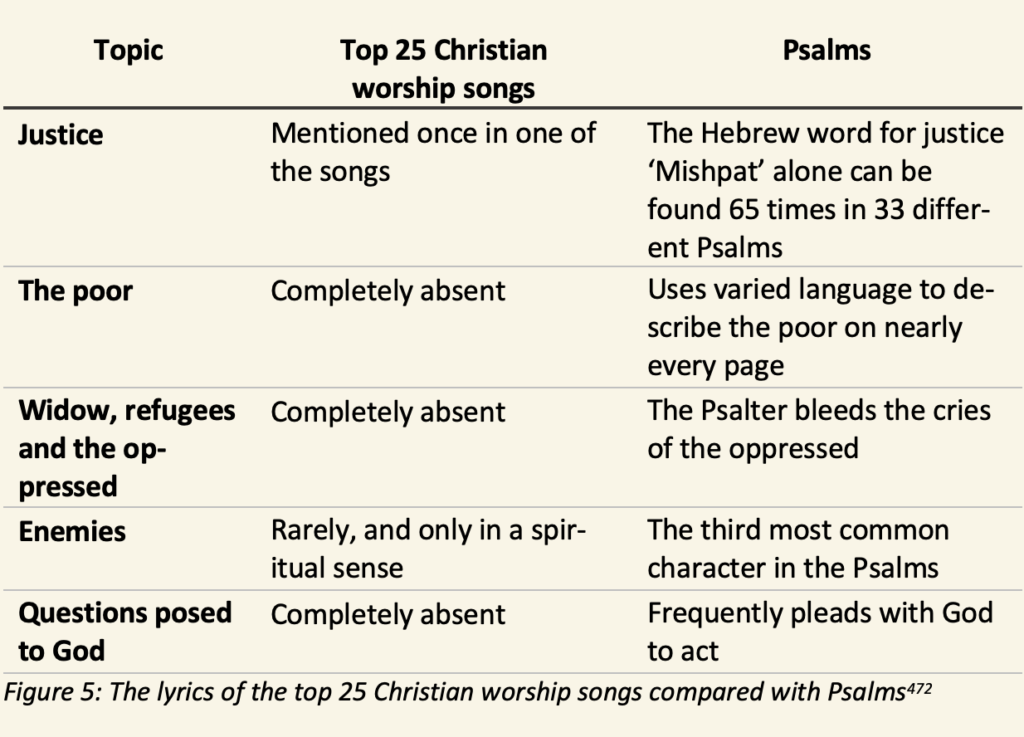
Old Testament scholar, Michael J. Rhodes, tweeted a summary of his research on the top 25 Christian worship songs, comparing them with the Psalms. For example, justice was mentioned only once in the top 25 worship songs, while the Hebrew word for justice (Mishpat) is found in almost a quarter of the Psalms. Also, while the poor, the widow, refugees and the oppressed were completely absent in the top 25 Christian worship songs, the poor and the oppressed are described on practically every page of Psalms. (Figure 5 outlines the main insights).472
An Example of the Lyrical Content of CCM
Newsboys is a Christian rock band founded in 1985 in Queensland, Australia and now based in Tennessee, United States. It is one of the most successful and iconic Christian music bands of all time. With a YouTube search of ‘Newsboys’, one of the first songs to pop up was Magnetic, the lead single released in 2021 for its fall project. Let us have a quick look at this song as an example of the lyrical content of their music. The key phrase of the song is, “Your love keeps pulling me back, pulling me back, it’s magnetic.” It is clearly a love song. However, it does not say who the love song is directed to. There is no mention of God or Jesus or any other title for our Lord. The middle stanza reads as follows:
“Your goodness won’t give up on me
It’s a fountain flowing so deep
You’re so patient and so gracious
It’s unconditional
Even when I try to go my own way
Even when my heart is in the wrong place
You bring it back around like a boomerang
Just like a boomerang.”473
The song gives the sense that God’s grace has no limit. We are passive spectators in the relationship. It does not even matter if we are doing the wrong thing because God will pull us back. It is true that God’s grace has no limit if we genuinely repent and unite ourselves with Him. It is true that His Spirit is always trying to lead us back to God. When we return to Him, all past sins are forgiven and every time we stumble, if we turn our face to Him, He graciously accepts us back with open arms. In that sense, God’s grace is unconditional and limitless. However, we should never presume upon God’s mercy and love. Our “adversary the devil walks about like a roaring lion, seeking whom he may devour (1 Pet 5:8)” and whenever we stray into enemy territory, we are vulnerable. If an antelope calf strays from the herd, it can easily be taken down by the predator. Peter cautions us to be sober and vigilant (v7), resisting the devil, steadfast in the faith (v9). Why the need for such vigilance if God always brings us back around like a boomerang? The reason is that, if we ‘try to go our own way,’ there is no guarantee we will ever make it back.
Mrs White says that “We cannot for one moment separate ourselves from Christ with safety.”474 (p93) This is scriptural. The Newsboys song is deceptively reassuring. We have to put on the armour of God to protect ourselves from the fiery darts. God’s grace is not unconditional – no healthy relationship is. Every covenant that God made with His people had conditions. There are always rules in a relationship and when rules are broken, the relationship suffers. If we think that God’s love is unconditional, we may be prone to letting our guard down. God promised the children of Israel great blessings, but, He said, “if you do not obey Me, but walk contrary to Me, then I also will walk contrary to you in fury (Lev 26:27-28).” They did walk contrary to God and they were taken into captivity by Assyria and by Babylon. The ten northern tribes never made it back to the promised land.
Through the prophet Isaiah, God promised great prosperity for Israel:
“But be glad and rejoice forever in what I create; for behold, I create Jerusalem as a rejoicing, and her people a joy. I will rejoice in Jerusalem, and joy in My people; the voice of weeping shall no longer be heard in her, nor the voice of crying.” (Is 65:18-19)
Many Christians, such as Zionists, are still waiting for God to fulfil all of His promises to the nation of Israel – they are waiting for Israel to rise to glory and for the temple to be rebuilt. But these promises came with conditions:
“‘If you are willing and obedient, you shall eat the good of the land; but if you refuse and rebel, you shall be devoured by the sword’; for the mouth of the Lord has spoken.” (Is 1:19-20)
Likewise, God spoke through the prophet Jeremiah:
“And the instant I speak concerning a nation and concerning a kingdom, to build and to plant it, if it does evil in My sight so that it does not obey My voice, then I will relent concerning the good with which I said I would benefit it.” (Jer 18:9-10)
And again, through the prophet Zechariah, God promises to restore the temple. But He warned:
“And this shall come to pass if you diligently obey the voice of the Lord your God.” (Zech 6:15)
The Jews were not faithful to God and they rejected the Messiah when He came. In the New Testament, God makes Jesus judge over all (Jn 5:22) and Jesus pronounces judgement on Israel when he prophesied the destruction of Jerusalem and the temple by the Romans. The God of the New Testament is just as harsh as the Old Testament toward those who disobey Him. Not because He is a vindictive God, but because He is Holy. Sin causes suffering and a Holy and just God cannot stand for this. Consequently, instead of receiving the blessings promised, the Romans crushed Israel in 70 AD and destroyed the temple. The Jews were scattered to the ends of the earth without another promise of redemption for their nation. God’s mercy does have limits.
The good news is that the nation of Israel is only a type representing spiritual Israel, which is the antetype. Spiritual Israel includes all true followers of Christ, his church:
“For he is not a Jew who is one outwardly, nor is circumcision that which is outward in the flesh; but he is a Jew who is one inwardly; and circumcision is that of the heart, in the Spirit, not in the letter; whose praise is not from men but from God.” (Rom 2:28-29)
The promises that were given to Israel in the Old Testament, now belong to us, the gentiles as well as all Jews who believe in Christ:
“And if you are Christ’s, then you are Abraham’s seed, and heirs according to the promise.” (Gal 3:29)
The promises to literal Israel did not come true due to disobedience, but for those of us who are faithful to Christ and who have been grafted into spiritual Israel, these promises have and will come true in spiritual blessings but also, literally, in physical and material blessings. The blessings that were for the nation of Israel that they missed out on due to disobedience will be received by faithful spiritual Israel:
“For behold, I create new heavens and a new earth; and the former shall not be remembered or come to mind.” (Is 65:17)
“Now I saw a new heaven and a new earth, for the first heaven and the first earth had passed away. Also there was no more sea. Then I, John, saw the holy city, New Jerusalem, coming down out of heaven from God, prepared as a bride adorned for her husband.’” (Rev 21:1-4)
However, as with the nation of Israel, the promises to spiritual Israel are conditional. Jesus said:
“If you abide in Me, and My words abide in you, you will ask what you desire, and it shall be done for you.” (Jn 15:7)
Therefore, our prayers are answered only if we abide in Jesus and in His words – which includes His commands. God’s faithful church, the remnant, the bride of Christ, keep the commandments of God and have the testimony of Jesus Christ (Rev 12:17); whereas the unfaithful church in the last days is referred to as the harlot dressed in purple (Rev 17:3-6) because it is unfaithful, just as the nation of Israel was called a Harlot for its unfaithfulness. One of the characteristics of the unfaithful church is that it would attempt to change times and laws (Dan 7:25). We do not get to pick and choose which laws to keep and which not to keep. Just as God was serious about His law in the Old Testament, He is still serious about His law today.
We have lost the balance between mercy and justice as found in the Bible. Our songs and sermons speak much of God’s grace – which is wonderful. We need to be repeatedly reminded of God’s love and grace. But we have been failing to adequately elevate and revere God’s law and warn of the consequence of disobedience. We must give people assurance of salvation but remind them that this assurance is only while they are abiding in Christ. Jesus said:
“Do not think that I came to destroy the Law or the Prophets. I did not come to destroy but to fulfill. For assuredly, I say to you, till heaven and earth pass away, one jot or one tittle will by no means pass from the law till all is fulfilled. Whoever therefore breaks one of the least of these commandments, and teaches men so, shall be called least in the kingdom of heaven; but whoever does and teaches them, he shall be called great in the kingdom of heaven. For I say to you, that unless your righteousness exceeds the righteousness of the scribes and Pharisees, you will by no means enter the kingdom of heaven.” (Matt 5:17-20)