
Harmonising with God in Our Music and Practices
Part 7 - Dance
Chapter 24
Chapter 24
Dance

There is no record of Jesus or the apostles in the Bible ever dancing or promoting dance. David danced on occasions, as did other godly characters in the Bible, but there is no direct command from God concerning dance. So how do we decide what is appropriate and what is not appropriate? Numerous passages in the Old Testament mention dancing in positive as well as negative contexts. The number of different forms of dance is about as diverse as music, and we know from our own experience that, just like music, not all forms of dance are appropriate. Just as Christians would not accept voodoo or black metal music in church, regardless of the lyrics, there are also certain types of dances that Christians would not find acceptable in church, such as twerking and ‘dirty dancing’, which are overtly sexually provocative. The Holy Flesh movement and General Booth put dance tunes to sacred words. Ellen White agrees that some forms of dance are appropriate for worship, while other forms are totally inappropriate for use by Christians:
“David’s dancing in reverent joy before God has been cited by pleasure lovers in justification of the fashionable modern dance, but there is no ground for such an argument. In our day dancing is associated with folly and midnight revelling… The music and dancing in joyful praise to God at the removal of the ark had not the faintest resemblance to the dissipation of modern dancing.”195 (p707)
Commenting on the Feast of Tabernacles as conducted during Jesus’ ministry on earth, Mrs White said:
“At evening when the lamps were lighted, the court was a scene of great rejoicing. Gray-haired men, the priests of the temple and the rulers of the people, united in the festive dances to the sound of instrumental music and the chants of the Levites.”87 (p463)
Ironically, it was in the temple court, where the Feast of Tabernacles was celebrated, that Jesus spoke the words: “I am the light of the world. He who follows Me shall not walk in darkness, but have the light of life (Jn 8:12).” Many of those who celebrated with great rejoicing and with festive dance the Feast of Tabernacles did not receive the light (Jn 1:10). This recapitulates the lesson that David learned when carrying the ark to Jerusalem. No form of rejoicing and worship, no matter how sincere, will save us if we are not obedient to His Word and walking in His light. Therefore, from the Bible, it appears that dance is an acceptable form of worship and pleasing to God when conducted in the right manner and with the right attitude of obedience toward Him, but it is not an essential element of worship.
So, the question is clearly not, is dancing acceptable or necessary for Christians, but if we choose to dance, what type of dance is appropriate? At what point does dance transition from being an acceptable expression of praise and worship of God to something inappropriate? We all know that dance can be very powerful at arousing sexual passion, which is contrary to what we want when we are worshipping God. What types of dance moves are sexually provocative?
There is no straightforward instruction in the Bible showing us which dance movements are acceptable and which ones are not. Like ancient Hebrew music, we cannot go back in time to observe the dance moves of ancient Israel. What did it look like? When the Psalmist says to dance, what type of dance did he have in mind? Unlike a painting or sculpture, dance is an ephemeral art and can only be understood by experiencing or observing it. Written descriptions fail to adequately preserve an understanding of the movements displayed.431 Regardless, there is still more than adequate detail in the Bible and from science to help us make an informed decision.
Dance and music are closely connected. Music provides the rhythm for dance, and certain types of music are even called dance music because it is easy to dance to these tunes. Each style of dance is suited to a certain type of music. For example, it is probably not possible to salsa dance to American country music. So, dance is very much tied to the style of music. A recent Harvard study confirmed that music is a universal language. No matter its cultural background, it is possible to understand the meaning of a song from its acoustic features, such as tonality, ornamentation and tempo.432 Dance is a visualisation of the sound we hear433 and dance is also considered a universal language in its own right.434 Therefore, like lyrics, dance can communicate both appropriate and inappropriate messages, either by communicating a message of its own or by conveying meaning from the music. So, we can look at the message of the dance or its accompanying music and, if it is inappropriate, then it will not be suitable for worship. We can also look at more recent Israelite folk dance and culture as an approximation of principles that might have guided their ancient ancestors in their selection of appropriate dance. Finally, we can look to Scripture for clues to style of dance as well as principles that can guide our choices.
Sexuality in Dance
Alan Lomax (1915–2002) was a leading anthropologist in the area of folk music and is celebrated for his research of dance.435 Because dance can only be truly understood by experiencing or observing it, Alan and his father, with the help of colleagues, underwent the monumental task of compiling more than 10,000 recordings of songs and dance from around the world for the Library of Congress. In his later career, Lomax, who pioneered the term choreometrics, used this film archive to scientifically analyse dance styles, classifying them by the type of repetitive movements found in each culture’s dances.
Alan Lomax observed that dance can be categorised into one of two different styles which he termed single-unit and multi-unit movement styles:
“Single-unit style uses a solid torso, mostly moving the legs, feet and arms and sometimes bending or using a rhythmic rocking motion forward and back at the waist… Meanwhile, multi-unit styles use an articulated torso, in which there is movement in the hips and undulation in the rib cage.”
He concluded from his extensive study of cultures and their dances that the hip-rocking motions found in multi-unit styles of dance are representative of sexual motion.431
Lomax was instrumental in launching the folk and blues revivals that took place among American musicians and listeners in the 1950s and 60s. He discovered and helped to bring to popular awareness numerous blues guitarists, folk artists and country blues singers. In 1959, he produced Folksong ’59, a Carnegie Hall concert, which was one of the first major events to recognise rock and roll as a musical form worthy of serious consideration.435
Rock and roll dances, which became popular in the 1950s, were mostly of African-American origin and displayed body movement involving pelvic and hip rotations and greater use of the torso.436 As discussed earlier in the book, at the time when rock music was emerging, the term ‘rock and roll’ was a euphemism for sex.198 The very first song acknowledged by historians to use the terms ‘rock’ and ‘roll’ was a song about a woman making love with her man.199 TIME acknowledges that “all rock…has always implicitly rejected restraints and has celebrated freedom and sexuality.”207 Rock and roll dance, with its hip-rocking motions, matches precisely the meaning of the music. The very foundation of rock music was sex.
Perhaps the greatest evidence that rock music was founded on sex and rebellion is the fact that modern day rock and pop music is saturated with sexual messages. Nothing has changed. From its very inception until now, by its very beat and sound, by its lyrics and dance, rock music has celebrated freedom, rebellion and sexuality. The lyrics, sound, images and movement communicate sexuality and rebellion against God’s laws. It glorifies materialism, unbridled passion and cheap love. We watch it and allow it into our homes and wonder why God is not giving us victory over our sin and sexual addictions. Even at church, we want to hang onto those familiar sounds we are used to, that resonate with us and invigorate our carnal nature. Contemporary Christian music copies the exact drum rhythms used in secular rock rhythms.212 Therefore, when we dance to these rhythms, we are ‘dancing to the same song.’
Dance is often defined as a set of intentional, rhythmic body movements, which is an important aspect of sexuality and is observed particularly in courtship contexts.437 It often functions as a means to attract potential partners.438 A scientific study by Northumbria University has nutted out the specific dance movements that make a dancer appear sexier. This study found that women who dance with bigger and more varied motions of the hips and thighs are perceived as sexier.438,439 In response to this study, The Verge, a popular technology news website, argues that most dancing is sexy.440 This opinion appears to be given in the context of social dancing, such as at night clubs, and is a reflection of the association of sex with modern dance styles.
The results of the study would probably come as no surprise for most people. However, what is especially significant is the finding of another study that found that hip swings and variation in lower body movement may draw men’s attention to these body areas and increase attractiveness in terms of short-term or promiscuous sex, whereas ‘harmonic dance movements’ are perceived as more attractive and desirable for long-term relationships. Unfortunately, the authors of the study do not quantify in kinetic terms which dance movement characteristics are perceived as harmonic.441 However, what is clear from these studies, at least in women dancers, is that science has confirmed what we already intuitively knew and what Alan Lomax had concluded from observing dances from cultures around the world – that hip and thigh movements draw attention to those body parts, communicate sexual motion and make the dancer more attractive for sex, especially promiscuous sex.
Dance in Ancient Israelite Culture and the Bible
Unfortunately, we do not have detailed information from Scripture or historical sources of the types of dances practised by ancient Israelite people. However, there is still a lot of insight that can be gained from Biblical and Talmudic narratives. Karen Codman, former Jewish dance instructor and graduate of dance anthropology at University of California, states that there are 11 terms used in the Bible for ritual dance while there is only one word for secular dance, indicating the essential role of dance in religious practice. The words themselves, she says, give some indication of the general styles of the dances, such as ‘hul’ which, when used in reference to dance, connotes a whirling, writhing, twisting motion and a fairly brisk tempo.442
As with musical instruments, according to Codman, early Jewish dance was profoundly influenced by the dances of the surrounding cultures, such as Egyptian, Phoenician, Babylonian and Hittite dance and ritual. For example, Miriam’s dance of thanksgiving to God by the Red Sea, reflected the sacred thanksgiving rituals of the Egyptians. However, “the Jews tended to assimilate the more refined and dignified dance styles of the Egyptians and shunned those dances which were unrestrained or orgiastic.” Likewise, the Phoenician bacchantic dances in honour of Ba’al Markod, the god of dance, was frowned upon by the Israelite priests. Sacred ritual dances done in conjunction with temple observances were always performed in a solemn, dignified manner. Processionals were also generally ritual in nature as were dances encircling sacred objects. These round dances also became popular in secular settings. Any form of unrestrained dance in a ritual context was considered pagan.442
There are also a few examples in the Bible of very joyous dancing, such as when David danced ‘with all his might’ before the ark when it was brought to Jerusalem.442 When we abide in Christ and we are completely submissive to His will, the Holy Spirit dwells in us and we experience great joy. That joy will be expressed in many different ways, including service to God and outward expressions of praise, such as singing and dancing. However, when we artificially create an atmosphere of excitement without obedience, the Holy Spirit is not present. The ecstatic feeling may give us a sense of oneness with God, when in actual fact, His Spirit may be far from us. David and the Israelites thought they were praising and pleasing God but were actually provoking His anger.
The fact that the Israelites neglected to carry the ark according to the proper order was a reflection of a deeper problem. God is not on His throne waiting to send a lightning bolt down to earth the moment we slip up. He is patient and forbearing. The deeper problem was that they were not familiar with their Scriptures – the Torah – and, therefore, they misinterpreted what was important to Him. Cain thought it did not matter which offering he brought to God, as long as He offered something. But God does not need our gifts, He needs our full allegiance. If David was carefully studying Scripture, he would have also discovered that for the first 2500 years God gave no instruction for his people to show their loyalty to Him through song and dance. This was not a priority for God. As discussed throughout the book, singing is a way to strengthen us spiritually, to unite fellow believers and to increase understanding. God enjoys hearing our praise, but without obedience, our praise is meaningless.
The word used to describe David’s dance in 2 Samuel 6:14, me·char·ker, is a whirling dance.443,444 Verse 16 also describes David as leaping and whirling. Therefore, according to Alan Lomax’s categorisation of dance, it was a single-unit style of dance, using a solid torso, mostly moving the legs, feet and arms. It was not a sexual motion as seen in the multi-unit movement styles where the emphasis is on hip-rocking motions.
According to Mrs White, in our time dance is associated with folly and midnight revelling and, therefore, believers should not participate in this type of dance.195 (p707) If her testimony is truly from Jesus and if the dance moves we use in worship resemble the dance moves of night clubs and pop concerts, by our very worship we are disobeying God. We may be angering Him by the way we praise Him. In excitement, we are prone to ignore God’s instructions and to be carried away with carnal passions and open to deceptive teachings.
The parallel account of the transport of the ark to Jerusalem, as recorded in 1 Chronicles 13-16, was written much later than the account in Samuel 6 and is a more detailed description of the event. In this second chronicle of the procession, the list of instruments has been altered. Israeli musicologist, Joachim Braun, says that the description of dance and the list of instruments in Samuel 6 has undertones of heathen practice. Apart from the removal of the rattle from the list of instruments played because of its association with cultic practice, as discussed in previous chapters, the name of the cymbals was changed from selselim to mesiltayim. These alterations, he argues, effectively removes the association with heathen practice and changes the later parallel account into “An organised, solemn liturgical ceremony of consecration.”227 (p107) The divinely inspired Biblical authors were, apparently, removing every trace of heathenism from the narrative of song and dance in the Scriptures. It appears that God was gradually and patiently weeding out heathen practice from their song and dance just as he was removing other inappropriate practices such as polygamy.
Bruce Bierman, award-winning theatre director in Los Angeles and celebrated Jewish dance master, teaches the many styles of Jewish dance. He demonstrates how the focus on hand gestures (as opposed to motions of the hips and thighs) is a distinguishing element of Jewish dance that has remained since ancient times and throughout the diaspora until now.445
Another important element of traditional Jewish dance is separation of the sexes. Victory dances were celebrated by groups of women,446 such as when Miriam led the women in dance with timbrels after the triumphant crossing of the Red Sea (Ex 15:20) and when the women sang and danced on the return of David upon his victory against Goliath (1 Sam 18:6). Men participated in joyous whirling dances. Festival dances were performed by both men and women; though, they were segregated by gender. Even in secular celebrations, God was to be glorified. During wedding celebrations, men danced with the bridegroom and women with the bride to maintain separation of the sexes. More recently, men could dance with the bride in traditional weddings, but only by maintaining separation by wrapping their hands in a cloth or by holding a cloth between them.447
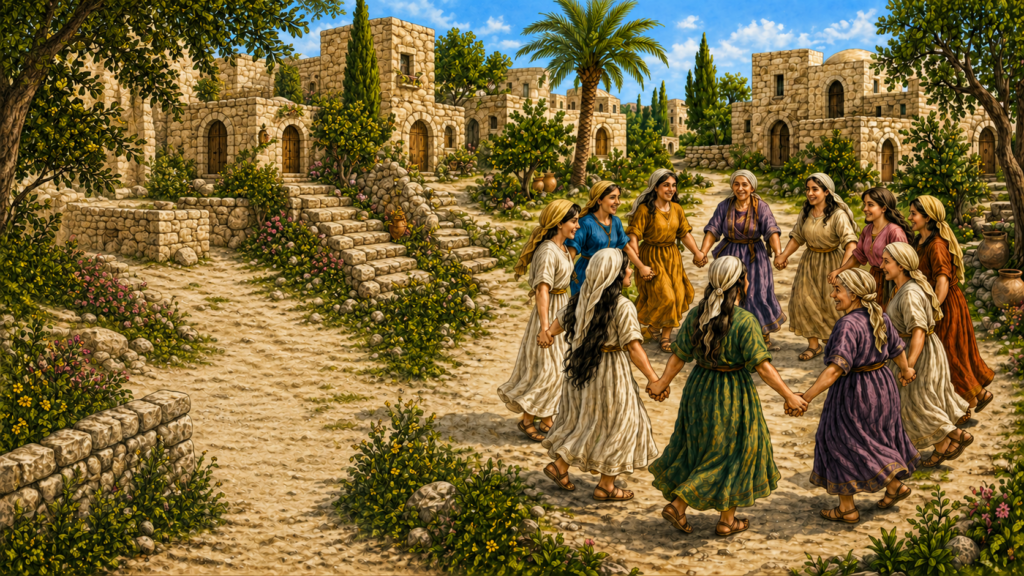
Jewish dance instructor, Teresa Cook, describes the types of dances used in ancient Israel, including circle dances, processional or line dances, and dances with hopping and whirling movements, which were exuberant with joy. However, she emphasises that the movements in Jewish dance had prohibitions and that worship to the Lord was to be in the beauty of holiness (Ps 29:2). She describes the clear distinction between the dances of the Jewish people, which were more of a sacred nature, and the sensual or ceremonial dances of the pagan nations that surrounded them:
“There would have been nothing inappropriate in the movements or the attire of the Jewish dancers. And I really think we would be wise to follow their example and be especially cautious of both our attire and our movements so that nothing is drawing attention to parts of our body that people shouldn’t be paying attention to, such as really tight tops or really low cut tops or things that really just accentuate parts of the body. That’s not for the people of God. Our dancers should give glory to God and not to the performer or to the performer’s body.”448 (4:55)
Cook goes on to describe how girls who attend her classes naturally want to swing their hips but that would not have been done with the Jewish people. She said:
“It’s unfortunate that in our culture so much of dance is out in the secular world and its children are taught at such a young age to move their bodies in a sensual way that we need to help un-train them and we need to teach them sanctified dance. I think that’s really what God wants to return to His people because just as God’s people are sanctified, we’re set apart for His glory, in the same way our dances should be expressions that are sanctified and set apart for His glory. And the honour and dignity that God created us to be as His children.”448 (6:32)