
Harmonising with God in Our Music and Practices
Part 6 - Intensity
Chapter 23
Chapter 23
Sacrifice Shouts Love
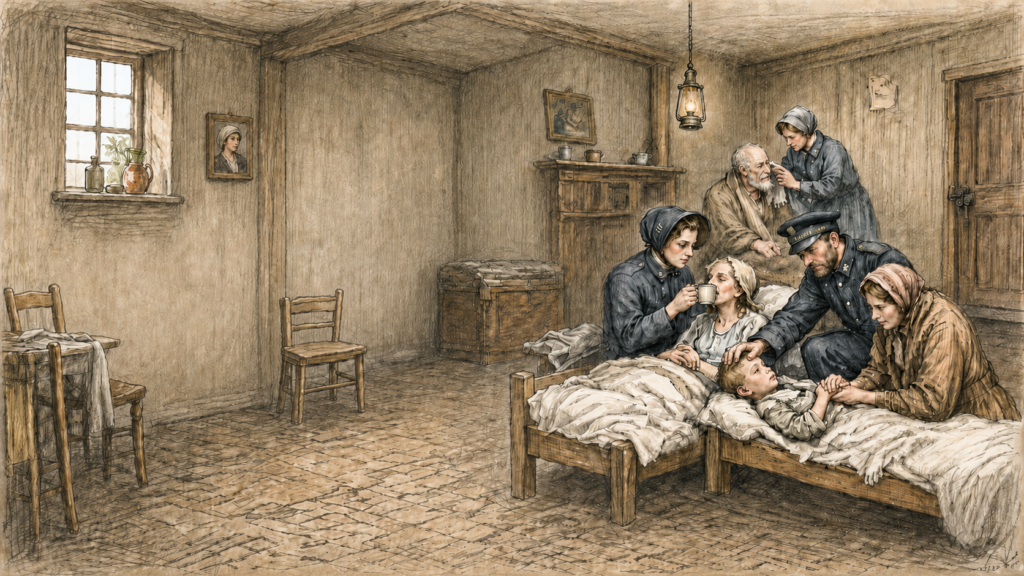

General Booth made a loud noise to keep people out of hell. Though not necessarily literally loud like the early Salvation Army, all Christians are to send a clear message to the world to be ready for God’s judgement by accepting the gospel message. But we must be careful the way the message is presented. Rather than pushing people away by aggressive opposition, we want to draw people to Jesus by demonstrating His loving character. Our message of warning to the world must be given in love and the best way to shout love is by sacrifice.
The Booths sacrificed much for the gospel, at times struggling to make ends meet, especially early in their ministry. When General Booth left his employment with the Methodist New Connexion in 1861, he was left without a regular salary to support his young family as he travelled across England running revivalistic meetings. He became loved by the working-class people of London’s East End because of his dedication to their physical and spiritual needs.
The Whites also faced many struggles in their ministry and sacrificed much for the Seventh-day Adventist movement. In the early years, there was no established church structure; therefore, there was no financial remuneration for anyone working for the cause. They had to pay their own way as they travelled around preaching. James went from job to job labouring to earn funds to support his family, to pay for travel expenses and to support the new publishing work. He harvested hay, chopped timber in the forest and laid sleepers on the railroad – whatever work he could get hold of – while preaching and writing publications. Very little of their earnings went toward building up a living for themselves.141
Later in life, the Whites were accused of profiteering from their ministry. Alma McKibbin, the first full-time Adventist school teacher in California, relates an experience she had as a young girl after her mother had become an Adventist. A visitor to their home, apparently trying to dissuade her from her beliefs, claimed the Whites were living a luxurious lifestyle in a palatial home with French colonial furniture, the richest carpets and upholstered chairs. When they went about travelling and preaching, he said, they put on their oldest clothes and told people to sacrifice everything in support of the cause. Curious, the young Alma arranged to visit Mrs White’s house. To her surprise, she discovered a very different home to what the visitor had described. This is Alma’s description of the sitting room in Mrs White’s house – the place where family and guests met for worship every morning and evening:
“Well, I looked at the chair I was sitting in, it was just a little old-fashioned rocker of the cheapest sort. On the floor was a well-worn rug. There were three or four straight chairs in the room – very plain – and a little cottage organ which had seen much use. Sister White was very fond of music and she loved her little old cottage organ. And that’s all there was in the room, except plain muslin curtains at the windows.”296
Because of this experience and others, Alma became convinced that all the stories about Mrs White were not true. On the contrary, she found Mrs White to be an honest and humble person who loved Jesus. She went on to become a pioneering Adventist educator, using Mrs White’s principles of holistic, Bible-based education. Mrs White could have become wealthy from royalties from her books, but the profits were invested in people and ministry. For example, she would buy material and clothes for the needy, give away produce from her garden and orchard, feed and house guests and support church activities. Records have even revealed that she would take out personal loans, paying up to 8% interest, so she could support ministry projects, such as starting a new school or church.293,296
Vaccinations & Religious Liberty
Christians throughout the ages have sacrificed much, even risking their lives, to help people and spread the gospel. An issue which has stirred up a lot of noise in the church and community in recent years is the controversy over vaccinations. Some Christians viewed it as an opportunity to support the community and help protect the vulnerable, while others saw it as an infringement of religious liberty. It is particularly in hard times that we either shine Jesus’ light to the world and help to build God’s kingdom or we reveal our dark human nature and turn people away from Jesus. We have to tactfully juggle words of judgement with acts of loving kindness.
After comparing the views of Mrs Booth and Mrs White, and looking at passages of Scripture, this chapter will take a position on vaccination mandates, but it is only one position. The apostles did not always agree with each other, but they kept prayerfully wrestling over disputed issues, using Scripture and Christ’s teachings as their guide, until they came to a consensus. Whether in favour of vaccines or against them, people on both sides of the argument want to be faithful to Jesus. However, some people have been very worked up over this issue. Mrs White cautioned against becoming indignant and flying into a passion over religious liberty. Quoting from Peter in this regard, as the servants of God, she said, ‘Honor all men. Love the brotherhood. Fear God. Honor the king (1 Pet 2:17).’ Sensible dialogue on touchy issues like this can only occur in calmness and respect for each other.
Just as she was sharply critical of orthodox medical practice in general, Mrs Booth was strongly opposed to vaccinations and discouraged parents from vaccinating their children.125 The first vaccine to be developed was the smallpox vaccination which became widely available in the 19th and 20th centuries, effectively eradicating the disease. The first mandatory immunisation program came into effect in the 1840-50s in Britain and parts of the United States.425 Fear of turning into a cow caused resistance to the smallpox vaccination due to its derivation from cowpox, a disease found in cows. Despite this, uptake for the vaccination was high. Mrs Booth believed, instead, in hydropathic treatment for patients with smallpox. She advised, “let us fall into the hands of God, and not of man.”125 (p630) Mrs White, on the other hand, did not speak out against vaccines. Though a prolific writer on health, there is no record of her ever advising people not to be vaccinated.
D. E. Robinson, Mrs White’s grandson-in-law and long-time office assistant, in 1931, in a letter he wrote in response to a question on vaccination, claimed that even Mrs White received a vaccination against smallpox:
“You will be interested to know however, that at the time when there was an epidemic of smallpox in the vicinity, she herself was vaccinated and urged her helpers, those connected with her, to be vaccinated. In taking this step, Sister White recognized the fact that it has been proven that vaccination either renders one immune from smallpox or greatly lightens its effects if one does come down with it. She also recognized the danger of their exposing others if they failed to take this precaution.”286
Some question the accuracy of Robinson’s recollection of events, arguing that he was influenced by his own personal bias. However, the Ellen G. White Estate provides other statements denying Mrs White’s objection to vaccinations. Arthur White, grandson of Ellen White and secretary of the White Estate at the time, responding to a letter he received, said “If someone has informed you that Sister White counselled against vaccination or inoculations, they are mistaken.” He then gives the following advice:
“I think of missionaries who went out in the earlier years of our work, some of whom thought was a violation of principle to be vaccinated. They were cut down with disease and filled early graves giving virtually no service to the mission field. Would it not have been much more pleasing to God for them to have taken the steps which would have prevented their succumbing to these dread diseases?
…I think of one of our physicians who today must spend much time in an iron lung [an early type of ventilator]. In the prime of life, he was sent a few years ago to North Africa where he led out in our medical work in a good way. The Lord blessed his ministry. The vaccine was secured for polio shots, but for some reason, there was not sufficient for all. The doctor gave the shots to everyone but himself. He recognized that it would be the part of wisdom for him to have taken the shots, but due to the shortage of vaccine, he did not do so. In the epidemic which swept the country, he succumbed to the disease, in a very paralyzing form. With the cooperation of the United States government, he was flown back to the United States in an ambulance plane. What the man suffered is hard to describe. There is little hope of his ever gaining the use of his normal faculties. He is a man with a family, a young man.”286
It is obvious where Mrs Booth stood on vaccinations. She openly and publicly opposed vaccines and taught others to do likewise, including avoiding vaccinating children. Mrs White, on the other hand, never publicly opposed or endorsed vaccinations. Eyewitnesses and those close to her claimed that she supported vaccines. Mrs White had an extra 25 years of life compared with Mrs Booth in which to voice her objections to immunisations. She remained silent. Mrs White’s usual pattern was to speak up when she disagreed with something, such as her opposition to slavery and the women’s rights movements. She was very vocal in lobbying for religious liberty, especially concerning the Sabbath; however, when vaccine mandates were rolled out across the United States and Great Britain, especially after 1855, requiring children to be vaccinated against smallpox before starting school for the first time, unlike Mrs Booth, she made no protest. Mrs White never made vaccination mandates a religious liberty issue. Though Mrs White released numerous publications on health at the time, she said nothing opposing vaccinations. If Mrs White was God’s messenger, He chose not to speak through her regarding vaccinations.
When it came to religious liberty, as already discussed, when Sunday laws started to come into effect in certain states of the US, Mrs White discouraged members from defying the law by working on Sunday. Though it was a religious liberty issue, she discouraged members from becoming overly passionate about it, warning against civil disobedience. Instead, she led by example by calmly and peacefully lobbying governing officials while remaining law abiding. Apparently, she believed that we should be obedient to the law, if at all possible, without breaking a direct command of God.
Elsewhere, Mrs White said:
“If we receive the grace of God in the heart, we must reveal to others this grace in every word and act. Those who dwell upon the long-sufferance and mercy of Christ must practice His patience and forbearance… Some will say, ‘How can we do this? We should be taken advantage of…’”426
She is saying that we should be patient and forbearing, demonstrating grace toward others, even when wrongfully treated. To those who object to this advice, arguing that it will lead to others taking advantage of them, she counsels:
“We are not to reason in regard to results… The Lord has spoken to us; and whatever may be the consequences, we are to receive His Word and practice it in daily life, else we shall be choosing our own version of duty and shall be doing exactly the opposite of that which our heavenly Father has appointed us to do… Jesus has said, ‘Do good to them that hate you’… It is always best to endeavor to carry out the whole will of God just as He has specified. He will take care of the results.”426
In other words, though it may make more intuitive sense to defend ourselves when unjustly treated, she says, don’t do it. Do not retaliate. Be gracious. Be patient and long-suffering as Christ was. Let God look after the results.
Though modern medicine is not ideal, and there are potential side effects, Mrs White’s advice was that the use of quinine to treat malaria is not a sin, explaining that we are expected to do the best we can. She was, however, opposed to the use of quinine for conditions where there was unproven benefit. Apparently, according to Mrs White, it is not a sin to use modern medicine if there is potential benefit. In the illustrations provided by the Ellen G. White Estate, missionaries and their children were removed prematurely from active service due to death and morbidity from preventable illnesses. Years of active service lost that could have been used to blow the gospel trumpet. In other words, in these cases, great harm resulted from not taking vaccines. The same could be said of numerous medical treatments. Though antibiotics disrupt the microbiome of the gut, which can have profound effects on our health, they can save us from deadly bacterial infections. Though we trust God and consider our body to be the temple of God, we still ingest and inject antibiotics when necessary because they have clear benefits when used appropriately.
A Seventh-day Adventist might ask, if it is okay to inject a vaccine which might cause harm due to an adverse reaction, why did Mrs White say, “Nothing should be put into the human system that will leave a baleful influence behind”?282 (p228) The intent in her statement is to avoid harmful effects. Mrs White did not object to anaesthetics which, when put into the system can cause harm, even death (baleful effect). She also did not object to using x-ray to treat a black spot on her forehead even though she cautioned that x-ray could cause harm just like stimulant drugs can. How can we reconcile these apparent contradictions in her comments and practice?
If the intent of Mrs White was to avoid modern treatments at all cost even unto death, as with Mrs Booth, then her acceptance of the use of x-ray, anaesthesia and quinine for certain uses makes no sense. But if the intent is to minimise harm, then it does make sense. If minimising harm is the goal, when evaluating the appropriateness of a treatment, we not only need to consider the potential harm from receiving the treatment but also the potential harm from not receiving the treatment. No substance, even healthy food, is totally risk free. For example, people can choke on food or have anaphylactic reactions to it but the benefits obviously outweigh the risks. Therefore, risks and benefits always have to be considered when determining the appropriateness of something we intend to put into the human body.
Melanoma was recognised in the medical literature in the mid-1800s.427 Perhaps Mrs White’s physician was concerned that the black spot on her forehead was a deadly melanoma. If this was the case, then the benefits of x-ray treatment might have outweighed the risks. If there were no alternative effective proven natural remedies available, then x-ray treatment might have been the appropriate choice. The same could be said of anaesthesia. Though anaesthetics can cause anaphylaxis, respiratory depression and other harms which can lead to death, the benefits of its use in necessary surgery outweighs the risk. Therefore, there would be a greater baleful effect from not using anaesthetic if a ban against its use prevented needful surgery. Likewise with quinine, when used for unproven purposes, it might cause more harm than good, whereas for the treatment of malaria, it has been proven to save lives.
Mrs White cautioned that we should not rely on prayer alone for healing, but that we should use the simple remedies provided by God. She goes on to explain that we:
“…are not to take the position that methods of restoration to health in accordance with nature’s laws are to be neglected… The human agent should have faith and should cooperate with the divine power, using every facility, taking advantage of everything that, according to his intelligence, is beneficial, working in harmony with natural laws; and in doing this he neither denies nor hinders faith.”280 (p381-2)
Elsewhere, she said, “There were physicians in Christ’s day and in the days of the apostles. Luke is called the beloved physician. He trusted in the Lord to make him skilful in the application of remedies.”428 (p26)
Determining the risk versus benefit ratio was not a part of medical practice in Mrs White’s time but is common practice today. For example, research has shown that all patients benefit from lifestyle intervention to prevent heart attacks, but not all patients benefit from drugs. While cholesterol and blood pressure lowering medications are harmful for low-risk patients, they have been shown to be protective for high-risk patients, even if they are in the process of making lifestyle changes. In other words, a person at high risk of heart disease might die of a heart attack before lifestyle interventions have taken adequate effect. Drugs, therefore, could be considered ‘poisonous’ for low-risk patients but lifesaving for high-risk patients. If the intent is to minimise harm, then high risk patients should be treated with medications until they can adequately reduce their risk through lifestyle change.
Christians who have a healthy lifestyle and who have faith in Jesus often do not feel much threat from infectious disease. In some cases, it might be that certain vaccines cause more harm than good for these individuals. Despite this, during the COVID-19 pandemic, many people were willing to ‘risk it’ so they could help protect the elderly and vulnerable. The vaccination issue is not simply an individual decision because it has community consequences; therefore, it is a community issue and requires a community decision. According to D. E. Robinson, Mrs White was of the opinion that, if we do not vaccinate ourselves, we are in danger of exposing others.286 Whether or not Mrs White really did believe this, it is a valid argument. Quarantine laws in the Bible took away liberty and caused harm to some individuals – in the case of leprosy, it caused greater harm to the leper who was forced out of the community – but it brought benefits to the community as a whole.
We hear stories of Christians, past and present, who have risked their lives by going to distant lands to help the poor and vulnerable and then give them the gospel message. They had to put their full faith and trust in God for protection but were willing to yield up their lives for His service if required. The Salvation Army is an exemplary illustration of the willingness to help others at all costs. In the Dutch Indies before immunisations were developed, for example, George Railton explains:
“Our Officers in every town and village are supplied with all the medicines and bandages they can use, for the Government has found that they live amongst the poorest all the time, and are always ready to bathe and bandage their wounded limbs and feet, or to give them the few medicines needed to combat the ordinary maladies. Moreover, from some terrible losses by death of Officers, in our earliest years there, it was made only too plain to everyone that our Officers would not abandon their people in times of cholera or other epidemics, but would rather suffer and die with them.”57 (p170)
If we just preach without first building a connection with the people, it often falls on deaf ears. But when we give of ourselves, give of our time, risk going to malaria- and dengue-infested areas, war zones and isolated regions far from the safety of modern services, and help those in need and spend time with their families, we earn their respect. We can then preach with much greater effect. However, we do not necessarily need to go to the back blocks of the world to serve. During the COVID-19 pandemic Christians had a great opportunity to ‘love the brotherhood’ and ‘honour the king.’ In other words, there was a golden opportunity to show our love to fellow humans and our willingness to cooperate with the law of the land. Numerous studies have shown, however, that religious conviction, including Christianity, can contribute significantly to vaccine refusal.429,430
A number of sensible reasons have been given for avoiding vaccines. Notable amongst these is the argument that our body is the temple of God and vaccines defile the body (1 Cor 3:16-17) because, unlike food and water, it was not made by God for the human body. However, the same could be said of antibiotics or quinine. Even though an antibiotic is a foreign substance which does not belong to the human body, we do the best with what modern medicine has to offer to combat the effects of sin and degradation – including infectious disease – while not ignoring the health principles God has given us. We have to be careful extrapolating too much from general principles and making rigid rules out of something God has not directly commanded.
The Pharisees were more concerned about defiling their own bodies by coming into contact with an unclean person than they were about having compassion on that person. They took general principles and designed rigid rules from that which God had not commanded. We have no command from God which directly or specifically informs us regarding the appropriateness of vaccines.
When the woman with bleeding touched Jesus, He had compassion on her, though she was unclean (Mk 5:25-34). His focus was on caring for her health and spiritual needs. Some of us prefer a plant-based diet because we believe it is good for our health and we want to honour the body God gave us. However, Jesus said, “There is nothing that enters a man from outside which can defile him; but the things which come out of him, those are the things that defile a man (Mk 7:15).” There might be occasions when we have to consume animal products in order to have compassion on others, such as a missionary working in an isolated location with limited resources. Being ‘unclean’ or eating animal products, though it may be desirable to avoid them, they are not necessarily sins. The same could be said of vaccinations. It is always a sin, however, to lack compassion on the needy. God said through Isaiah:
“Is it a fast that I have chosen, a day for a man to afflict his soul. Is this not the fast that I have chosen: To loose the bonds of wickedness, to undo the heavy burdens, to let the oppressed go free, and that you break every yoke? Is it not to share your bread with the hungry, and that you bring to your house the poor who are cast out; when you see the naked, that you cover him, and not hide yourself from your own flesh?” (Is 58:5)
In the eyes of God, fasting is desirable for it improves our own physical and spiritual health, but feeding the poor is an even greater priority.
There is no clear divine revelation from God concerning vaccinations, but there are commands regarding love to our neighbour, obedience to governing authorities, spreading the gospel and warning people of future judgement. The only time our church leaders, or individual members, should disobey the law is when it is in clear opposition to God’s law. Sabbatarians believe that some of the early leaders of the Christian church made a fixed tradition out of that which was not commanded in the Bible, the first day, while neglecting that which was commanded, the seventh-day Sabbath.
Making up laws and claiming they are required by God is just as serious as breaking His laws. One of the greatest problems Jesus had with the Pharisees was not that they were keeping God’s law strictly – for He said, unless our righteousness exceeds that of the Pharisees, we will not enter the Kingdom of God – it was that they expanded His law and added new laws of their own which were burdensome. If there is no clear command, the default should be to do what is seen by the majority as most loving and submissive, because that is clearly commanded in the Bible. We are to be peacemakers. To do otherwise promotes disorder and anarchy.
We should strive to give leaders the benefit of the doubt, many of whom make decisions according to the dictates of their own religious convictions – many of whom are Christians themselves. They are answerable to God for the decisions they make. Authoritarian governments are more likely to infringe on religious liberty. The church leadership, and individual members, have a responsibility to respectfully advocate for religious liberty. As a church, we should always lobby to have religious liberty in the forefront of the government agenda. This is more likely to be achieved if done with respect and by a united effort. If the government is being dictatorial and overbearing, it is likely because Christians have not been the beacon of light that we should be – we are not being the salt of the world (Matt 5:13-14). We are partially to blame. Our gospel message has to go to leaders as well. If we are seen in the community doing acts of goodwill toward humanity and we practise what we preach, this rubs off on the rest of the community, including government officials.
Due to their temperance work and opposition to immoral behaviour, the Salvation Army had a positive influence on society in reducing alcohol abuse, gambling, prostitution and other vices – including government regulations restricting these practices. George Railton describes how, due to the influence of the Salvation Army at the height of its work:
“Upon the question of temperance, there is happily a widespread awakening amongst the nations. So convinced are all governments and peoples that drinking and crime are closely connected, that much has already been done, with good effect, to lessen the sale of intoxicants in many lands.”57 (p173)
How do we determine if God’s law has been compromised? Unlike the autocratic style of governance of the Salvation Army, the democratic structure of the Seventh-day Adventist Church should allow for all members of the church to come together, the members with the leadership, to pray and wrestle with Scripture until a consensus opinion is agreed upon. Leaders must not make the mistake that David made when he brought the ark to Jerusalem without a thorough searching of Scripture to determine if God’s law has been compromised. No doubt there were individuals amongst the Israelites who knew that David was not following the proper order, but they were not consulted. David, as leader of the nation, made a rash decision without taking time to consult the people and God’s Word.
When just a few men at the top make decisions without due process, mistakes are made. All sides of the story must be heard when it comes to important and contentious issues. Only then, must a vote be taken and a decision made on the consensus vote. Mrs White said:
“every conference, every institution, every church, and every individual, either directly or through representatives, has a voice in the election of the men who bear the chief responsibilities in the General Conference.”47 (p236)
In other words, the men at the top represent the voice of the constituency. For those in appointment positions, Mrs White advised that they must draw on the experience and wisdom of the church as a whole:
“So far as possible, committees should let the people understand their plans in order that the judgment of the church may sustain their efforts. Many of the church members are prudent and have other excellent qualities of mind. Their interest should be aroused in the progress of the cause. Many may be led to have a deeper insight into the work of God and to seek for wisdom from above to extend Christ’s kingdom by saving souls perishing for the word of life. Men and women of noble minds will yet be added to the number of those of whom it is said: ‘Ye have not chosen Me, but I have chosen you,… that ye should go and bring forth fruit (John 15:16).’”411 (p259)
Jesus came and lived in a sinful world amongst an unclean people. He exposed himself to the sin and decay of fallen humanity. He was willing to mingle with us to bring physical and spiritual healing. He warned of judgement but then provided us with a way out. His life and death was one of hardship and rejection, yet he never complained about the injustice inflicted on Himself.
“He was oppressed and He was afflicted,
Yet He opened not His mouth;
He was led as a lamb to the slaughter,
And as a sheep before its shearers is silent,
So He opened not His mouth.
He was taken from prison and from judgment,
And who will declare His generation?
For He was cut off from the land of the living;
For the transgressions of My people He was stricken.
And they made His grave with the wicked—
But with the rich at His death,
Because He had done no violence,
Nor was any deceit in His mouth.
Yet it pleased the Lord to bruise Him;
He has put Him to grief.
When You make His soul an offering for sin,
He shall see His seed, He shall prolong His days,
And the pleasure of the Lord shall prosper in His hand.
He shall see the labor of His soul, and be satisfied.
By His knowledge My righteous Servant shall justify many,
For He shall bear their iniquities.
Therefore I will divide Him a portion with the great,
And He shall divide the spoil with the strong,
Because He poured out His soul unto death,
And He was numbered with the transgressors,
And He bore the sin of many,
And made intercession for the transgressors.” (Is 53:7-12)
He was silent before his oppressors, yet His sacrifice has resounded around the world. He is our example. If, when we are oppressed and afflicted, instead of protesting, we show love and concern for our enemies in return, it shouts love and the pleasure of the Lord shall prosper in our hands also.