
Harmonising with God in Our Music and Practices
Part 5 - Restrictions on Instruments
Chapter 17
Chapter 17
Censored Instruments
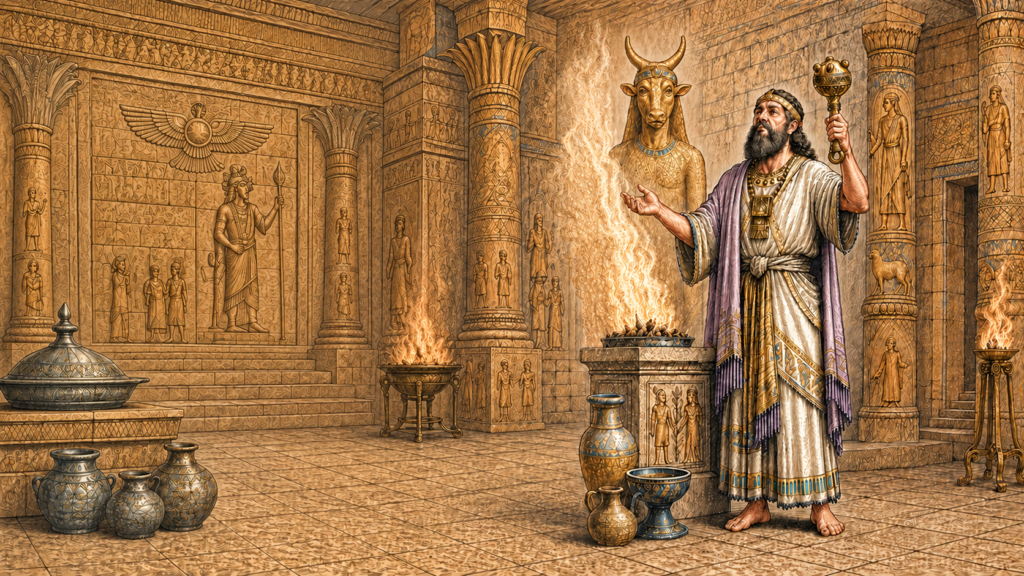

For the first three millennia after creation, there is no instruction in the Bible from God for instruments to be used for making music. Though musical instruments are mentioned often in the Old Testament, there is not a lot of instruction from God concerning the use of musical instruments. There is no clear record of the patriarchs worshipping God with musical instruments or in song. The first instruments introduced by God – the Trumpet and bells – were designed to make sound but not to make music as such. Their purpose was for practical and ceremonial purposes.
In the Torah, the first five books of the Bible, God gives detailed instruction regarding how He wanted His people to relate to Him – music was not one of them. For example, the Bible is filled with instruction concerning a loving covenant relationship, His law, obedience, sacrifice, separation from pagan worship and forsaking the ways of the wicked. It is not until His people are in the promised land that God gives instruction for the use of cymbals, stringed instruments and harps to be used along with the trumpets in temple worship for making music. Even then, this instruction is revealed to us in the Bible indirectly and not as a direct command from God (2 Chron 29:25). This helps to illustrate how God values practical demonstrations of loving relationship, such as through righteous obedience, over emotional expressions of worship, such as through music. To rebellious Israel in the time of Amos, God said:
“Take away from Me the noise of your songs, for I will not hear the melody of your stringed instruments. But let justice run down like water, and righteousness like a mighty stream.” (Amos 5:23-24)
Jewish musician, conductor and musicologist, Alfred Sendrey,311 in his book Music in the Social and Religious Life of Antiquity, describes the importance of singing to the Jewish people:
“In Ancient Israel, music – especially singing – meant: to serve God, to exalt God with sounds. Singing, in whatever form, is for the Jew the religious creed expressed in sounds, the palpable affirmation of his close connections with the Eternal, the union in harmonious sounds of the Creator with His creation.”312 (p167)
Likewise, Mrs White affirms the elevated status of the human voice over musical instruments: “The human voice that sings the music of God from a heart filled with gratitude and thanksgiving is far more pleasing to Him than the melody of all the musical instruments ever invented by human hands.”168 (p506) Therefore, she encourages us all “to cultivate the voice so that God’s praise can be sung in clear, soft tones, not with harshness and shrillness that offend the ear. The ability to sing is the gift of God; let it be used to His Glory.”196 (p143) She also instructs that only the best singers should lead congregations in singing and “they should devote some time to practice, that they may employ this talent to the glory of God.”313 (p466)
Therefore, it seems that praise through musical instruments is not first priority for God. Regardless, the playing of musical instruments remained an important part of temple services from the time of David onward. Music was undeniably a very important part of Israelite culture. Moses is known to have possessed a knowledge of music which was imparted to the Israelite people. The Jewish temple music tradition is considered by musicologists to be of the highest order and one of the greatest spiritual traditions of antiquity. The fame of Jewish music spread far beyond the borders of Israel.9 (p58-9) When in captivity, “By the rivers of Babylon,” the Psalmist recollects, “those who carried us away captive asked of us a song, and those who plundered us requested mirth, saying, ‘Sing us one of the songs of Zion!’” But the Jews sat down and wept when they remembered Zion and hung up their harps upon the willows (Ps 137:1-3).
Today, there are many of us living in captivity to sin and in hardship due to the consequences of sin. For some, when they come to church and hear upbeat, joyful praise, it rings hollow. They feel no immediate joy because the music denies their reality. Even if the music elevates them for a moment, they may feel deflated afterward. This was the experience of God’s people in captivity in Babylon. The music did not bring them joy. We want people to feel cheerful at church, so we play joyful, light-hearted and exuberant music, yet oddly, it may not be what some people need to feel happy. Paradoxically, sad music can make us happy while happy occasions can make us sad. Research has demonstrated the healing power of sad music.314–316 The sad sounds of stringed instruments, for example, can be healing for these people. The greatest celebration is yet to come, when our Lord comes to take us to the Promised Land. Now is the time to work – to rescue people from captivity and save souls for eternity.
Upon return from captivity, musicians were reappointed by Nehemiah after the wall of Jerusalem was rebuilt (Neh 7:1-2) indicating the important place of music in temple service. Singing and instruments are mentioned repeatedly in the Psalms and, therefore, was an important part of worship for God’s people. It was eventually allowed and even commanded by God, but not as first priority. The giving of the law and call to obedience came first. In this regard, General Booth’s use of musical instruments as first priority to motivate people to repentance does not seem Biblical.
Hierarchy of Instruments
Certain instruments in the Bible had special functions suggesting a hierarchy of sacredness by the way they were used. Plucked stringed instruments, shofars and metal trumpets were used in conjunction with sacrifices and at non-sacrificial rituals. Percussion instruments, such as the tambourine or hand drum, ranked below these since they were not employed in sacrifices.34 (p59) God specifically ordained certain instruments for use in the temple, while others were not allowed. Stringed instruments, cymbals and trumpets were played in the temple. Other instruments were not generally associated with temple worship but were used during processions, feasts and special events.
There is evidence that certain musical instruments were forbidden by the Israelite religious leaders. The lute was a favourite instrument amongst the Egyptian people whom the Hebrews had lived with for centuries but, for some puzzling reason, was not popular with the Jewish people. Israeli musicologist and author of Music in Ancient Israel/Palestine, Joachim Braun, theorises that the Jews regarded the lute as impure due to the Egyptian tradition of associating it with the pleasures of love.228 (p360) Note that some Bibles give the impression that the lute was in common use by the Hebrews. That is because some Bibles translate the nēbelas lute, others as harp but the consensus of modern scholarship is that it was probably a variety of lyre.34 (p52-3),227 (pp22-3)
The rattle is another instrument that was undoubtedly censored from Scripture and religious ritual. An enormous number of rattles have been excavated with even distribution across different regions of Israel/Palestine dating from very early periods to modern times. It was literally produced for the masses, including for Israelite people. Despite this, there is only one single reference to the rattle in the whole Bible – it was named amongst the instruments played by David and the Israelites while attempting to move the ark to Jerusalem (2 Sam 6:5). Even more telling, in the parallel passage in First Chronicles, written at a later date, the rattle is conspicuously absent. Braun attributes this censoring of the rattle by Israelite religious leaders to its association with pagan religious ritual, especially debaucherous cultic festivities.227 (pp19,98-107)
The round tambourine, a small handheld frame drum without jingles, is depicted in Egyptian artwork as being exclusively played by women.317 Likewise, in Israelite archaeology and Biblical references, it is more often women that we encounter playing the tambourine (Jud 11:34; 1 Sam 18:6; Jer 31:4; Ps 68:25). For example, Miriam, with the other women, played the tambourine in her song of praise after crossing the Red Sea (Ex 15:20-21) – a reflection of the culture they had just left behind in Egypt. Though it was sometimes used in secular and religious settings – such as processions, secular celebrations, religious feast days and the singing of hymns – the drum is not mentioned in connection with temple music (1 Chr 25:6).227 (p29-30) Moreover, although the small, handheld drum was adopted by the Hebrews and used largely by women, as with the Egyptians, the ancient Hebrews did not adopt other types of drums commonly used by surrounding nations, including the larger bass drums.34,317,318 A scholarly explanation for this is not readily available. Though the musical instruments used by the Hebrews were very similar to that of their neighbours, it is evident that there was partial and complete censoring of certain instruments, including the rattle from religious practices, the tambourine from the temple and larger drums as well as the lute from secular and religious use.
Musical Instruments in the Early Church
At the time of Christ, music was an important element in pagan society as well as various segments of Jewish life, including religious and non-religious settings. Outside of Judaism, “In the Roman Empire, vocal and instrumental music was present in pagan cults, in the theatre, at symposia, and in diverse other areas of public and social life.”226 Within Judaism, singing was expressed during sorrowful occasions, death and in the face of calamity. Singing and the sound of musical instruments were also frequently associated with public and private expressions of joy, pleasure and prosperity in Jewish communities – such as weddings, pregnancy, love, public festivities and victory celebrations. For devout Jews, in ancient times and throughout history, the whole of life is sacred. On joyous occasions, praise is given up to God and in times of sorrow, appeals are made to God for comfort and help. Therefore, music outside of religious occasions did not necessarily lack a religious dimension.34 (p135-65)
There is evidence of singing during informal religious occasions in Jewish homes. For example, a passage in 4 Maccabees has a father singing Psalms and other Biblical material to his children.34 (p117) In keeping with Jewish custom, Mary likely gave Jesus oral instruction consisting of singing and other forms of recitation. As Paul Hamel, former music department chair at Andrews University, describes:
“Large amounts of sacred literature were set to music and learned by the young. A cooperative and willing student, such as Jesus surely was, would accumulate a large repertoire of sacred songs based upon the teachings of the Old Testament.”9 (p121)
Though little is documented in the gospels of music in Jesus’ life and ministry, the songs He learnt in childhood would have been a comfort and strength to Him throughout His life and ministry. Paul’s instruction for believers to encourage each other in singing was likely inspired, at least in part, by the testimony of eyewitness accounts of Jesus’ ministry. Extra Biblical sources indicate that it is also likely during the time of Christ that singing, and possibly the playing of music, was a part of formal religious occasions in the home, especially the Passover meal.34 (pp117-21) Jesus and His disciples sang a hymn during the Passover meal (Matt 26:30).
In the late temple period, Psalms were still being sung with the accompaniment of musical instruments as part of the sacrificial system in the Temple at Jerusalem. However, curiously, according to Brill Encyclopaedia, singing and music was not part of the synagogue services.34 (p131-34),226 In his book on ancient Judaism, John Arthur Smith states, “Sources from the early first century CE show that the main religious purpose of the synagogue was the Sabbath instruction of the faithful through scriptural exposition and exegesis.” There is no documentation of musical activity in the synagogue until late, he says.34 (p131)
Written sources in the early church frequently mention musical instruments but there are no concrete references to Christians playing musical instruments until well into the Middle Ages.34 (p169) In fact, many of the church fathers expressed hostility toward the playing of musical instruments and this only increased with the course of time. Clement of Alexandria (150-215 AD), for example, rebuked the use of certain instruments, such as the auloi, psalteries, Egyptian clappers and ‘other such playthings’ which, he said “become altogether indecent and uncouth, especially when joined by beating cymbals and tympana and accompanied by the noisy instruments of deception.” Though Christians used musical instruments metaphorically to interpret Scripture as Paul did (1 Cor 14:7-9), he reasoned that instruments were not to be played because of their association with superstition, licentious living, moral degeneration, paganism, aggression and war. We Christians, he admonished, are pacifists and we:
“…make use of but one instrument, the word of peace alone by which we honour God, and no longer the ancient psaltery, nor the trumpet, the tympanum and the aulos, as was the custom among those expert in war and those scornful of the fear of God who employed string instruments in their festive gatherings, as if to arouse their remissness of spirit through such rhythms.”
Clement of Alexandria was certainly not alone in these sentiments. According to some scholars, so influential were the attempts to keep worldliness and paganism out of the church that music in early Christian settings was, it seems, largely vocal with little accompanying musical instruments.34 (p172-4)
The Mingling of the World with the Church
In Genesis, where we find the foundation of many of our doctrines, we discover the first mention of musical instruments. It is recognised by many theologians that the first appearance or mention of something in the Bible – especially in the book of Genesis – has significance to its meaning in Scripture. Jubal, of the lineage of Cain, “was the father of all those who play the harp and flute(Gen 4:21).” It was the ‘sons of men’ or the descendants of Cain, those opposed to God, who are first to become masters of musical instruments. The ‘sons of God’ or the descendants of Seth, those who accepted God, are not mentioned to have made use of musical instruments. This does not make musical instruments evil, but it is a warning or caution to God’s people that those who oppose God were masters of musical instruments from the beginning.
A century after the death of Clement of Alexandria, Christianity was legalised. There was less attempt to keep the world out of the church. Relics, chants, bells, paintings, statues and incense, adopted from the pagan world, were brought into the church to impress the mind and attract the masses. The Great Controversy highlights just how impressive Roman Catholicism became:
“Its gorgeous display and solemn rites fascinate the senses of the people, and silence the voice of reason and of conscience. The eye is charmed. Magnificent churches, imposing processions, golden altars, jeweled shrines, choice paintings, and exquisite sculpture appeal to the love of beauty. The ear also is captivated. The music is unsurpassed. The rich notes of the deep-toned organ, blending with the melody of many voices as it swells through the lofty domes and pillared aisles of her grand cathedrals, cannot fail to impress the mind with awe and reverence.”159 (p566)
As with Paul, who recognised the mystery of lawlessness already at work in his time, Mrs White recognised the “striking similarity between the church of Rome and the Jewish church at the time of Christ’s first advent.”75 (p568) This is not to say that Catholics and Jews are not godly people. At the time of Christ, there were many Jews who accepted Jesus, just as there are many Catholics who are genuine followers of Christ today. But ever since the time of Christ, the devil has been infiltrating the church to corrupt it and distort its purity.
Cristina Rocha, Professor of Anthropology and the Director of the Religion and Society Research Cluster at Western Sydney University, compares the outward splendour, pomp and ceremony of Roman Catholicism with the ecstatic material experiences of Pentecostal and Charismatic Christianity. The Roman Church, she says, uses:
“…objects (relics, altars), sounds (chanting, bells, drums), lights (think stained-glass in cathedrals), images (paintings, statues of saints), rituals, and their bodily senses (the smell of incense burning, ecstatic states) to engage with the divine.”46
Likewise, she explains, Pentecostal and Charismatic churches create ecstatic experiences by engaging the senses with music, objects, lights, images and other spectacle to make the transcendent immanent. Though Rocha sees no problem with this, Mrs White points out that:
“The religion of Christ needs not such attractions to recommend it. In the light shining from the cross, true Christianity appears so pure and lovely that no external decorations can enhance its true worth. It is the beauty of holiness, a meek and quiet spirit, which is of value with God.
Brilliancy of style is not necessarily an index of pure, elevated thought. High conceptions of art, delicate refinement of taste, often exist in minds that are earthly and sensual. They are often employed by Satan to lead men to forget the necessities of the soul, to lose sight of the future, immortal life, to turn away from their infinite Helper, and to live for this world alone.”159 (pp566-7)
History tells us the end result of mingling worldliness with the church as described in The Great Controversy:
“When the early church became corrupted by departing from the simplicity of the gospel and accepting heathen rites and customs, she lost the Spirit and power of God; and in order to control the consciences of the people, she sought the support of the secular power. The result was the papacy, a church that controlled the power of the state and employed it to further her own ends, especially for the punishment of ‘heresy.’ In order for the United States to form an image of the beast, the religious power must so control the civil government that the authority of the state will also be employed by the church to accomplish her own ends.
Whenever the church has obtained secular power, she has employed it to punish dissent from her doctrines. Protestant churches that have followed in the steps of Rome by forming alliance with worldly powers have manifested a similar desire to restrict liberty of conscience…
…It was apostasy that led the early church to seek the aid of the civil government, and this prepared the way for the development of the papacy—the beast. Said Paul: ‘There’ shall ‘come a falling away, … and that man of sin be revealed (2 Thes 2:3).’ So apostasy in the church will prepare the way for the image to the beast.
The Bible declares that before the coming of the Lord there will exist a state of religious declension similar to that in the first centuries.”159 (pp443-4)
Though the early church may have been overly strict toward musical instruments in an attempt to keep worldliness out of the church, Christianity flourished. It remained largely pure in doctrine and spread rapidly, even in the face of extreme persecution in the 2nd and early 3rd centuries. No attempt was made to attract people to the church by worldly means. This all changed, however, beginning with Constantine, in the 4th century. As worldliness came in, human doctrine corrupted the church. Consequently, the ‘Spirit and power of God’ diminished and the church united with civil power in order to ‘control the consciences’ of the people.
In the 16th century, the Protestant reformers opposed many of the practices of the Catholic church, attempting to turn back to the Bible as the sole source of authority for Christian faith and practice. In the 18th and 19th centuries, there were the great religious awakenings. The Great Controversy says of this time:
“Deep conviction took hold upon their minds and hearts. They were convinced of sin and of righteousness and of judgment to come… With faith and humility they accepted the Lamb of God, that taketh away the sin of the world.”
True conversion brought about a complete change of character:
“The things they once hated they now loved, and the things they once loved they hated. The proud and self-assertive became meek and lowly of heart… The vain fashions of the world were laid aside.”159 (p461)
Christians sought not the outward adornment – “arranging the hair, wearing gold, or putting on fine apparel (1 Peter 3:3),” rather, they sought “the hidden person of the heart, with the incorruptible beauty of a gentle and quiet spirit, which is very precious in the sight of God (1 Peter 3:4).” They were deeply passionate about their faith and many Victorian Christians opposed worldly amusement and leisure pursuits. Christian influence pervaded social and political life to an extent almost unimaginable today, elevating morality and bringing about social reform. The Bible became the primary textbook of education for many young people. It was a time of deep searching of the Scriptures. Many ran to and fro, and knowledge increased (Dan 12:4), especially understanding of end time prophecy. The Bible society was established and missions were set up around the world.
It was in this setting that the Millerite movement arose and the soon coming of Christ was proclaimed. Then came the great disappointment of the Advent movement. Seventh-day Adventists see this as fulfilment of the opening of the ‘little book,’ which was sweet as honey in John’s mouth but bitter in the stomach (Rev 10:8-11). After the great disappointment, knowledge continued to expand. Religious revival, forsaking of worldliness and turning to deep study of Scripture led to a movement promoting the faith of Jesus, the keeping of the commandments of God (Rev 14:12) and the soon coming of Jesus. Historicists see this as the age of the ‘Philadelphia’ church. Unlike the Adventists, the Salvation Army did not often discuss the prophecies of the Bible or tie the events of the 1800s with any prophetic events of Daniel or Revelation.
When Christians are willing to forsake all, the Holy Spirit can manifest in mighty ways. But not all religious revivals yield such profound and lasting effects. The Great Controversy suggests that the revivals of the late nineteenth and early 20th century were not as they were with earlier revivals, for:
“…many of the revivals of modern times have presented a marked contrast to those manifestations of divine grace which in earlier days followed the labors of God’s servants. It is true that a widespread interest is kindled, many profess conversion, and there are large accessions to the churches; nevertheless the results are not such as to warrant the belief that there has been a corresponding increase of real spiritual life. The light which flames up for a time soon dies out, leaving the darkness more dense than before.
Popular revivals are too often carried by appeals to the imagination, by exciting the emotions, by gratifying the love for what is new and startling. Converts thus gained have little desire to listen to Bible truth, little interest in the testimony of prophets and apostles. Unless a religious service has something of a sensational character, it has no attractions for them. A message which appeals to unimpassioned reason awakens no response. The plain warnings of God’s Word, relating directly to their eternal interests, are unheeded.”159 (p463)
When worldliness is kept out of the church, the church moves closer to the light, developing a purer doctrine and elevating the morality of society. The attempt by some of the early church fathers to censor musical instruments is symbolic of their desire to keep worldliness out of the church due to its association with worldliness. But when worldliness comes into the church, it moves further into darkness and apostasy. When the church fails to oppose the immorality of the world, society sinks further into debauchery and depravity. As Mrs White put it: “Conformity to worldly customs converts the church to the world; it never converts the world to Christ.”159 (p509) We tend to blame the world for its wickedness, but when we fail to share the gospel with our neighbours, when we fail to blow the trumpet and clang the cymbals, both the world and the church become corrupted:
“Wherever a church is established, all the members should engage actively in missionary work. They should visit every family in the neighborhood and know their spiritual condition. If professed Christians had engaged in this work from the time when their names were first placed on the church books, there would not now be such widespread unbelief, such depths of iniquity, such unparalleled wickedness, as is seen in the world at the present time…
And not only in the world do we see the result of the church’s neglect to work in Christ’s lines. By this neglect a condition of things has been brought into the church that has eclipsed the high and holy interests of the work of God. A spirit of criticism and bitterness has come into the church, and the spiritual discernment of many has been dimmed. Because of this the cause of Christ has suffered great loss. Heavenly intelligences have been waiting to co-operate with human agencies, but we have not discerned their presence.”16 (p296)
The greatest evidence of the failure of the church is the great darkness that is seen in the world today and even creeping into the church. Instead of pushing back against the world, the church of the late 1800s began to embrace it – including using worldly music and entertainment to attract the world. In like fashion, the modern church has embraced the rhythm and methods of the secular world. Instead of opposing Hollywood and the secular music industry, the modern church has remained silent, even indulging in their products, bringing them into their homes and even into the churches. Consequently, we too have lost the ‘Spirit and power of God.’ We have found ourselves in the Laodicean age with a lukewarm membership. The ‘unbelief’, ‘iniquity’ and ‘wickedness’ in the world at the time of writing of The Great Controversy in the 19th century is far greater today. Unlike the praiseworthy works of the church of Smyrna (Rev 2:9), the works of the Laodicean church is lukewarm, therefore, Jesus will vomit it out of His mouth (Rev 3:15-16).
We have lost our influence and, consequently, the world has become like Sodom and Gomorrah. As with the Catholic Church which lost its influence due to apostasy from the time of Constantine and united with civil power to gain influence; in recent years, the evangelical church has been looking to unite with civil power to enforce its will against the liberty of conscience. President Donald Trump recently stated in a public speech, “Separation between church and state… let’s forget about that… we’re bringing religion back to our country.”319 (7:03) Clinical psychologist and television talk show host, Dr Phil, said to President Trump in response to his speech, “I can’t tell you first off how proud I am to see religion coming back to the White House. God bless you for doing this.”319 (18:16) The second beast has become like the first beast and is ready to restore the power of the first beast. Just as the apostate Catholic Church led to the dark ages, so will we be plunged into “great tribulation, such as has not been since the beginning of the world until this time, no, nor ever shall be (Matt 24:21).”