
Harmonising with God in Our Music and Practices
Part 4 - Instruments
Chapter 16
Chapter 16 Women Revivalists: Church Roles

Ordination of Women
Apart from their role in the family, how are women to be instruments for God’s service? Mrs Booth believed that, though wives are subject to their husbands in the home, women have identical roles to men in the church. Some Adventist scholars and theologians agree with Mrs Booth on this point. For example, Richard M. Davidson, Senior Research Professor of Old Testament Interpretation at Andrews University, does not agree with the traditional Adventist view which opposes the ordination of women. His understanding is more in line with Mrs Booth. However, he does point out that this is not an easy position to argue scripturally. He says that “women did not immediately receive full and equal participation with men in the ministry of the church.” Though women are not given prominent roles in the New Testament, Richard Davidson argues that, just as Paul did not immediately outlaw slavery, the removal of gender role distinctions would eventually be removed in time. He believes that the early church had begun baby steps in that direction.137 (p3)
According to The Acts of the Apostles, ordination is a public recognition of divine appointment. It gives a believer the right to, not only teach truth, but to baptise converts and to organise churches with the full authority of the church. It is “an acknowledged form of designation to an appointed office and a recognition of one’s authority in that office.”297 (p161-2) The word ordination is a Latin word used by most Bible translations to convey this meaning. The church practice of authorising someone for a holy purpose is found throughout Scripture. Examples of ordination in the New Testament include the twelve apostles (Mk 3:14), Paul and Barnabas (Acts 13:1-2), Timothy (1 Tim 4:14; 2 Tim 1:6) and elders in general (1 Tim 3:1–6; 1 Tim 5:22). Mrs White speaks of all of these events as ‘ordination.’298
In her article, Female Teaching, Mrs Booth’s arguments in favour of equality in roles becomes increasingly technical. Though she normally dismissed the value of academics and educated clergy for spiritual guidance, she relies heavily on Biblical scholarship to help interpret Paul’s writings on this topic. These arguments are complicated and open to debate. Richard Davidson argues that:
“…in 1 Tim 2:13 Paul is not arguing for a creation headship of man over woman as has often been assumed. Rather, he is correcting a false syncretistic theology in Ephesus which claimed that woman was created first and man fell first, and therefore women are superior to men. Because of this false theology, wives were apparently domineering over their husbands in public church meetings… Paul’s counsel for husbands and wives cannot be extended to the relationship of men and women in general.”137 (p2)
Mrs Booth, though drawing on a different scholarly argument, comes to the same conclusion as Richard Davidson – that Paul’s statements about women being subject to men in church is an issue between husbands and wives and not between men and women in the church in general.136 (p10) Because the Booths saw the traditional roles of women as demeaning compared to men, they felt that the role of women had to be elevated.
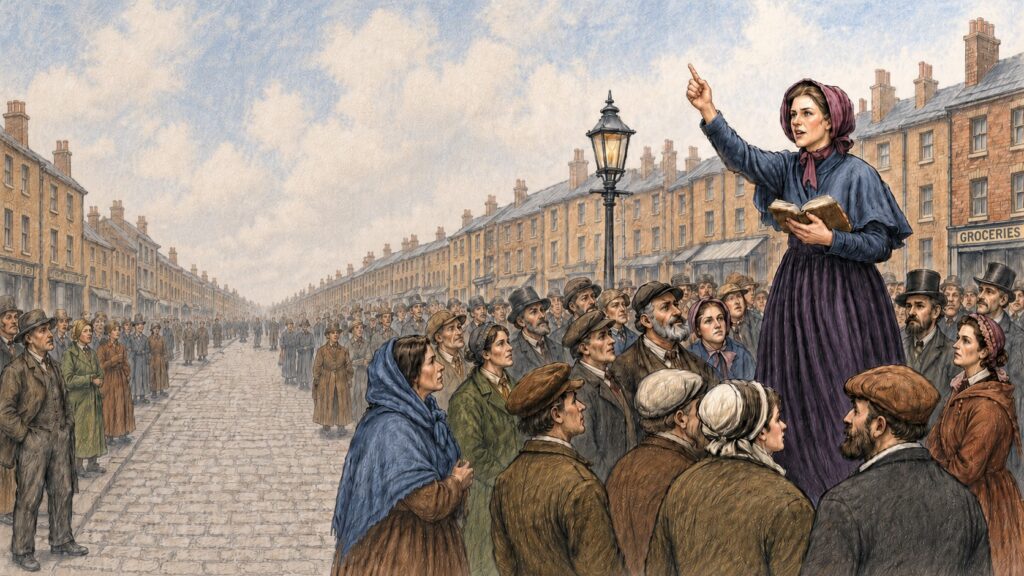
Liberation of women in America was a hot topic in the 1800s. Mrs Booth struggled with the heavy demands of motherhood. Once she began her preaching career, in a letter to her parents, she explained how she felt more at home preaching than in the kitchen.2 Advocacy for women’s rights was one of Mrs Booth’s most enduring legacies and it was a core attribute of the Salvation Army. She fought tirelessly for equal opportunities for women in leadership and ministry in the Salvation Army.299 Many working-class women assumed positions of authority.2 Mrs Booth herself became a prominent public evangelist. Her significant influence extended beyond the Salvation Army, including advocating for the right of women to vote.299 From the foundation of the Salvation Army, due to Mrs Booth’s influence, it became official policy that women were eligible for any office and to speak and vote at all official meetings. Women were officially made equal in their roles as men, though this was not always the case in practice.
Paul said there is “neither male nor female, for ye are all one in Christ (Gal 3:28 KJV).” Mrs Booth sees in this statement “that in the privileges, duties, and responsibilities of Christ’s kingdom, all differences of nation, caste, and sex are abolished.”300Opposers of women’s ordination have argued that, if Paul meant that women and men are equal in duties and responsibilities, why did he later say that “the husband is head of the wife, as also Christ is head of the church (Eph 5:23)?” They argue that the context of Paul’s statement concerns salvation. In Christ we have all been redeemed (Gal 3:13). We ‘are all sons of God (v26).’ We ‘have put on Christ (v27).’ From the context we know that Greeks and Jews, slave and free, male and female, are all equally part of God’s kingdom when they accept Christ, it is argued. Equally saved does not necessarily mean equal in role. However, Richard M. Davidson agrees with Mrs Booth that “This is not merely a statement on equal access to salvation among various groups.” Rather, he goes on to argue:
“…it specifically singles out those three relationships in which the Jews had perverted God’s original plan of Gen 1 by making one group subordinate to another: (1) Jew-Gentile, (2) slave-master, and (3) male-female.”137 (p3)
Mrs Booth leaned heavily on passages that supported the prominent standing of women in the Bible and their equal share in the gift of prophecy.2 She cites a number of women in the Bible as examples of females who led or spoke with authority, including Deborah, Huldah and Miriam. Richard Davidson also compiles a similar list of female leaders in his arguments in favour of women’s ordination. Most of these examples are prophetesses or women who were inspired to make prophetic statements.298 (p37) However, those opposing women’s ordination have argued that the leadership roles of these women were limited in extent compared to their male counterparts. For example, Mrs White writes of Huldah:
“The mind of the king, filled with anxious foreboding, reverted to her, and he determined to inquire of the Lord through this chosen messenger to learn, if possible, whether by any means within his power he might save erring Judah, now on the verge of ruin.”301 (p44)
In other words, she saw Huldah’s position as that of messenger of the Lord. There is no suggestion that Huldah had a leadership role over men.
Miriam was also cited by Mrs Booth and Richard Davidson as an example of female leadership. God said he sent Moses, Aaron and Miriam before the people (Mic 6:4) indicating leadership. Miriam led the women in song and dance in praise to God after the crossing of the Red Sea and, as with Huldah, she was a prophetess (Ex 15:20-21). Therefore, Miriam had leadership capacity, including as a messenger of the Lord and in leading women in worship. The book, The Adventist Ordination Crisis (authored by Doug Batchelor, Stephen Bohr and others), opposes the ordination of women. They state that “Although Miriam had a leadership role, her dispute with Moses offers clear evidence that it was not a headship role.”298 (p42) Mrs White writes:
“After Moses had told the Lord that he was unable to bear the burden of the people alone, and God had directed him to choose seventy of the elders, and he had put the same Spirit upon them which was upon Moses, Aaron and Miriam were jealous because they had not been consulted in the matter.”302 (p285)
Miriam had instigated an uprising against Moses because she had not been invited to be part of the process of selecting leaders for overseeing the governance of the Children of Israel – she was denied that leadership role. Miriam was also never given a priestly role as was her brother Aaron. Therefore, her leadership was limited compared to her two brothers.
The prophetess, Deborah, is another example of female leadership discussed in Mrs Booth’s book and cited by Richard Davidson in support of women leadership in the church. The Adventist Ordination Crisis, on the other hand, states:
“Deborah lived in the era of the judges, at a time when the prescribed theocratic government had broken down… Deborah did what a vice president might do in the absence or incapacity of a president, or what a wife should do in the absence or incapacity of her husband.”298 (p42)
According to Mrs White, Deborah had to step in as leader of the nation because there were no male magistrates available and the man God assigned to lead the nation was timid and lacked faith:
“She was known as a prophetess, and in the absence of the usual magistrates, the people had sought to her for counsel and justice. The Lord communicated to Deborah His purpose to destroy the enemies of Israel, and bade her send for a man named Barak, of the tribe of Naphtali… Although he had been designated by the Lord Himself as the one chosen to deliver Israel, and had received the assurance that God would go with him and subdue their enemies, yet he was timid and distrustful... He refused to engage in such a doubtful undertaking unless Deborah would accompany him, and thus support his efforts by her influence and counsel.”301 (p37)
Turning to the New Testament in support of women leadership, Mrs Booth and Richard Davidson both make reference to Junia as a female apostle. The text reads as follows, “Greet Andronicus and Junia, my countrymen and my fellow prisoners, who are of note among the apostles, who also were in Christ before me (Rom 16:7).” There is much controversy over the meaning of this passage. Unlike Mrs Booth and Richard Davidson, the authors of The Adventist Ordination Crisis see no hard evidence of female apostleship in this passage. In fact, they say:
“…theologians, Bible translations, and even the underlying Greek manuscripts disagree about whether Junia was a woman… A female apostle is an extraordinary claim, and it would require extraordinary, clear biblical proof, which is not present here. Even granting that Junia was a woman, the better reading of this ambiguous passage is that Andronicus and Junia were well known to the apostles, not themselves apostles.”298 (p33-4)
Therefore, there are no clear or undisputed examples of female apostles in the New Testament.
In the immediate context of Paul’s discussion about women’s submission in church, he discusses the requirements of Elders and Deacons, including the requirement that they be men – the husbands of one wife:
“Let a woman learn in silence with all submission. And I do not permit a woman to teach or to have authority over a man, but to be in silence. For Adam was formed first, then Eve. And Adam was not deceived, but the woman being deceived, fell into transgression. Nevertheless she will be saved in childbearing if they continue in faith, love, and holiness, with self-control. This is a faithful saying: If a man desires the position of a bishop, he desires a good work. A bishop then must be blameless, the husband of one wife, temperate, sober-minded, of good behavior, hospitable, able to teach… Likewise deacons must be reverent, not double-tongued, not given to much wine, not greedy for money, holding the mystery of the faith with a pure conscience. But let these also first be tested; then let them serve as deacons, being found blameless. Likewise, their wives must be reverent, not slanderers, temperate, faithful in all things. Let deacons be the husbands of one wife, ruling their children and their own houses well. For those who have served well as deacons obtain for themselves a good standing and great boldness in the faith which is in Christ Jesus (1 Tim 2:11-3:2, 3:8-13).”
Pr. Stephen Bohr, one of the contributors to the book, The Adventist Ordination Crisis, highlights what he sees as a clear pattern of male leadership in the Bible, as follows:
“Adam was given the leadership role at creation. After sin, the firstborn males were the spiritual leaders of each household. When God established Israel, he chose 12 males as the founders of the tribes. The regional leaders that were established in the days of Moses, which were the 1000s, the 100s, the 50s and the tens, were all male. The 70 elders that were chosen by Moses… was all composed of males. All of the priests of the Old Testament were males. All of the Levites – which would be equivalent, I believe, to the deacons today – they took care of the temple, the offerings, cleaning up and so on which is the role of the deacons today. All of them were males. Of the 42 kings in the history of Israel and Judah, all of them were males, with the exception of Athaliah, who was a usurper.
The 12 apostles that Jesus established were all males. The 70 that Jesus sent out were all males. The successor of Judas was chosen from two males that had been chosen from a larger pool of males. The seven deacons were all males. Paul and Barnabas of course, were males. The apostles and elders, who were delegates at the Jerusalem Council, were all males. Paul’s criteria was that those who are leaders in the church – the elders and the bishops – must be the husbands of one wife. And then you have, of course, Timothy and Titus that were ordained as elders, both males. There’s not a single case in all of Scripture where a woman was ordained as an elder or as a pastor of a church. So, as you look at the preponderance of the evidence in Scripture, it becomes very clear that God’s pattern of leadership is males.”303 (9:55)
Mrs White did encourage women to do ‘pastoral’ work. She said, “It is the accompaniment of the Holy Spirit of God that prepares workers, both men and women, to become pastors to the flock of God.”16 (p322) Pastor Ted Wilson, General Conference President of the Seventh-day Adventist Church at the time of writing, explains what the term ‘pastoral’ meant in Mrs White’s time: “Today, we use the word ‘pastor’ and ‘minister’ interchangeably,” but, when she wrote this, “ordained gospel ministers were referred to as ministers.” He then quotes Mrs White from Manuscript Releases, vol. 5:
“The ministers are paid for their work, and this is well. And if the Lord gives the wife, as well as the husband, the burden of labor, and if she devotes her time and her strength to visiting from family to family, opening the Scriptures to them, although the hands of ordination have not been laid upon her, she is accomplishing a work that is in the line of ministry…
Seventh-day Adventists are not in any way to belittle woman’s work. If a woman puts her housework in the hands of a faithful, prudent helper, and leaves her children in good care, while she engages in the work, the conference should have wisdom to understand the justice of her receiving wages.
Women helped our Saviour by uniting with Him in His work. And the great apostle Paul writes, ‘Therefore, my brethren dearly beloved and longed for, my joy and crown, so stand fast in the Lord, my dearly beloved. I beseech Euodias, and beseech Syntyche, that they be of the same mind in the Lord. And I entreat thee also, true yoke-fellow, help those women which labored with me in the gospel, with Clement also, and with other my fellow-laborers, whose names are in the book of life…’
Again and again the Lord has shown me that women teachers are just as greatly needed to do the work to which He has appointed them as are men.”304
Therefore, though they were not ordained ministers, women who were “seeking to do all in their power to win souls to Jesus Christ,” were encouraged to do ‘pastoral’ work, which included Bible studies, visiting families and even preaching when appropriate. These women were to be paid for their labours. However, though Mrs White also encouraged much freedom of women in the church, when her ministry and writings are compared with that of Mrs Booth, there is a stark contrast.
Women were able to hold positions of the highest level of authority in the Salvation Army. For example, General Booth’s daughter, Evangeline Booth, became the fourth general of the Salvation Army. Although the opportunity also existed in the Seventh-day Adventist Church for women to be given the same level of authority as men, it never eventuated. William Fagal, author of Ellen White and the Role of Women in the Church, said that he had no evidence that women ever served as leaders of any Seventh-day Adventist Churches during the time of Mrs White.305 (p12) Similar to the Army, the Seventh-day Adventist Church was a new denomination, open to involvement of women in ministry and to other radical changes. It also had an influential female as one of its founders, as with the Salvation Army.
In her book, Women Called to Witness, Nancy A. Hardesty describes how:
“Throughout the nineteenth century, Christian women and men wrote innumerable works questioning traditional Biblical definitions of women’s role, offering quite different interpretations of the relevant texts.”126 (p74)
Prominent amongst these women, she says, were Sarah Grimke, Antoinette Brown, Phoebe Palmer and Catherine Booth. Opportunities were also opening for women in other segments of society. For example, The London School of Medicine for Women was established in 1874 and Mrs White encouraged involvement of female physicians in medical missionary work.138 (p335) In this social setting, there was much opportunity for Mrs White also to endorse women’s ordination. What is more, Adventists tended to believe in the authority of Mrs White’s prophetic gift, giving her influence for change. Yet, unlike Mrs Booth and Mrs Palmer, along with other prominent advocates for women, Mrs White did not concern herself with women’s rights movements. When urged by other women to join the crusade for the right of women to vote, she declined. She said her work was of another character.306 (p6) Consequently, though identified as a significant figure in American history by the Smithsonian institute, Mrs White has not been named amongst the great Christian women liberators of the 19th century.
While Mrs Booth led the way in bringing about equal opportunities for women in the Salvation Army, Mrs White never asked for women to be given the same leadership roles as men. There is no documented record of any article between 1850 and 1915 that recommended the ordination of a woman to gospel ministry or as Conference, Union or General Conference presidents in the Seventh-day Adventist Church.298 (p44) A reader submitted the following question to the Signs of the Times: “Should women be elected to offices in the church when there are enough brethren?” In the January 1895 edition of the Signs of the Times, we find the editor’s response:
“If by this is meant the office of elder, we should say at once, No. But there are offices in the church which women can fill acceptably, and oftentimes there are found sisters in the church who are better qualified for this than brethren, such offices, for instance as church clerk, treasurer, librarian of the tract society, etc., as well as the office of deaconess, assisting the deacons in looking after the poor, and in doing such other duties as would naturally fall to their lot. The qualifications for church elder are set forth in 1 Tim. 3:1-7 and in Titus 1:7-9. We do not believe that it is in God’s plan to give to women the ordained offices of the church. By this we do not mean to depreciate their labors, service, or devotion. The sphere of woman is equal to that of man. She was made a help meet, or fit, for man, but that does not mean that her sphere is identical to that of man’s. The interests of the church and the world generally would be better served if the distinctions given in God’s word were regarded.”307 (p56)
Sometimes women were given ministerial licences but not ministerial credentials. The General Conference Bulletin of 1899 explains the difference:
“Ministerial credentials are granted to ordained ministers in good standing, and engaged in active labor. Ministerial licenses are granted to licentiates, – those who are engaged in preaching, but who have not yet been ordained to the gospel ministry.”308 (p43)
Mrs White was the only exception because of her recognition as a prophet. The church had no official credential for a prophet; therefore, she was periodically issued standard ministerial credentials from 1871 to officially recognise her unique prophetic ministry. However, no ceremony of ordination was ever performed on Mrs White298 (p39-40) and on at least one occasion, the word ‘ordained’ was crossed out from her credential indicating she was not to be regarded as an ordained minister. W. C. White (son of Mrs White), wrote in a letter to his son-in-law, Dores E. Robinson, that Mrs White was never ordained, she never baptised, nor did she ever give the ordination charge to others.307 (p86-7) Neither did she perform weddings or organise any churches.309 (p4,36) Mrs White herself, in 1909 filled out a biographical record for the General Conference marking that she had not been ordained by the church.310
Though she was heavily involved in the foundation of the Seventh-day Adventist Church, she said, “No one has ever heard me claim the position of leader of the denomination.” Instead, she said that the responsibilities of church leadership should be “distributed among a large number of competent men.”47 (p236) She saw her calling as from God, not from humans, and did not perform typical ordained duties like baptism. This is how she described her role:
“I have a work of great responsibility to do – to impart by pen and voice the instruction given me, not alone to Seventh-day Adventists, but to the world… This is my work – to open the Scriptures to others as God has opened them to me.”47 (p236)
Though she often delivered instruction and rebukes to male leaders of the church, because she had no administrative authority over them, they were free to reject her counsel, which they did on several notable occasions. In fact, she dutifully submitted to the authority of the male leadership of the church, such as when called to move to Australia at the request of the General Conference.298 (p40)
When certain men called for ordination of women, Mrs White did not encourage their efforts. When the General Conference of the Seventh-day Adventist Church voted down women’s ordination in 1881, she was silent. In contrast, Mrs Booth wrote a scathing rebuke when the Rev. Arthur Augustus Rees spoke out publicly against women preachers. She wrote to her mother saying, “I am determined that fellow shall not go unthrashed.”2 (p25) She then compiled one of her most memorable and popular works, Female Teaching, in 1859 – the focus of discussion of this chapter.
Unlike the women’s ordination issue, when the church was divided on other issues, Mrs White spoke up. For example, when there was debate over the Trinity, for which even her husband was originally opposed, Mrs White spoke up in favour of the Trinity on the first page of chapter one of Desire of Ages: “From the days of eternity the Lord Jesus Christ was one with the Father.”87 (p19) And again, in chapter 58, she wrote: “In Christ is life, original, unborrowed, underived.”87 (p530) Concerning the emancipation of African Americans, Mrs White was very vocal and active, calling for the abolition of slavery and the liberation of African Americans in the United States.233 (p100) However, regarding the authority and liberation of women, she made no such call.
Why was Mrs White silent concerning equal opportunities for women? Mrs Booth’s holiness theology taught her that entire sanctification removed original sin and restored women to pre-fall status – which she believed was identical to Adam. Therefore, she concludes, women who have received entire sanctification have equal role to men in the church. She made it a life goal to give women equal authority to men in the Salvation Army. Mrs White, on the other hand, while finding room in Scripture for women to do much more in ministry than tradition had allowed, she did not go as far as Mrs Booth in calling for equality in roles between the genders. Unlike the Salvation Army, the Seventh-day Adventist Church, as a whole, has never approved the removal of all restrictions on female leadership. On July 8 2015, delegates at the 60th Session of the General Conference of Seventh-day Adventists again voted ‘no’ with an overwhelming majority on a question regarding the ordination of women to Gospel Ministry. However, it has remained one of the most debated issues in the Seventh-day Adventist Church. Not all Divisions of the church accept the official position of the church on women’s ordination and some regions have appointed women pastors to lead churches. The distinctions between men and women are gradually diminishing. The worldwide survey of Seventh-day Adventist pastors conducted in 2013 showed that about 45% believe it is correct to limit ministerial ordination to males only, another 17% are happy to accept what the church teaches while 22% have questions and 15% have major doubts.77
Adventists prided themselves in being ‘people of the Book,’ reflecting their strong emphasis on the Bible as their central source of truth and authority. Sometimes, unfortunately, this led to an overemphasis on head knowledge and a lack of reliance on the presence and guidance of the Holy Spirit. That is why Mrs White, with the help of her husband, James, urged members to keep their spiritual life in balance. For example, Mrs White said:
“The evil of formal worship cannot be too strongly depicted, but no words can properly set forth the deep blessedness of genuine worship. When human beings sing with the spirit and the understanding, heavenly musicians take up the strain and join in the song of thanksgiving.”196 (p143)
Like a symphony, all of Scripture must be kept in perfect harmony according to how God has weighted it. If the trumpets in an orchestra are played too loud or the violins too quiet, the music is not pleasant to the ear. Worse still, if the wind instruments ignore the conductor and start doing their own thing, there is complete disharmony. God is the conductor of our spiritual lives, and He has given us the balance He wants in His Word. Like skilled musicians, we have to ensure we are following the conductor to keep all of Scripture in harmony. Just as a highly skilled orchestra has to put much time into practice to ensure they get every note in harmony, we have to keep studying together until we are perfectly in harmony with God.
Seeing the patterns in Scripture and figuring out their significance is important. The fact that God ordained only men as priests in the Old Testament is significant. The fact that there are no clear and unambiguous examples of women being ordained as elders in the New Testament is striking. For the Whites, although they also did not agree with the dry formalism of the established churches and the restrictions on the involvement of women, they felt that the Army and other Holiness movements had gone too far to the side of emotionalism, radicalism and the associated emphasis on women’s rights and were out of harmony with Scripture – they were leaning too much into the ‘spirit’ but not enough into the ‘understanding.’ That is why Mrs White said numerous times not to adopt Salvation Army practices.
Like Richard Davidson from Andrews University, numerous Adventist scholars and theologians today who are in favour of women’s ordination have adopted many of the arguments found in Mrs Booth’s highly influential book, Female Teaching. None of her arguments were her own original ideas but she drew heavily on the scholarly arguments of her day. Though this book was in wide circulation in Mrs White’s time, she did not refer to it or adopt the same arguments that Mrs Booth was using.
Female Preaching and Teaching
So, what do we do with Paul’s statement on the silence of women in church? If there is one thing that Mrs Booth and Mrs White did agree on more than anything else, it is that women are free to teach and preach in church. However, they seem to be out of tune with Paul in this regard:
“Let your women keep silent in the churches, for they are not permitted to speak; but they are to be submissive, as the law also says. And if they want to learn something, let them ask their own husbands at home; for it is shameful for women to speak in church.” (1 Cor 14:34-35)
“Let a woman learn in silence with all submission. And I do not permit a woman to teach or to have authority over a man, but to be in silence. For Adam was formed first, then Eve. And Adam was not deceived, but the woman being deceived, fell into transgression. Nevertheless she will be saved in childbearing if they continue in faith, love, and holiness, with self-control.” (1 Tim 2:11-15)
Actually, Paul’s two statements on the silence of women in church at first appearance seem to be out of harmony with Scripture, since there are multiple examples in the Bible of women speaking and teaching publicly about spiritual matters in the presence of men, including in the New Testament. There are multiple examples of women prophets in the Bible and there is no hint that they were only to prophesy to women. In fact, Paul, addressing the issue of order in the church when the whole congregation comes together, discusses how women are to behave when they prophesy, pray and speak in tongues (1 Cor 11:5; 14:23), therefore, even Paul admonishes that women were to speak in church. An example is the story of Priscilla, the wife of Aquila, who taught a man, Apollos, in the synagogue:
“Now a certain Jew named Apollos, born at Alexandria, an eloquent man and mighty in the Scriptures, came to Ephesus. This man had been instructed in the way of the Lord; and being fervent in spirit, he spoke and taught accurately the things of the Lord, though he knew only the baptism of John. So he began to speak boldly in the synagogue. When Aquila and Priscilla heard him, they took him aside and explained to him the way of God more accurately.” (Act 18:24-26)
When Jesus was brought to the temple by His parents to present Him to the Lord, Anna, the prophetess, addresses publicly in the temple all who were present:
“Now there was one, Anna, a prophetess, the daughter of Phanuel, of the tribe of Asher. She was of a great age, and had lived with a husband seven years from her virginity; and this woman was a widow of about eighty-four years, who did not depart from the temple, but served God with fastings and prayers night and day. And coming in that instant she gave thanks to the Lord, and spoke of Him to all those who looked for redemption in Jerusalem.” (Lk 2:36-38)
Therefore, Paul’s statements on the silence of women does not appear to sync with Scripture. We have to dig deeper to look for the harmony. Looking closely at the context of Paul’s statements, the issue he is addressing is not silence of women but order in the church. The goal is to maintain order, not to keep women silent. One way we achieve order, he maintains from the outset, is by acknowledging our God ordained roles: “I want you to know that the head of every man is Christ, the head of woman is man, and the head of Christ is God (1 Cor 11:3).” As outlined above, God likes to maintain order in our conduct and roles. Paul is in complete harmony with Scripture in this regard. The goal is proper conduct in church. The means to achieving this goal may change over time according to local customs.
Paul then proceeds to give examples of how the women of Corinth are to fulfil their role. Firstly, when women pray and prophesy, they are to keep their heads covered, for, according to the custom of the day, it is shameful for a woman’s head to be uncovered (1 Cor 11:5-6). In a culture where it is not shameful for a woman to have her head uncovered, there is no point in keeping her head covered since it does not help to maintain the goal of proper conduct. In fact, in some cultures, it might be shameful for a woman to have her head covered indoors and therefore it would lead to disharmony if she was to ignore the local customs.
In chapter 14, Paul describes how people were speaking in church whenever they felt like it, leading to disorder. Therefore, to fulfil the goal of maintaining order, members were to keep silent and only speak when it was their turn. It is in this context that Paul says that women must keep silent in church and, instead, they are to be submissive. The aim is not to silence women, but to maintain order. Apparently, by telling the women of Corinth to keep silent he was helping them to maintain order. There is obviously some meaning lost to us today because these same women were praying, prophesying and speaking in tongues in church and Paul did not object to this. Scholars like Richard Davidson have tried to give a satisfactory explanation, but they can be technical and difficult to understand. What is clear is that these women knew what Paul meant by keeping silent but the meaning has been lost to us today. This does not matter. The lesson is, we need to conduct ourselves in church, first and foremost, according to God’s order and commands and, secondly, according to the customs of our time and location – as long as they do not clash with God’s commands – to ensure that we are maintaining order in the church.
Though the Seventh-day Adventist Church officially restricts ordination of women into ministerial positions, there is otherwise no restriction on women. Women are encouraged to be involved in all other areas of church work, including other leadership positions. In that respect, there was very little difference in views between Mrs Booth and Mrs White. For example, Mrs White encouraged both men and women to obtain a profession. There are advantages in doing ministry without the title of Elder or Pastor – it frees us from many committees and mundane tasks. For example, women who gain a profession in other fields, such as medicine or business, can have profound influence and a powerful gospel ministry that pastors cannot achieve, as they are in the community connecting with people, blowing the trumpet, clanging the cymbals and bringing honour to their Lord.