
Harmonising with God in Our Music and Practices
Part 10 - Consequences Of Poor Music Choices
Chapter 32
Chapter 32
God’s Law Rejected


Another consequence of poor music choices is the rejection of God’s law. The first Psalm contrasts delight in God’s law with walking in the counsel of the ungodly. Because we have been inadvertently ‘standing with sinners’ and ‘keeping company with scorners (Ps 1:1),’ God’s law is no longer more ‘precious than gold’ or ‘sweeter than honey’ to us (Ps 19:10). We have been singing the songs of those in the religious world who do not delight in God’s law and the songs of those in the secular world who mock His law.
It is important to remind ourselves here that, although Paul referred to the law as a curse (Gal 3:13), he also said “the law is holy, and the commandment holy and just and good (Rom 7:12).” The psalmist said, “Great peace have those who love Your law(Ps 119:165).” This is only true for those who are forgiven. The law is a curse to those who are not under grace, for “the wages of sin is death (Rom 6:23)” and sin is transgression of the law (1 Jn 3:4). Fortunately, Jesus cancelled the debt owing to us, “having wiped out the handwriting of requirements that was against us, which was contrary to us (Col 2:14).” Therefore, we can enjoy the benefits of the law without the penalty owing to us due to transgression. David understood this. He knew that he was under grace due to the sacrificial system and, therefore, the law was sweeter than honey, perfect and holy, making us wise and rejoicing the heart (Ps 19:7-11). Because of God’s mercy, though we deserve death because of our transgression of the law, we no longer have to fear the law, but we can rejoice in the bountiful blessings it brings to us.
Unfortunately, this is not what we see in practice. We rarely rejoice in God’s law anymore. New Testament scholar Gordon D. Fee once said, “Show me a church’s songs and I’ll show you their theology.”520 (p222) As Mark Noll puts it, “We are what we sing”.521 If we rarely sing of God’s law, then our theology and teachings will undervalue God’s law. The gospel message becomes skewed disproportionately toward God’s grace, and we lose a healthy fear of God. Sinful behaviours become acceptable behaviours.
Following is a section from the song by the Gaither Vocal Band, Loving God, Loving Each Other:
“They pushed back from the table
To listen to His words
His secret plan before He had to go
It’s not complicated
Don’t need a lot of rules
This is all you’ll need to know
Loving God, loving each other
Making music with my friends
Loving God, loving each other
And the music never ends
We tend to make it harder
Build steeples out of stone
Fill with explanations of The Way
But if we’d stop and listen
And break a little bread
We would hear the Master say…”
According to this song, Jesus removed the rules and teachings, making it easier for us. Perhaps the author of the song had in mind rigid man-made rules, but the song gives the impression that all rules are a hindrance and a burden. Since God’s law is a reflection of His character, if we teach that His rules are demanding and harsh, God becomes unattractive to us, so we modify His commands to make Him more appealing and easier to accept.
If, on the other hand, we teach as David did that God’s law is more desirable than fine gold and sweeter than honey from the honeycomb (Ps 19:10), His character becomes attractive. We desire Him, not just because Jesus died for us, but because His statutes are right, rejoicing the heart (v8). Of course, overly rigid man-made rules are burdensome, but God’s rules are not:
“By this we know that we love the children of God, when we love God and keep His commandments. For this is the love of God, that we keep His commandments. And His commandments are not burdensome. For whatever is born of God overcomes the world. And this is the victory that has overcome the world – our faith.” (1 Jn 5:2-4)
Loving God and loving each other does not negate the rest of God’s rules. In fact, apart from the law, we do not even know how to love. Mrs White said:
“Men and women and youth need to see the law of God with its far-reaching requirements. It is not hardship, toil, or poverty that degrades humanity; it is sin, the transgression of God’s law. The efforts put forth to rescue the outcast and degraded will be of no avail unless the claims of the law of God and the need of loyalty to Him are impressed on mind and heart.”16 (p259)
Far from minimising the law, Jesus magnified it. We are not just to love God, but we are to love Him with all our heart, soul, mind and strength. We are not to just love others, but we are to love them as ourselves (Mk 12:30-31). If you think about it, Jesus set a very high standard here – far higher than the Jewish law of His day. One of the first things Jesus did when He began His ministry was to broaden the meaning and application of the law in His sermon on the mount. For example, Jesus said:
“You have heard that it was said to those of old, ‘You shall not murder, and whoever murders will be in danger of the judgment.’ But I say to you that whoever is angry with his brother without a cause shall be in danger of the judgment.” (Matt 5:21-22)
If we are to harmonise with God, we must harmonise with His law. The world is becoming increasingly accepting of sexual immorality which is against God’s law. The second greatest commandment is to love our neighbour as ourselves. As much as we may want to show love to others by ‘liberating’ them from the law, we would be breaking the first and greatest commandment to love God with all our heart, soul, mind and strength. Though we may not understand the reasons why He made certain laws, we must trust God. God’s commands are so binding that just one sin has led to 6000 years of separation from God, resulting in endless suffering and the crucifixion of Jesus. Why didn’t God simply elevate grace above the law and forgive Adam and Eve without Jesus having to pay the penalty? Wouldn’t this have prevented all the suffering? It is because righteousness has to be upheld – at all cost – because sin is the cause of suffering. General Booth had a clear understanding of this:
“Christ’s sacrifice was devised to maintain the dignity of the law man had broken and at the same time to rescue man from the penalty he had incurred. So far, therefore, from the atonement being a reflection on the justice and benevolence of God, it is perhaps the greatest evidence we possess both of his unswerving Justice and of his boundless love.”232
So steadfast is God’s law that even His Son, the eternal second person of the Godhead, had to pay the cost of disobedience by His own death. So powerful is His love for us that He was willing to pay that price. That’s how important the law is to our Lord. He would rather lay down His own life than bend His law. Love is at the heart of His unyielding commitment to His law because His law embodies unselfish love and shields us from the oppressiveness of sin. Therefore, if we truly love our neighbour, we will uphold the law of God because that is the loving thing to do. On this subject, General Booth also said:
“We must hold on to the doctrine of the atonement because it forms a strong incentive to us to love God in return as I kneel before his bleeding form and remember who he was and why he came there… We must hold on to the doctrine of the atonement because of the picture it presents of the majesty of the Divine law and the importance of its maintenance as I look upon the suffering Christ.”232
In getting out of harmony with God’s love and justice, James White saw present day Christians making an equally serious but opposite mistake to the Jews:
“The Jews boasted of God, of Abraham, and of the law, but despised and rejected Jesus. The great facts connected with his resurrection were soon to be so convincing that many would believe. And as the Jews were to reject and crucify the Son, while boasting in the law, Christians would run to the opposite and equally-fatal heresy of trampling upon the authority of the Father, and despising his law, while receiving Christ and glorying in the gospel. It has ever been Satan’s object to separate, in the faith of the church, the Father and the Son. With the Jews was the cry, The Father, Abraham, the law; but away with Jesus and his gospel. With Christians the cry was to arise, Christ, the cross, the gospel; but away with the law of the Father.”32 (p315)
The genius of God is that, at the cross, He was able to uphold every jot and tittle of the law while remaining a God of love and mercy. Consequently, we can and must embrace both and, because of His magnificent majesty and love, strive to maintain His law.
God’s law is central to His government. He dwelt amongst His people on earth and governed them from the sanctuary. The Hebrew sanctuary housed the ark which contained the 10 commandments (Heb 9:4) and the earthly sanctuary was a model or pattern of the heavenly things (Heb 8:5). On a much grander scale, God governs the universe from His sanctuary in heaven. John the Revelator saw the temple of God opened in heaven, “and the ark of His covenant was seen in His temple (Rev 11:19);” therefore, God’s commandments are also central to His government in heaven. Following this scene, God’s followers are identified as commandment keepers (Rev 12:17, 14:12).
Throughout the Bible, God’s people are marked by their faithful observance of His law – it is stamped on their foreheads and hands. In other words, God’s law is written on their hearts, governing their thoughts and actions. God instructed the Hebrew people to bind His commands to their hands and foreheads:
“And these words which I command you today shall be in your heart. You shall teach them diligently to your children and shall talk of them when you sit in your house, when you walk by the way, when you lie down and when you rise up. You shall bind them as a sign on your hand, and they shall be as frontlets between your eyes. You shall write them on the doorposts of your house and on your gates.” (Deut 6:6-9)
The forehead is where the frontal lobe is situated – the part of the brain used for conscious thoughts, reasoning and moral judgement. It is where we choose to either disobey or to obey and love God. With our hands we put into action our thoughts. In Ezekiel’s time, those who esteemed God’s law were given a mark: “put a mark on the foreheads of the men who sigh and cry over all the abominations that are done within it (Ez 9:4).” In the Bible, violations against God’s moral and ritual laws are often labelled abominations (e.g. Lev 18:22). Those who lamented over the breaking of God’s law received a ‘mark’ which protected them from God’s judgement (v5-6). In the same fashion, the earth is not to be harmed in the end time until God’s people are sealed: “Do not harm the earth, the sea, or the trees till we have sealed the servants of our God on their foreheads (Rev 7:3).”
As discussed previously, Martin Luther identified the Roman Catholic Church with the little horn power of Daniel 7 – the antichrist or the apostate church. That does not mean that individuals in the Roman Catholic Church are necessarily opposed to Christ, but Luther certainly believed that some of the teachings of the Catholic church contradict the Bible. Unlike God’s people, who are commandment followers, the antichrist power opposes God’s law by thinking “to change times and law (Dan 7:25).” In other words, the apostate church thinks that it has the authority to change God’s law, thereby speaking pompous words against the Most High (v25). The Roman Catholic Church openly and assertively claims to have such authority over Scripture through the rights given to it by apostolic succession. For example, according to the Convert’s Catechism, the Catholic church asserts the right by the authority of Christ to substitute Sunday for Saturday.267 Protestants do not accept the Pope’s claim to authority over Scripture.
Like the little horn power of Daniel 7, Martin Luther also felt that the Roman Catholic Church was fulfilment of the beasts of Revelation 13.360 Of the second beast, Revelation 13 says:
“He causes all, both small and great, rich and poor, free and slave, to receive a mark on their right hand or on their foreheads, and that no one may buy or sell except one who has the mark or the name of the beast, or the number of his name.” (Rev 13:16-17)
If the mark of God’s people is love for and allegiance to His commandments, then it would stand to reason that everyone else is marked by their rejection of God’s law, at least in part, or by their submission to a different authority. Those who receive the mark of the beast on their right hand or on their foreheads must be those who conform to the beast power and reject God’s law. Those who choose not to break God’s law will be prohibited from buying and selling and participating in business and commerce.
The third angel’s message of Revelation 14 is a loud cry – a shout, a trumpet call, a warning – not to worship the beast:
“If anyone worships the beast and his image, and receives his mark on his forehead or on his hand, he himself shall also drink of the wine of the wrath of God, which is poured out full strength into the cup of His indignation.” (Rev 14:9-10)
Similar to Martin Luther, Seventh-day Adventists interpret the first beast as the Roman Catholic Church which united with secular powers to enforce religious law on civilians, especially during the dark ages. The Catholic Church lost its political power after the pope was imprisoned by Napoleon Bonaparte in 1798 – this is recognised by Adventists as the deadly wound which would be healed (Rev 13:12). The second beast is depicted in Revelation 13 as a politico-religious power which restores authority back to the first beast. Seventh-day Adventists have always taught that the second beast is the United States of America which, like the Roman Church in the dark ages, will enforce religious law on its civilians. They believe the second beast will become a persecuting power when separation of church and state is abolished in America. One of the laws they believe it will enforce is Sunday observance. If Adventists are correct about this, if we neglect to praise and uplift the law of God in our worship, we are setting believers up to give allegiance to the beast power – to receive the mark of the beast.
In contrast to worshipping this false religious system, the first angel’s message of Revelation 14, also a loud cry, a trumpet blast, calls us to worship the true God. The true God is identified as the creator:
“Fear God and give glory to Him, for the hour of His judgment has come; and worship Him who made heaven and earth, the sea and springs of water.” (Rev 14:7)
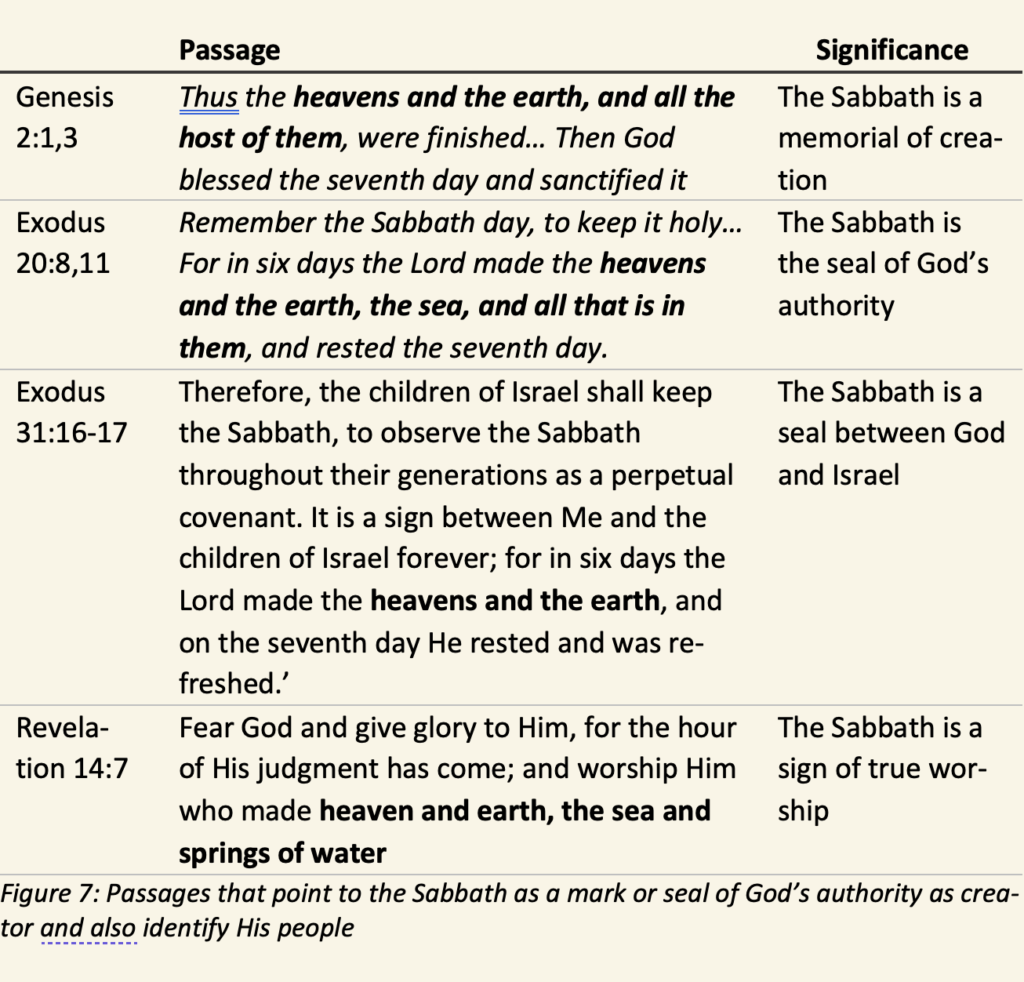
Why does it call us back to the creator and not back to the saviour? At creation, God set up a special day in honour of His creation, a mark of His authority – the seventh-day Sabbath. In the Old Testament, God said that the Sabbath was a sign between God and His people “for in six days the Lord made the heavens and the earth, and on the seventh day He rested and was refreshed (Ex 31:17).” God links this phrase, which is also echoed in Rev 14:7, with the Sabbath which marks His people. Since Christians are “Abraham’s seed, and heirs according to the promise (Gal 3:29),” the sign of the Sabbath as God’s people also applies to Christians. Therefore, Seventh-day Adventist theology teaches that the Sabbath is a seal or mark of God’s authority and His people.
Conversely, the Catholic church claims that Sunday worship is proof of its authority, as follows:
“There is no authority in the New Testament for the substitution of Sunday for Saturday… For Catholics there is not the slightest difficulty… We have in the authoritative voice of the Church the voice of Christ Himself. The Church is above the Bible; and this transference of Sabbath observance from Saturday to Sunday is proof positive of that fact.”522
In other words, the Roman Catholic Church is saying that Sunday observance is a mark or sign of its authority, since Protestants continue to observe Sunday though it is not authorised in Scripture. Those who worship the beast and his image receive the mark of the beast on the hand and forehead. That is to say, they think and act like the first beast and accept the authority of the beast, including Sunday worship (see Figure 7).
According to Seventh-day Adventist theology, Sunday worship undermines God’s authority as creator. There is a growing rejection today of God as creator. One of the core teachings of Gnosticism also undermines God as creator. It teaches that God does not create anything – true existence cannot be created.476 The creator of the material world, the Demiurge (i.e. Yahweh of the Old Testament), is an inferior and ignorant being, distinct from the true, transcendent God who resides in a perfect spiritual realm, the Pleroma.523,524 The first angel’s message, on the other hand, acknowledges God as the supreme God who created the heavens and the earth. Seventh-day Adventist theology also teaches that apostate Protestant Christians will unite with Roman Catholicism to oppose God’s true followers in the time of the end. Today, numerous religious leaders are calling for an end to the protest.
Is it really possible that something as innocent as worship music could lead multitudes of believers into deception? Well, King David, Martin Luther and Fanny Crosby all sang of God’s law, yet now we never do. How did that happen? If Keith Getty is right, that the content of the most popular worship songs is driven by commercialism – by the mighty dollar – then pride, envy, covetousness and other sinful human traits can wedge their way in. Though individual artists have noble intentions, the industry is driven by an ignoble undercurrent. This has provided a channel for the devil to work out his cunning schemes. Consequently, God’s law has been erased, and we didn’t even notice it.
Which Laws Are We to Follow?
If this is all true and we need to get back to praising God’s law more than we have been, how do we know which commands are applicable to us today? There is a distinction in the Bible between the ten commandments and the Mosaic or ceremonial law. The ten commandments were written by God’s own finger and placed inside the Ark of the Covenant (Deut 10:2), whereas the ceremonial law was written by Moses and placed beside the ark (Deut 31:24-26). The ceremonial law pointed to Jesus and was fulfilled in His death and resurrection, whereas the moral law, the 10 commandments, had its foundation in creation. Paul made a distinction between the ceremonial law and the commandments when he said, “Circumcision is nothing and uncircumcision is nothing, but keeping the commandments of God is what matters (1 Cor 7:19).” In other words, he is saying that it was no longer important whether a believer was circumcised or not, for circumcision was part of the ceremonial law which was fulfilled in Jesus’ death. Therefore, we discard what is no longer relevant, the ceremonial law, but obey what is relevant, the commandments of God.
While Mrs Booth recognised the distinction between circumcision and the 10 commandments, she extrapolates from Paul’s statement to assume that all rituals have been spiritualised and no longer necessary:
“That circumcision is nothing, and that uncircumcision is nothing; baptism is nothing, and being unbaptized is nothing; the Lord’s Supper is nothing, and abstaining from the Lord’s Supper is nothing, in itself as a form, for he embraces under circumcision all mere outward forms and ceremonies; and all these are nothing, but ‘keeping the commandments of God.’”130 (p53)
Therefore, the Salvation Army does not practise baptism or communion. However, we are specifically told that physical circumcision is no longer required but baptism and the Lord’s Supper were commanded by Jesus and, therefore, they are not nothing – we must continue to practise these institutions. Paul said, “For as often as you eat this bread and drink this cup, you proclaim the Lord’s death till He comes (1 Cor 11:26).” Some Christians have also spiritualised the Sabbath, insisting that it is no longer required. However, Adventists maintain that God instituted it before the fall, it is part of the commandments which He wrote with His own finger and God has never given us permission to discontinue it.
The devil would prefer we abandon God’s laws and rituals. Just as when Eve partook of the tree of the knowledge of good and evil, you can be sure that whenever God’s law is disregarded, the devil is behind it. The two largest religions in the world – Islam and Christianity – both worship on Friday and Sunday respectively, either side of the day God made holy in the beginning. If Sabbatarians are correct, there is a mastermind making a mockery of God’s law and we have fallen for it. We have “worshiped and served the creature rather than the Creator… For this reason God gave them up to vile passions (Rom 1:25-26).”
At the heart of sin is a lack of love for God and for others. Paul said, “he who loves another has fulfilled the law (Rom 13:8).” Therefore, if we break the law, we hurt others. If a person commits adultery, it shows that they love themselves more than their partner and Jesus said that even lust is equivalent to committing adultery. God likens the disobedience of His people to adultery because it demonstrates unfaithfulness or a uniting with the world and a false religious system. Revelation identifies the apostate church in the last days as a harlot (Rev 17:1-6) because it has been unfaithful to God. Does that mean, according to Adventist theology, that all Christians who worship on Sunday have the mark of the beast? Fortunately, regardless of whether we accept Adventist theology or not, by God’s grace, He gives His people the opportunity to come out of Babylon. He gives a loud cry for His people to return to true worship.
The Seventh-day Adventist Church is the largest modern seventh-day Sabbatarian denomination and it is growing rapidly around the world. There are numerous other modern-day seventh-day Sabbatarian church denominations, such as Seventh Day Baptists and Sabbatarian Pentecostalists, but the overall proportion of seventh-day Sabbath keepers is small. However, the majority view on any given topic is not always the correct view. When Martin Luther stepped out in faith to reform the Roman Catholic Church, he was one amongst just a few voices. He and those who followed in his footsteps were taking on a giant, attempting to overthrow a system that had established itself as the authority on Christian doctrine over many centuries – doctrines that the reformers were convicted were in error and belonged to a system that had been corrupted.
Even today, Protestant churches are in the minority amongst Christians and the majority of people in the world do not even believe in Jesus. The vast majority of people on earth did not believe Noah. The vast majority of Israelites ignored the prophet Jeremiah and believed false prophets instead. The majority of Jews did not believe Jesus was the Messiah when He came. That is why, instead of first striving to harmonise with humankind, first and foremost, we must strive to harmonise with God, including delighting in His law.