
Harmonising with God in Our Music and Practices
Part 1 - The Roots of Modern Christian Music
Chapter 3
Chapter 3 Holiness Theology

Does it really matter what type of music we play or listen to? As long as we have given our hearts to Jesus, isn’t that all that matters? Well, according to John Wesley, giving our heart to Jesus should profoundly influence our behaviour and practices. John Wesley, founder of the Methodist movement, was a great revivalist of the 18th century and an important figure in the First Great Awakening. In fact, John Wesley’s Methodist movement, which began in England, so dominated Protestant Christianity in America that it was known as the Methodist Age. It became the largest religious group in the United States by the 1840s.36 The Salvation Army and Adventism both have roots in Methodism. Many of the founding members, including the Booths and Mrs White, came out of the Methodist church.
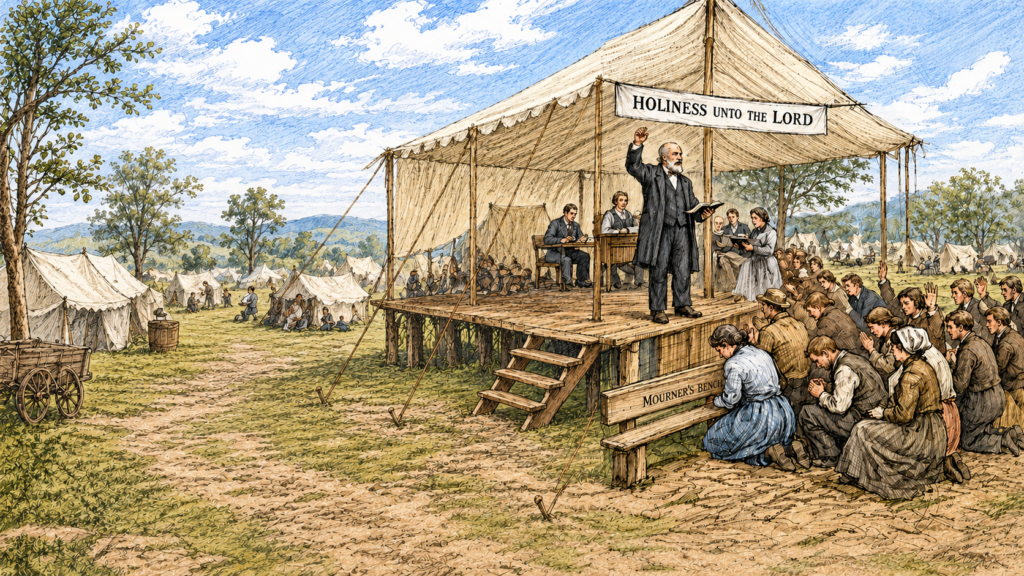
Unlike mainline established churches with their staid formalities, Methodism was very much a religion of the heart. Methodist preachers would proclaim truths in a manner that would stir the feelings of the congregation. The grace of God moved on the heart to awaken them to their sinful and lost condition. Personal testimonies were frequently called on to add to the experience. During every service, those awakened or convicted by the preaching were called to come forward and kneel at the mourner’s bench in front of the preacher’s stand where they were prayed over. Conviction led to an emotional experience which often demonstrated itself as weeping and shouting. This idea of a personal relationship with God gradually influenced Protestants more broadly.
However, the Booths felt the Methodist Church had lost this emotional experience and had become dry and formal. They wanted to restore the feeling back into worship. Adventism was also a religion of the heart and adopted some of the Methodist practices. Mrs White encouraged heart-felt religion. There must be a personal relationship with Jesus, and this should be reflected in worship. However, though formerly baptised a Methodist herself, Mrs White felt that the Salvation Army and some of the offshoot movements overemphasised emotional demonstrations. She encouraged emotion but discouraged emotionalism and, instead, put emphasis on the pursuit of truth.37 A. Gregory Schneider, professor of Religion and Social Science at Pacific Union College, describes how this heartfelt revivalistic style of religion has remained a part of Seventh-day Adventist culture:
“The spread of the ‘celebration’ worship style, with its carefully engineered and staged ‘spontaneity’ of emotion is one bit of evidence that personal piety and corporate worship in Adventism are still under the sway of revivalistic tradition.”37 (p34)
Another area of similarity between Methodists and Seventh-day Adventists is their teachings on salvation. Both denominations believe in salvation by grace through faith, in line with Protestant tradition, and sanctification that comes about by a personal relationship with Jesus. Once a person had received the awakening and been convicted of sin, they were invited to become members of the Methodist society, which required regular attendance at meetings and adherence to strict rules, including giving up worldly practices, such as card-playing, drinking and dancing and adopting spiritual practices, such as private and family prayer, reading Scripture and attending preaching and prayer meetings. Though they were justified by faith, they were to ‘go on to perfection’. It was a perfection of the heart, with love for God and others and ‘perfect’ motives and cleansing of impure motives, such as pride, vanity, envy, anger and lust. Perfection made them more useful for God’s service, to convert the world and usher in the second coming of Jesus Christ.37
In the song book of the Bible, David sings about the reward of those who walk uprightly – they get to abide in God’s Tabernacle where He dwells:
“Lord, who may abide in Your tabernacle?
Who may dwell in Your holy hill?
He who walks uprightly,
And works righteousness,
And speaks the truth in his heart;
He who does not backbite with his tongue,
Nor does evil to his neighbor,
Nor does he take up a reproach against his friend;
In whose eyes a vile person is despised,
But he honors those who fear the Lord;
He who swears to his own hurt and does not change;
He who does not put out his money at usury,
Nor does he take a bribe against the innocent.
He who does these things shall never be moved.” (Ps 15)
Many 18th century evangelical revivalists were claiming that we need not be concerned with overcoming sin since Christ covered for our past and present sins. Luther believed that true faith naturally leads to good works, but he insisted that even the most righteous Christians will remain sinners – but justified by faith. For Wesley, justification by faith alone must be accompanied by sanctification by grace through faith. Phillip Cary, Professor of Philosophy at Eastern University, in a lecture on the Holiness movement, says that Wesley believed that:
“sanctification could go all the way to Perfection. The whole heart perfectly loving God and neighbour. That’s Wesley’s new contribution and it makes a big difference in people’s Christian lives.” He went on to say, “Never say that Wesley doesn’t believe in grace. Oh yes, grace is what sanctifies us – with our cooperation – but it’s the grace of the Holy Spirit that really cleanses your heart… Entire sanctification, this is what you should seek. It’s obligatory to seek Christian perfection for Wesley, whereas, for Luther, it makes no sense at all. No one can seek Christian perfection; we don’t have such a possibility.”38 (3:51)
Out of the Methodist teachings on holy living developed the Holiness movement in the 19th century. While John Wesley taught that sanctification was a gradual, ongoing process of transformation which could eventually lead to perfection, the Holiness movement emphasised a distinct, instantaneous experience of entire sanctification which eradicates original sin.
Phoebe Palmer is considered the mother of the Holiness movement. She was a Methodist who was looking for a ‘shorter way’ to holiness that did not require years of struggle with sin. She taught that anyone could receive entire sanctification by simply laying all on the altar – all of their hopes, desires and fears – and believing in God’s promises. It was a simplified and modified version of Wesley’s doctrine of Christian perfection. There was an increased emphasis on the power of the Holy Spirit to instantly perfect us. It was entire sanctification received passively and instantly.38,39
The Salvation Army was a branch of the Holiness movement and integrated Methodism, holiness theology and revivalism. According to historians, the movement the Booths founded was shaped by their own personal and religious concerns, including holiness theology. Their commitment to Methodism and their disenchantment with its rules and restrictions shaped the theology and practice of the Christian Mission and the Salvation Army.
In the Holiness tradition, when a person is born again, they consecrate themselves to God and seek baptism of the Holy Spirit. Many Holiness teachers associated baptism of the Holy Spirit with an instantaneous conversion experience in which the Holy Spirit cleanses the heart of original sin and empowers the believer to live a perfect life of holiness in service to God.2,40–42Music, powerful preaching and ardent prayer were used to create excitement and bring on the conversion experience, which was manifest in bodily expressions, such as prostration, groans and shaking.2,41,42 Holiness theology emphasises the experience of Pentecost and the Holiness movement had a significant influence on the emergence of Pentecostal and Charismatic traditions. Pentecostalism, which emerged in the early 1900s, built on Holiness theology by adding the gift of tongues as a manifestation of the baptism of the Holy Spirit. With an estimated membership of 600 million strong, Pentecostalism is said to be the fastest growing religious movement on earth.43
In contrast with holiness theology, Mrs White did not teach that sanctification is an instantaneous experience but rather a work of a lifetime. She tended to speak in terms of gaining victory over sinful tendencies and habits rather than eradicating original sin.40 The Holy Spirit gave some members of the early Church the gift of speaking in other languages so that they could spread the gospel (Acts 2:3-12). For Seventh-day Adventists, the gift of tongues was only ever for the practical purpose of sharing the gospel to people with foreign languages. The Corinthians were so earnest to manifest this gift that they were speaking these foreign languages in church, though nobody understood them (1 Cor 14:1-5). Paul cautioned that speaking should be for edifying others by revelation, knowledge, prophesying or teaching (v2-3). He said, “in the church I would rather speak five words with my understanding, that I may teach others also, than ten thousand words in a tongue (v19).”
Likewise, Paul said, “I will sing with the spirit, and I will also sing with the understanding (v15).” This interpretation of Paul influenced Adventist understanding of singing. Speaking and singing should build each other up in knowledge and understanding, they would argue, and not simply for bringing on an ecstatic emotional experience. The Salvation Army used sensationalism to bring about instant public professions of faith without an emphasis on sustained Bible study. They used whatever means possible to achieve this end.
This is one area in which Mrs White disagreed with the Salvation Army method – they were worshipping more in spirit than they were in truth, she believed. The Holiness movement was making much of the music and excitement for the purpose of manifesting the Spirit without adequately building up believers in truth. The ritual of Holiness worship would often involve penitent believers coming forward during the service to be prayed over until they received a conversion experience. Once they received the Holy Spirit, they were then instantly equipped to begin evangelism,42 especially sharing their testimony. For Mrs White, this emphasis on instant conversion by baptism of the Holy Spirit without the sanctifying effect of truth on the heart was cheap Christianity:
“There is the Salvation Army, the Holiness Band with their cheap Christianity, and yet it pleases because there is no warfare. They present all smooth sailing.”44 (p309)
In other words, there is instantaneous superficial change instead of a deep struggle with sin over time brought about by the convicting power of the Word of Truth conveyed through Bible study and preaching. That is not to say that all Salvationists promoted a so-called cheap grace as described by Mrs White. Mrs Booth herself said:
“I do not profess to preach an easy gospel, or to bring you salvation without suffering and cross-bearing. I don’t believe that anybody has ever found such a salvation, and I fear those who think they have will find themselves to have been utterly deceived.”45 (p161)
Mrs White says that ‘truth brings before the people heart religion.’44 (p309) Christians need to be sure that zealousness for the moving of the spirit, as with the tongue speakers in the Corinthian church (1 Cor 14:12), does not cause them to elevate music above the plain preaching of the Word, as Paul cautioned. Otherwise, outsiders who come into church may think the worshippers are out of their minds! That is the impression that observers had when they witnessed revivalist meetings, such as that of the Salvation Army, and why the Army received such ridicule from the public. They were seen as fanatics.
Embracing Worldly Methods
Pamela Walker describes how, instead of opposing the amusements and leisure pursuits of the world, which Christianity had traditionally done, the Salvation Army embraced entertainment to attract the world. “The Army borrowed the music-hall tunes, the language and gestures of theatrical performers, and the advertising style of the circus” she states.2 (p174) They considered everything to be religious if it was not clearly irreligious, she said. Whatever elements of the larger culture could be used for the saving of souls should be employed, it was argued – “no musical form, dress or style of address was categorically profane.”2 (p211) This approach is used by churches today and with the same level of criticism but by fewer people than in the 19th century.
Cristina Rocha, Professor of Anthropology and the Director of the Religion and Society Research Cluster at Western Sydney University, points out that “cool churches,” like Hillsong:
“…blur the sacred and secular by adopting youth styles, marketing, business strategies, and new technologies – from fashion trends to pop music, social media, cool graphic design, creative industries, and services that resemble clubbing or a concert.”46
In other words, churches in the 21st Century, as with the Salvation Army in the 19th, are using worldly entertainment to attract the masses. This is not a modern phenomenon. After Constantine made Christianity the official religion of the state, pagan customs were brought into the church to attract the masses.
By contrast, Mrs White taught that true conviction and transformation does not require conformity with the world, as counselled by Paul: “And do not be conformed to this world, but be transformed by the renewing of your mind, that you may prove what is that good and acceptable and perfect will of God (Rom 12:2).” However, in Testimonies to the Church Volume 8, Mrs White cautioned against judging others harshly:
“The Lord has marked out our way of working. As a people we are not to imitate and fall in with Salvation Army methods. This is not the work that the Lord has given us to do. Neither is it our work to condemn them and speak harsh words against them. There are precious, self-sacrificing souls in the Salvation Army. We are to treat them kindly. There are in the Army honest souls, who are sincerely serving the Lord and who will see greater light, advancing to the acceptance of all truth. The Salvation Army workers are trying to save the neglected, downtrodden ones. Discourage them not. Let them do that class of work by their own methods and in their own way. But the Lord has plainly pointed out the work that Seventh-day Adventists are to do. Camp meetings and tent meetings are to be held. The truth for this time is to be proclaimed. A decided testimony is to be borne.”47 (p184)
Since Charismatic churches, such as Hillsong, grew out of and adopted similar methods as the Holiness movement of which the Salvation Army belongs, Mrs White’s quote would apply equally to Hillsong methods. Her advice to avoid judging harshly those from Pentecostal or Charismatic faiths would be sensible. Furthermore, Mrs White would equally advise fellow members to avoid adopting their methods but, rather, to proclaim the truth for this time.
The 19th century has conventionally been viewed by historians as a period of religious decline and increased secularism. However, a growing number of historians have challenged this notion, arguing that it is based on a distortion and oversimplification of the literature. For example, it was too readily assumed that non-churchgoers were irreligious.2 (p4) Early writings of the Salvation Army frequently make reference to the heathen masses of Britain; however, they never suggest in their writings that these working-class people lacked a fundamentally Christian perspective. The message of the Salvation Army was effective because of the population’s existing religious conviction that they were sinners bound for hell unless they repented and gave up their drinking and gambling. The revivalist meetings of the Salvation Army simply brought this conviction to their attention.2 (p87)
Though secularism was a strong force in the wake of the French Revolution and also as a result of urbanisation and industrialisation, the 1800s was a period of great religious awakening, fervour and missionary zeal.48 Christianity was the single most important belief that characterised the Victorian era. Religion pervaded social and political life to an extent almost unimaginable today.49 Worldliness was shunned. Church attendance and Bible knowledge were at an all-time high and the Scriptures pervaded every aspect of life. Bible reading in the home was common practice, even amongst agnostics and atheists. The Bible was the primary text for schools, and it was not uncommon for children to have read the entire Scriptures multiple times over before reaching adulthood. It was fashionable to attend sermons of celebrated preachers, much the same as it would be to attend a pop concert today. Sermons were even printed in full in the newspapers and extensively circulated in pamphlets and books.48
The mission of the church also flourished. Sunday schools were established.48 The British and Foreign Bible Society came into existence in 1804 to translate the Scriptures into foreign languages and distribute it throughout the world.50 Tracts were mass-produced to educate and convert youth to Christianity. Youths played an active role in evangelism through tract distribution. White, black, rich and poor were included in evangelistic efforts.51 Many Christians became strong supporters of the abolitionist movement to end slavery.52 Mass revival services vastly increased the number of Christian converts.51 Health reform began and prohibition of alcohol grew in popularity during the late 19th century. Long before national prohibition came into effect, individual communities had already established themselves as ‘dry’ and banned alcohol.53 Missionaries spread the gospel message far and wide.48 Missionary societies and volunteer movements sprang up in various countries, including Germany, Great Britain, the Netherlands and the United States.50 The 19th century was the greatest century for missions in the history of the church. Importantly, the second great awakening of the 19th century gave birth to the Holiness movement, from which the Salvation Army emerged, and the Millerite movement, from which the Seventh-day Adventist Church emerged with its proclamation of the three angels’ message.54
Perhaps this is the period referred to by the prophet Joel in the end time when the king of the north is driven out, abundant rain is received and God’s Spirit is poured out on all flesh (Joel 2:18-32). This period also fits the description of the faithful Philadelphia church of Revelation:
“I know your works. See, I have set before you an open door, and no one can shut it; for you have a little strength, have kept My word, and have not denied My name. Indeed, I will make those of the synagogue of Satan… come and worship before your feet, and to know that I have loved you. Because you have kept My command to persevere, I also will keep you from the hour of trial which shall come upon the whole world, to test those who dwell on the earth.” (Rev 3:8-10)
It is on this backdrop that the Salvation Army emerges and is widely opposed in the first two or three decades of its existence. The historicist interpretation of the seven churches of Revelation chapters 2 and 3 represent seven consecutive time periods from the time of Christ until the end of the world. If we are living in the last days, that would mean we are the Laodicean Church – the lukewarm church. The Laodicean church, incidentally, follows immediately after the faithful Philadelphia church quoted above. If that is the case, what caused the church to go from being the faithful Philadelphia church to the lukewarm Laodicean church we are today? George Railton, first commissioner of The Salvation Army, described the opposition to their organisation as follows:
“Such expressions as ‘blasphemy,’ ‘blasphemous performance,’ ‘mockery of religion,’ have been repeatedly used by the most thoughtful and influential critics with respect to [The Salvation Army]… The greater part of the community… denounced the whole of the proceedings as an ‘outrageous nuisance,’ ‘a farce,’ etc., which ‘ought to be put down’ or got rid of if it were possible, and which it is to be hoped ‘will not last long.’”55
Was there any justification for the opposition to The Salvation Army’s methods? This is the question we have already asked. General Booth was bringing worldly methods into the church to attract the world to the church and it was widely seen as blasphemous. Though sincere and well-intentioned in his desire to serve and praise God, as David was, did he inadvertently set a precedent that would later open the floodgates of worldliness into the church? Or is this just alarmism – just the murmurings of concerned brethren holding back progress? Some might contend that we have been too slow to embrace General Booth’s ideas. Was Mrs White just a product of her time, swept along with this alarmism? Was she too focused on law and holiness and not enough on God’s grace? Did she focus too much on truth and not enough on the Spirit?
This book will attempt to find answers to all of these questions through Biblical and scientific investigation. It will compare the Whites’ theology and practice with that of the Booths. Why? Well, General Booth is a prominent figure who proposed that there is no moral force in music itself – it is only the lyrics that matter – while Mrs White objected to Salvation Army methods. Couple this with Mrs White’s claim of inspiration and it makes for an interesting study. The aim is not to denigrate anyone but, through the process of investigation, to take an honest look at ourselves as a worldwide Christian body so that we can reflect on our current methods and seek harmony with God in our music and practices. This is what Luther attempted to do and it is what we must continue to do until Christ returns.
Decades before Pentecostalism emerged in the early 1900s, there were Christian denominations that were using all kinds of methods to create an emotionally charged worship service to bring people to repentance. This included copying secular entertainment methods and combining Christian lyrics with secular tunes to create excitement, as the Salvation Army was doing. Mrs White, along with numerous other Christians, cautioned against such methods, advising, as Paul did, they would argue, that our focus should be on preaching and teaching. The common modern-day reaction to Victorian people’s concern about merging the sacred with the secular is that they were far too rigid and puritanical. On the other hand, almost everyone agrees that, today, we are living in the time of Laodicea:
“I know your works, that you are neither cold nor hot. I could wish you were cold or hot. So then, because you are lukewarm, and neither cold nor hot, I will vomit you out of My mouth. Because you say, ‘I am rich, have become wealthy, and have need of nothing’—and do not know that you are wretched, miserable, poor, blind, and naked – I counsel you to buy from Me gold refined in the fire, that you may be rich…” (Rev 3:15-18)
In our era, in contrast to the 19th century, church attendance is at an all-time low in the western world. Bible literacy is at a record low. Instead of pushing back against worldliness and secularism, we have embraced it. According to the historicist understanding of Revelation, because of their faithfulness, the Philadelphian church was kept from the hour of trial (Rev 3:10), but it is our era, the lukewarm church, which will face the great tribulation.
At the turn of the 20th century, a Pentecostal-style movement called Holy Flesh emerged in the Seventh-day Adventist Church. Long before this movement arose, Mrs White was warning against excessive emotionalism in worship. In 1885 she wrote:
“…the Salvation Army have a great deal of what Paul denominates ‘bodily exercise,’ that ‘profiteth little.’ They follow impressions and claim to be taught of the Spirit… they place these impressions above the written word of God, while they trample upon the divine law because their hearts are not in harmony with its precepts.”56 (p129)
Mrs White is not here referring to every single Salvation Army officer, for elsewhere she said, “There are in the Army honest souls, who are sincerely serving the Lord.”47 (p184) At times, she also had harsh words to speak against individuals in the Seventh-day Adventist Church if, as she claimed, she received a vision showing that they were acting contrary to Scripture. There is no doubt that General Booth was one of those who was sincerely serving the Lord. Even in old age, George Railton explains that the General threw himself into all his undertakings for Christ with zest and enjoyment.57
General Booth said that from the time of his conversion onward he was committed to God’s law: “I had no disposition to deny my instincts which told me that, if there was a God, His laws ought to have my obedience and His interests my service.”57 (p10) He was committed to obedience to the Scriptures in general. Speaking of His conversion, he said: “Ever since that day it has led me to measure my own actions and judge my own character by the standard of truth set up in my soul by the Bible and the Holy Ghost.”57 (p14) General Booth was deeply committed to obedience to God and stamping out sin. In fact, one person describes General Booth’s deep hatred of sin as follows:
“…at the mention of real sin – his brows contract, his eyes flash, and his tongue hisses out such hatred and contempt and detestation,” and he cries out in no uncertain terms who the true culprit of suffering is: “Sin! Sin is a real thing – a damnable thing! I don’t care what science calls it, or what some of the pulpits are calling it. I know what it is. Sin is devilish. It is sin and only sin which is stopping progress. It is sin and only sin which prevents the world from being happy. Sin! Go into the slums of the great cities – pick up little girls of six years of age sold into infamy by their parents; look at the drunken mother murdering her child, the father strapping his cripple son – sin! – that’s what I call sin.”57 (p204)
Mrs White, in tune with General Booth, said:
“Men and women and youth need to see the law of God with its far-reaching requirements. It is not hardship, toil, or poverty that degrades humanity; it is sin, the transgression of God’s law. The efforts put forth to rescue the outcast and degraded will be of no avail unless the claims of the law of God and the need of loyalty to Him are impressed on mind and heart.”16 (p280)
Not all in the Salvation Army thought as General Booth did. Some were focused primarily on alleviating physical suffering but were not going the next step and convicting people of the root cause of their suffering. First Commissioner of the Salvation Army George Railton, General Booth’s right-hand man, saw this as one of the shortcomings of the Army:
“There has been a great lack of direct aim at the true goal of our Social Work on the part of some Officers who have been engaged in its direction. Some of our comrades have been content with a ‘soup-and-blanket’ régime. That is to say, they have too often been satisfied with the alleviation of the miseries of the hour, and have stopped short of the removal of the evils that have caused the poverty, vice, and agony from which the sufferings sprang. Consequently, the work, being superficial, has in some cases only had superficial and temporary results…
Another cause of our shortcomings has been the lamentable fact that some of our Officers have been deficient in personal religion. Our Social Work is essentially a religious business. It can neither be contemplated, commenced, nor carried on, with any great success, without a heart full of pity, and love, and endued with the power of the Holy Ghost.”57 (p197)
By the standards of more conservative Christians, these shortcomings are reflected in the Salvation Army’s evolving position on social issues such as sexual identity and abortion which are more accommodating to the sociocultural environment than conservative evangelical denominations. Formerly, the Salvation Army’s official statement held that homosexuality is clearly contrary to the teachings of the Bible and that it “presents a serious threat to the integrity, quality and solidarity of society as a whole.” However, since the 1990s, the official position of the Salvation Army has evolved and reads as follows:
“…homosexuality is not in itself blameworthy nor is the disposition seen as rectifiable at will… No person is excluded from membership, fellowship or service in the Army solely on the basis of sexual disposition.”
Consequently, if asked what to do if someone wrestling with their sexual identity wants prayer:
“Salvationists are encouraged to help people explore their identity – for instance, by praying that God will affirm their authentic identity and speak into their search for who they were made to be; or by pastorally exploring what it is that has led them to conclude that they need to change. Salvationists will not pray for a specific outcome with regards to someone’s sexuality.”58
However, the official statement of the Salvation Army on sexuality is not the position of every member and only God knows the heart of every individual and their motive. Also, this statement was provided by one territory of the Salvation Army and may not represent the position of the whole organisation. A growing number of Christians today no longer consider homosexuality a sin. We will discuss this sensitive topic further in a later chapter, comparing the views of Progressive Christians with those of more conservative Christians.